



 Google reviews

Rear eaves and back additions on the terraces
Stand in the back garden of a Shaftesbury Park cottage, or the yard of a Park Town flat, and look up. The rear eaves of the main roof runs the width of the house, and the back addition adds another straight run down its side. A sectional gutter on those runs has a union joint every few metres, and on an old house each of those joints is a place where a seal perishes and drips onto the brickwork or the boundary wall below.
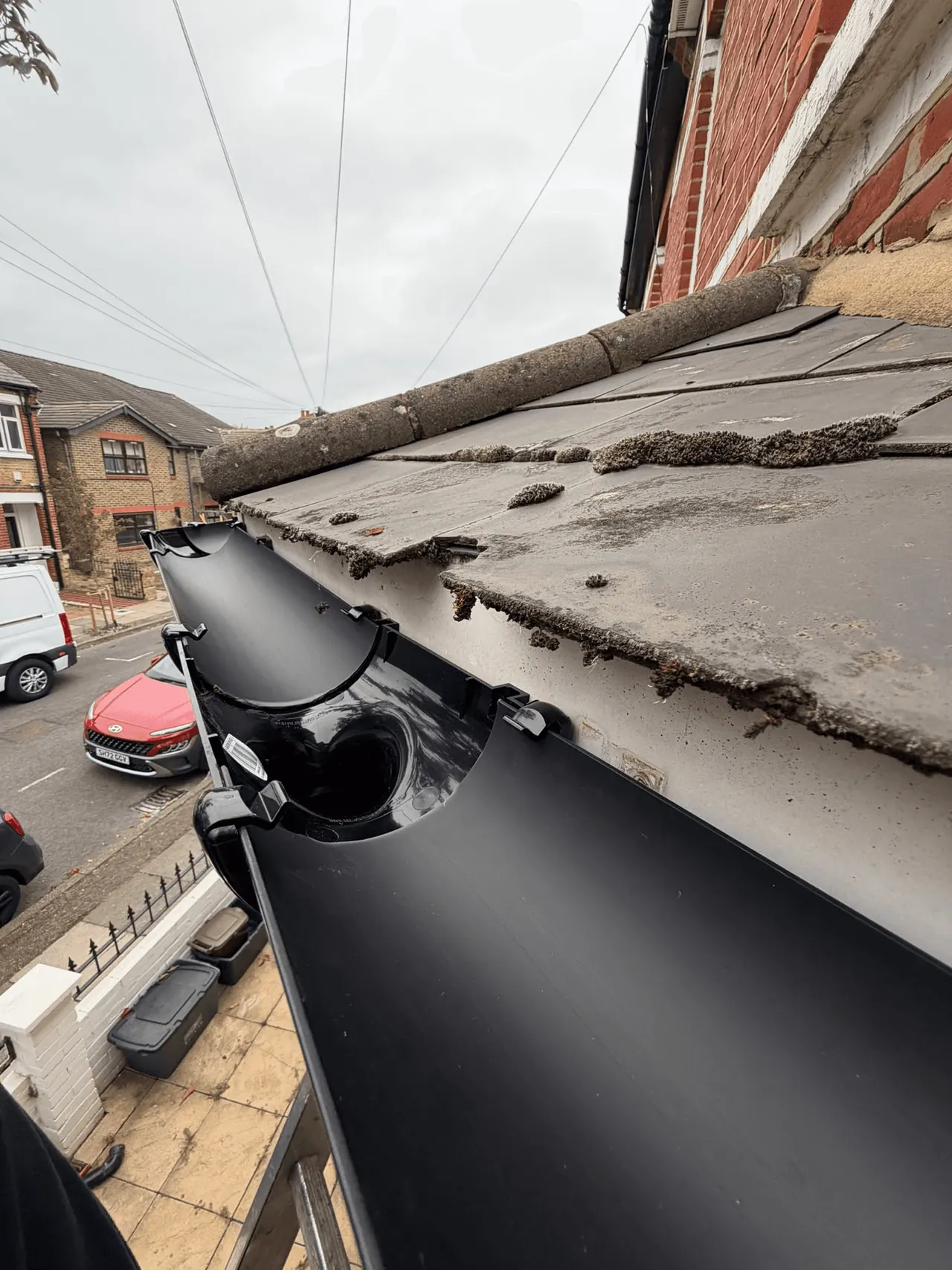
A seamless gutter is formed to length from a coil of aluminium, often on site, so each straight run is one continuous piece. The only joints left are at corners, stop ends and downpipe outlets. On a rear eaves that means the length between the two party walls has no joints at all, and on a back addition the run down the side is one piece to the outlet. Aluminium does not rust and comes with a coloured coated finish, so it can be black to sit with painted cast iron.
The fronts are a different matter. Our gutter installation page for Battersea explains why the council prefers cast iron on the street side of Shaftesbury Park, and what its guidance says about matching the size and pattern of the original at the back.
Post-war infill houses around Brassey Square
The Shaftesbury Park appraisal notes that plain, cheap post-war housing was built to fill the gaps left by wartime bombs, mainly around Brassey Square but also in other isolated spots. Those houses have no Victorian gutter to match. Their eaves tend to be plain and straight, front and back, which is the shape seamless suits.
The front of an infill house still sits in a Victorian street inside the conservation area, so the front gutter should follow the same thinking as its neighbours. At the back, the choice is open. Riverside blocks and 1950s council housing near Battersea High Street are usually managed by a council, housing association or managing agent, and gutter replacement there is their call.
Profiles, measuring and a rough cost
Where the council's wording asks a rear gutter to follow the original pattern, the profile matters. Seamless runs are formed in the profiles the forming machine makes, so at the survey we confirm which can be matched to what is on the front. If a true half-round is needed to sit with cast iron and cannot be formed in one piece, a sectional black half-round in aluminium meets the same guidance with a few more joints.
Because each run is formed to length, it has to be measured accurately. We check the eaves line along its full length, look at the boards or brickwork the brackets fix to, and note where downpipes and gullies are before anything is formed. Rotten boards are renewed first, as described on our Battersea fascia and soffit page. Each run is then hung on evenly spaced brackets and set to fall to its outlet.
As a worked example using a published guide figure, MyJobQuote gives aluminium guttering at £55 to £78 per metre supplied and fitted. On a rear eaves of about 5 metres plus a back addition run of about 7 metres, that comes to roughly £660 to £940 before downpipes and any access costs. The real figure depends on your house, and our main seamless gutter installation page has more on the system.
Frequently asked questions
Can a seamless run go along the back addition of my Park Town flat if it sits on the boundary?
Usually, yes. The run is measured and formed for that wall, and the outlet is placed so the water goes to your own downpipe and gully, not over next door's yard. If the only safe access is from the neighbour's side, we will need their agreement first.
Is seamless suitable for a post-war infill house near Brassey Square?
Often, especially at the back. The front still sits in a Victorian street covered by the Article 4 Direction, so the front gutter should follow the same rules as its neighbours.
The Latchmere has its own Article 4 Direction. Does that cover the gutter at the back of my house?
It covers external alterations visible from the street, which takes in all front elevations and some side and rear ones. On a corner house or one facing the recreation ground, check with Wandsworth's planning team before changing the material.





