



 Google reviews

Forty-year-old gutters off Portinscale Road
Much of the land around Portinscale Road was redeveloped in the 1980s, after the bomb damage and post-war change recorded in the council's East Putney appraisal. The appraisal notes that this newer housing sits outside the conservation area, even though the conservation area wraps round it.
Housing of that age was usually fitted with plastic guttering. Where the original runs are still up, the plastic has had around forty summers of sun, and by now it tends to go brittle, the rubber seals in the joints harden and the brackets lose their grip. A run like that can drip at every union along its length, and patching one joint just moves the drip to the next.
Replacing it with seamless aluminium removes most of those joints. Each run is formed to length on site from one piece, so the only joints left are at the corners and the outlets. The coated finish needs no painting, and with no conservation-area front to match, these houses can take whatever colour suits the windows.
Lytton Grove's later houses
Lytton Grove runs from the footbridge over the railway to Putney Hill, through the old Clock House Estate. The East Putney appraisal treats its older houses as part of the same redevelopment as southern Keswick Road, by the same builder, John Gibbs. Since then the gaps have filled in. The Rusholme Road appraisal points to infill such as a 1980s house built in the back garden of a large corner plot on West Hill, and shows a typical 1930s semi on the street.
Lytton Grove is covered by the Rusholme Road appraisal, so the choice there depends on the house. On a 1980s infill house, the case is much the same as off Portinscale Road. On a 1930s semi that still has its original gutters, it is worth checking what they are made of before deciding anything, because the appraisal puts weight on original features.
Blocks and parapets on Keswick Road
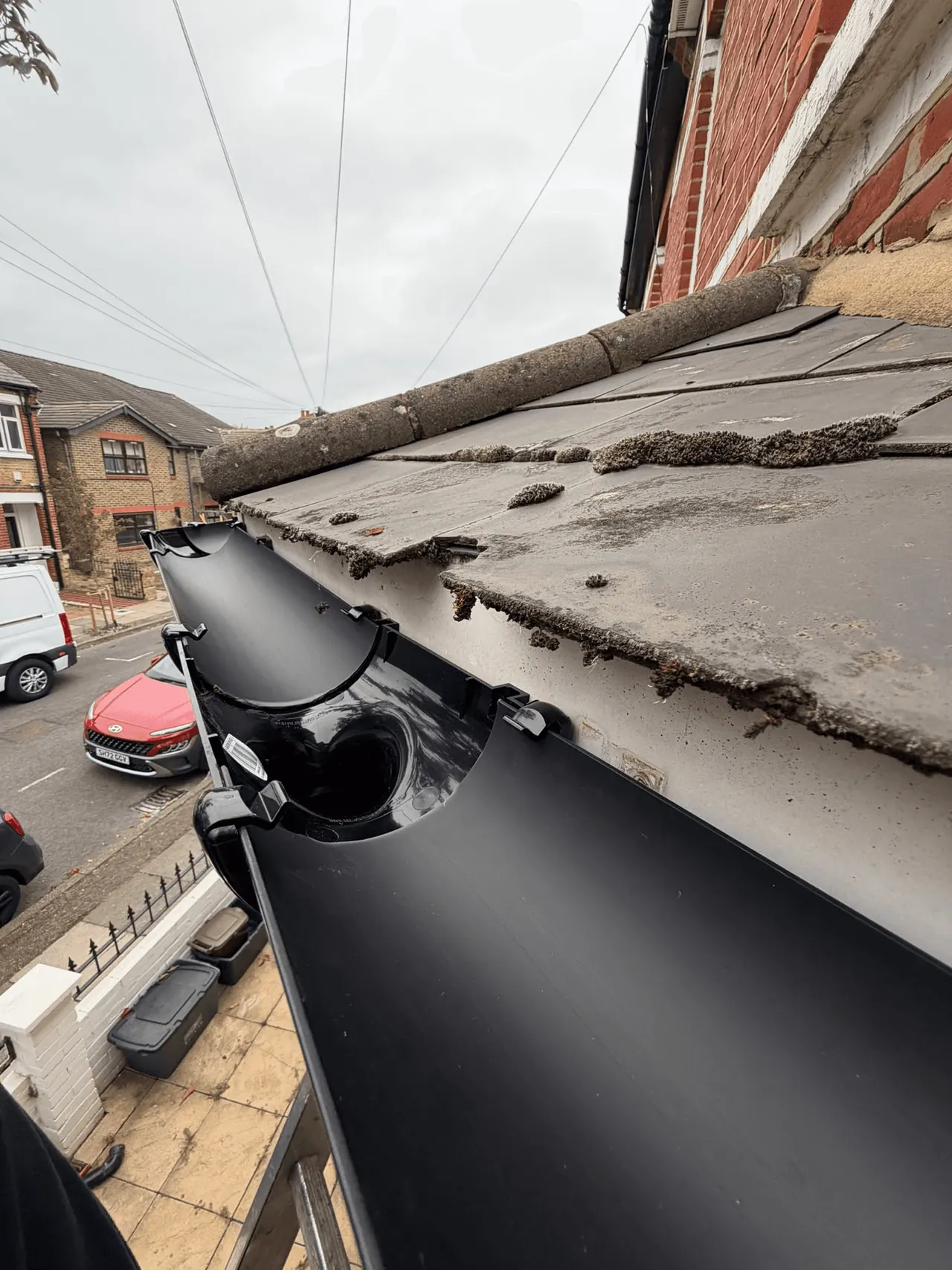
Post-war blocks fill several of the bomb sites on Keswick Road. Where a block has exposed eaves gutters, a managing agent replacing them can choose seamless aluminium so there are fewer joints to come back to. Where a block has a parapet with a hidden gutter behind it, seamless is not the answer, because the gutter there is usually lined rather than hung. For a gutter that keeps overflowing, see our East Putney blocked gutter repair page.
The Victorian and Edwardian fronts that make up most of East Putney's conservation areas are a different job. The Dutch-gabled houses around Rusholme Road and the gabled villas on southern Keswick Road have eaves broken into many short runs, so seamless saves few joints there, and some owners prefer cast iron on the front. For cast iron or uPVC, our gutter installation in East Putney page covers the options. Our main seamless gutter installation page explains how the runs are measured and formed.
Frequently asked questions
Is seamless a good choice for the 1980s houses off Portinscale Road?
Often, yes. They are outside the conservation area, so there is no period front to match, and replacing tired plastic with one-piece aluminium runs leaves far fewer joints to fail.
Our 1930s semi on Lytton Grove still has its original gutters. Should they go to seamless?
Not automatically. If they are sound cast iron, repairing and repainting them keeps an original feature the Rusholme Road appraisal values. If they have already been replaced with plastic that is failing, seamless aluminium is a sensible upgrade. We look first and tell you which.
Would a black seamless gutter work on the front of a house in the Rusholme Road Conservation Area?
On a house, replacing gutters does not usually need permission, and a black half-round or ogee profile reads much like painted cast iron from the pavement. On the gabled Tuckett houses, though, the runs are so short that cast iron or a standard system is often the better fit. On a flat, check with the council before changing the material on the front.





