



 Google reviews

The 1872 pairs on North Side
A green streak down yellow stock brick, starting at a gutter joint three floors up, is often the first sign of trouble on a tall house along the north edge of the Common. The brick shows water clearly, and on a house this high the gutter is a long way from anyone who might notice it leaking.
North Side is now part of the South Circular. Wandsworth Council's appraisals record that Earl Spencer kept this land back when the Common passed to Conservators in 1871 and developed it for housing. Numbers 35 to 49 North Side, built in 1872, are four pairs of three storey yellow stock brick houses. Nearby, 2 and 3 Spencer Park, built in concrete around 1872, finish in a parapet with globe finials, and behind them is the private Spencer Park garden, 1.6 hectares laid out after 1884.
Three storeys of rain: front, side and back
A three storey pair sheds a lot of water off each slope, and that water reaches the gutter fast. If the gutter is too small, has lost its fall or has an outlet in the wrong place, it overflows onto the bay or porch below and down the face of the brick, and yellow stock that stays wet for years spalls and stains. A new installation is the moment to size the system for the roof rather than copying what was there, which can mean a deeper profile or an extra outlet.
- The front. This is the elevation the street sees, so the profile matters as much as the capacity.
- The sides. On a pair, each house has one long side elevation, often with a downpipe running the full three storeys. That pipe needs secure brackets and a proper connection at the foot, so water goes to the drain and not into the base of the wall.
- The back. Rear slopes often drain onto a back addition roof below, so the lower gutter has to cope with the main roof's water as well as its own. uPVC is a sensible, low-maintenance choice at the back, where the street does not see it.
Before fitting anything, we check that the fascia boards or the brickwork the brackets fix into are sound, then set the brackets at the right spacing so the run does not sag under wet leaves, set the fall to each outlet and seal every joint. Soft boards are covered on our fascias and soffits page for the Common, and a continuous aluminium run for the long side and back elevations is on our seamless gutter page.
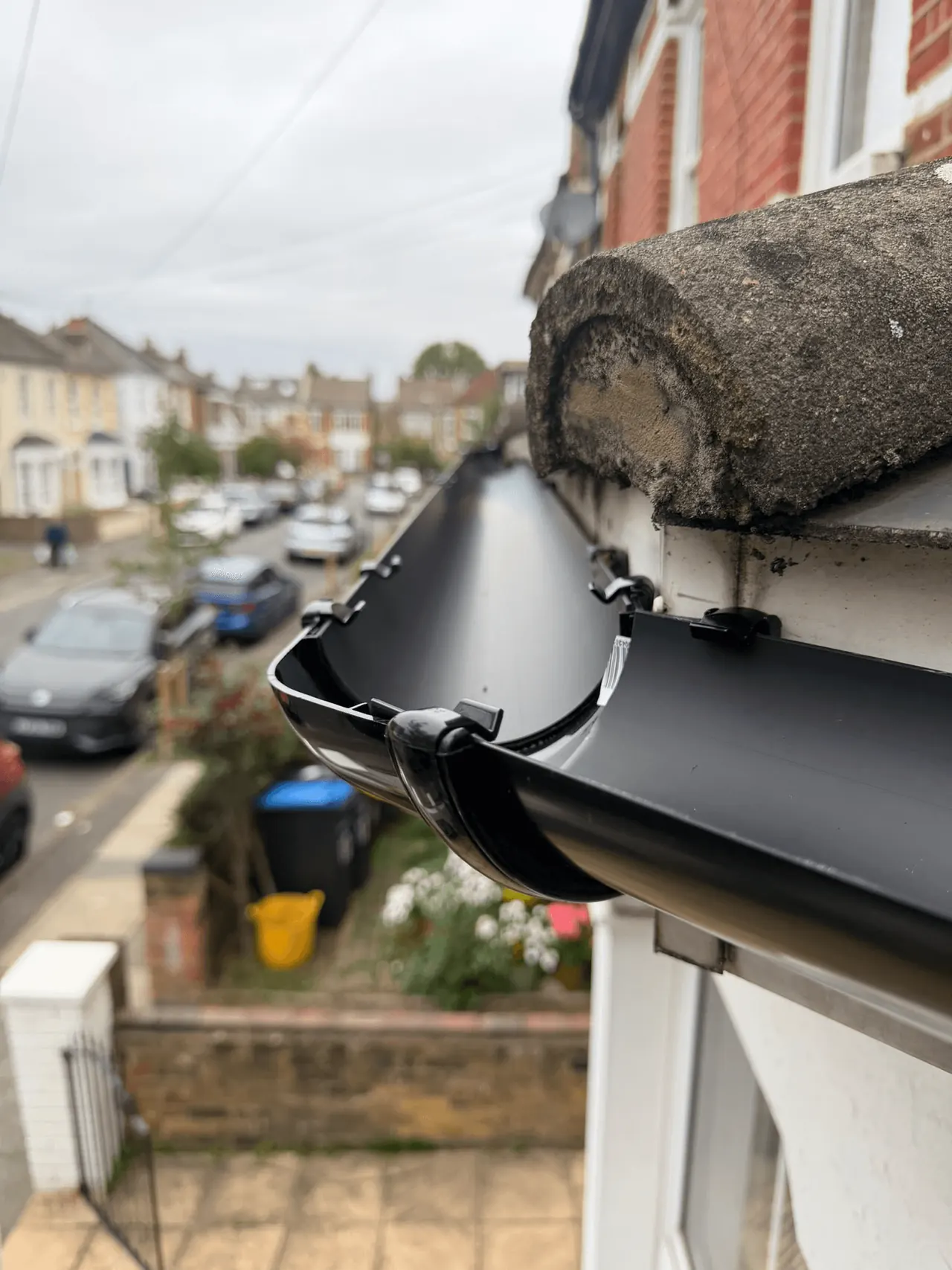
What goes on the front of an 1872 house
North Side is not covered by an Article 4 direction on visible alterations, so changing the gutters at the front is not normally a planning matter there. The one direction in the Wandsworth Common Conservation Area that controls visible changes and roofs covers 62 to 72 Wandsworth Common West Side, and our Wandsworth Common area page lists what each direction covers.
The choice is still worth thinking about on design grounds. Cast iron suits the front of an 1870s house and lasts a very long time if it is painted. Coated aluminium in a dark finish is lighter and can give a similar line. Plastic at the front of a house like this tends to look out of place beside the neighbours. As a guide, MyJobQuote's gutter replacement figures put cast iron, supplied and fitted, at about £50 to £75 a metre, and on a three storey front the access adds to that. The gutter installation service page compares the materials in more detail.
Frequently asked questions
Do I need permission to change the gutters at the front of a North Side house?
Not under Article 4, because North Side is not covered by a direction on visible alterations. If the building is split into flats, permitted development rights do not apply, so check with Wandsworth Council first. On design grounds, cast iron or a cast iron lookalike suits these fronts best.
The South Circular runs past our front door. How is access arranged for the front gutter?
We plan access around the pavement and the traffic, and on a three storey front that usually means scaffolding or a tower. Scaffolding on a public pavement needs a licence from the council, so allow a little time for that.
Our yellow stock brick is stained under the old gutter. Will new gutters stop it getting worse?
Yes, if the cause was overflow or a leaking joint. The staining itself may take a long time to fade, and badly spalled bricks are a job for a bricklayer, but keeping water off the face stops the damage spreading.





