



 Google reviews

The Grid and the Triangle
Parts of the old Wimbledon Park estate around Southfields were sold for building in the 1870s, but the area was largely farmland and parkland until the District Railway opened Southfields station in 1889. The houses that followed arrived in a fairly tidy order, and the order still shows on the roofs.
First came the Grid. On 23 December 1891 London County Council approved nine new streets for the Wimbledon Park Land Company: Replingham and Brookwood Roads, and Astonville, Trentham, Elborough, Engadine, Clonmore, Heythorp and Elsenham Streets. Building was slow at first. Lavenham Road was added in 1899 and Revelstoke Road in 1903, and by the middle of 1906 the Grid held 1,766 houses, maisonettes and shops. Wandsworth's Urban Design Study describes narrow streets laid out with formal regularity and two to three storey buildings.
For a roofer, that layout means long, unbroken runs. Almost every house shares a party wall, a gutter line and usually a chimney stack with the house next door, and a good number of the terraces were built as maisonettes, one flat above the other. A Grid roof may have been re-covered at some point since it was built, so any repair is matched to what the houses either side have now.
The Southfields Triangle, between Standen Road, Granville Road, Pulborough Road and Merton Road, is almost entirely Victorian and Edwardian housing too. Its best known building is the 1904 Frame Food factory on Standen Road, Art Nouveau with green ceramic tiles, now listed and converted to flats. Riversdale School on Merton Road, listed and dating from 1890, has the most dramatic roofline in the district: cupolas, gables and tall chimneys that you can pick out from King George's Park.
Wimbledon Park Road's gabled estate
Between about 1910 and 1920 the developers Allen & Norris built a private estate along Wimbledon Park Road, then Gatwick Road, Hambledon Road and finally Wincanton Road, where the houses are staggered to follow the curve. Their estate office stood on the corner of Gatwick Road and Wimbledon Park Road. Wandsworth made the estate a conservation area in 1989.
The council's appraisal calls it the best example of its period and style of housing in the borough, pointing to the curved terraces, the prominent gabled fronts and the clinker-brick front walls. Every house has square bays on both floors with decorative clay tile hanging, a plain clay tiled main roof, and a deep recessed porch with its own small clay tiled roof on pink granite columns. The terraces come in groups with gaps between them for rear service passages.
That is a lot of small roofs on one frontage: main slope, gable, two bay tops and a porch, each with its own junction against the wall. Those junctions are where water usually finds its way in on houses of this type. For individual faults, our Southfields roof repair page goes through the bays and porches in more detail.
Up the hill: Sutherland Grove and Victoria Drive
West of the station the land rises. Sutherland Grove, Girdwood Road, Skeena Hill and Coombemartin Road were mostly built over ten to fifteen years in the 1920s and 1930s, and became a conservation area in 1992. The 2023 appraisal records roofs that are almost all hipped and covered in plain clay tiles, with original green glazed pantiles still on some houses, particularly on Girdwood Road. Sutherland Grove itself is lined with maples and planes, while the side streets have smaller cherry and pear trees.
Further towards Wimbledon Park and Putney Heath is the Victoria Drive conservation area, which takes in Kingsmere Road, Inner Park Road, Albert Drive and part of Wimbledon Park Road. Its large detached houses were built between 1927 and 1939 on wide plots, many designed by George W. Smith or built by Alfred J. Styles. The roofs are steep red clay with sweeping hips, valleys and gables, and most houses have tall, slender chimney stacks. Rear gardens of around 100 feet hold forest-sized oaks, beeches and limes.
Big hipped roofs like these hide a great deal from the ground. A roof inspection in Southfields uses a drone to photograph the valleys and the backs of the stacks without anyone climbing up.
What the conservation guidance means for your roof
None of the Southfields conservation areas is on Wandsworth's list of Article 4 directions, so the extra controls that apply on estates such as Totterdown Fields do not apply here. The appraisals still set out clear expectations:
- Victoria Drive: roofs should be re-covered in natural clay tiles, good tiles should be reused where it is the nails that have failed, chimney stacks should never be removed, and planning permission is needed for any roof extension.
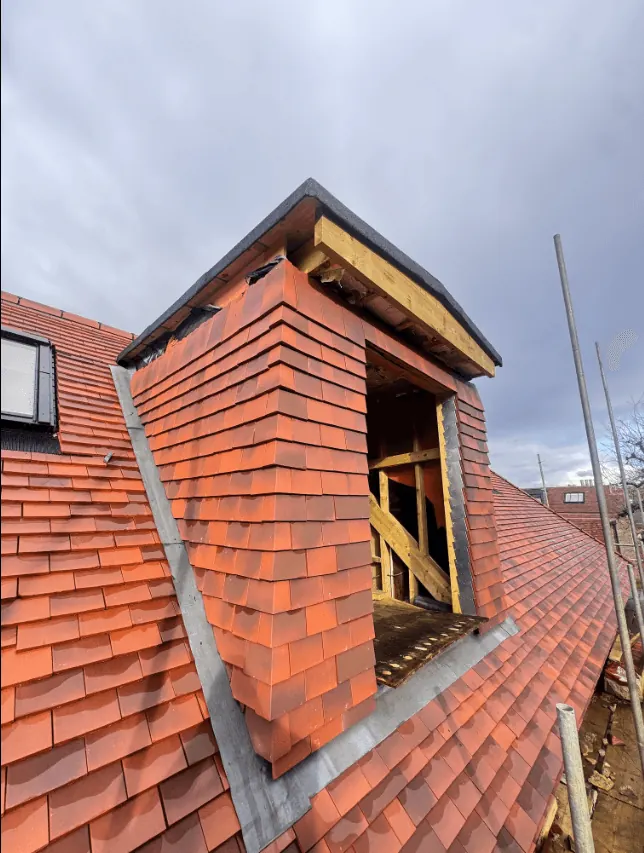
- Sutherland Grove: front dormers and hip-to-gable extensions are unsuitable, and lead or zinc clad dormers often clash with the clay roofs.
- Wimbledon Park Road: alterations, especially to boundaries, front elevations and roofs, are said to detract from the estate.
Across the borough, the council's Housing SPD says concrete tiles and artificial slates have spoiled many historic roofscapes. Like-for-like repairs are maintenance. If a job would change what your roof looks like, we will say so before you commit, so you can speak to the council first. Flats and maisonettes do not get the permitted development rights that houses have, which matters on the Grid.
The full range of roofing and guttering work is on our services page. Quotes are free, and if you would rather talk it through, call 0330 133 4111.
Frequently asked questions
Wimbledon Park Road runs through two conservation areas. Which one is my house in?
The Wimbledon Park Road conservation area covers the Allen & Norris terraces bounded by Wimbledon Park Road, Pulborough Road and Granville Road: Gatwick, Granville, Hambledon and Wincanton Roads and the Wimbledon Park Road frontage. Further south, part of Wimbledon Park Road falls inside the Victoria Drive conservation area with Bedgebury Gardens. The council's conservation area maps show the exact boundary, and the guidance differs slightly between the two.
There are green glazed pantiles on my Girdwood Road roof. What happens if some break?
The appraisal treats them as an original feature worth keeping. Matching the colour and profile is harder than with plain clay tiles, so we start by reusing every sound tile and, where needed, moving good tiles from a slope that cannot be seen to the one that can.
Can you plan roof work around the Wimbledon Championships?
Yes. Southfields is the main station for the Championships, and the streets around it get very busy during the fortnight. For anything that needs scaffolding or a skip on a Grid street, we agree dates either side of it when we quote.





