


 Google reviews

Home Park Road and the Banky Field houses
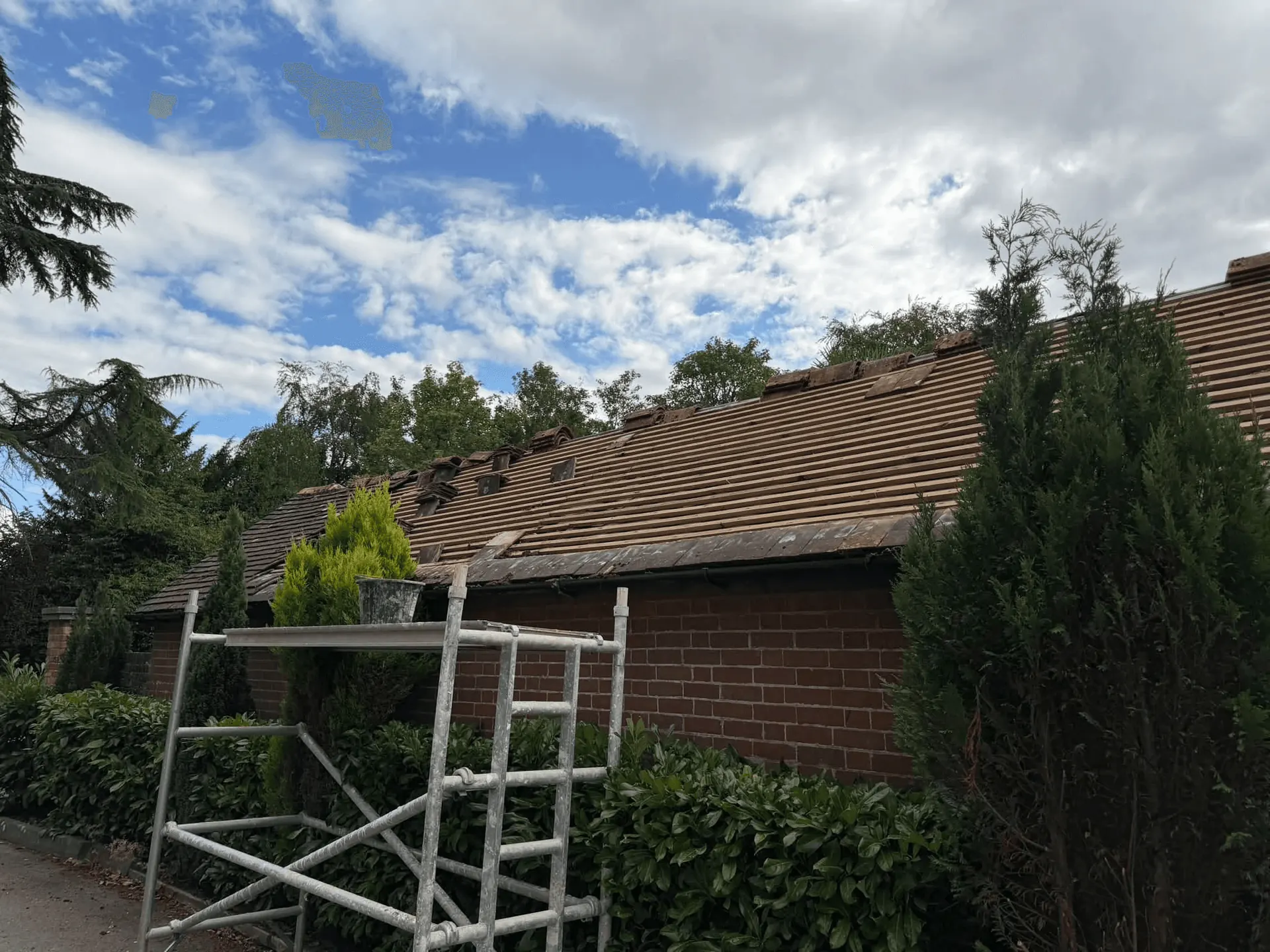
The detached houses on Home Park Road share a recognisable roof: clay tiled hips, a front gable over a bay, a tall chimney stack, often an attached garage, and second-floor rooms inside the roofspace lit by dormers. Merton Council's Wimbledon North appraisal lists those features and explains where the houses came from. The road was laid out in the 1870s by John Augustus Beaumont, who bought the old Spencer estate in 1846, but most of the houses stand on Banky Field, the wooded slope of Vineyard Hill sold to developers in 1925. They mainly date from the late 1920s and 1930s, with Nos. 118 to 126 and the houses on the old Cherry Tree Wood added in the 1950s.
For a roofer that means a lot of hip tiles to keep bedded, eaves on every side of the house, a dormer or two to keep watertight and a stack that is hard to judge from the garden.
The land falls steeply from the Arthur Road ridge down Home Park Road and Church Road, and on the park side of the upper road the houses sit below the pavement, so you look across their roofs as you walk past. Houses facing the open parkland and the former golf course get less shelter than houses tucked into the grid, and their hips, ridges and verges are the first places to check after a gale.
The Mansell semis at 72 to 96 Home Park Road
At the railway end of the road is an older group. Nos. 72 to 96 were mainly built in the early 1900s to designs by the architect Mansell, and Merton added them to the Wimbledon North Conservation Area in October 2007, as its appraisal of the group explains. Their tiled roofs have party wall parapets projecting through them, and the pairs at 80 to 90 have unusual angled central chimneys.
Parapets and angled stacks mean far more leadwork than a plain roof, and the gutters stop against brickwork at every boundary. Small faults here tend to show up as damp on a party wall or a stain around the chimney breast rather than a drip from the ceiling.
Dora Road, Vineyard Hill Road and the streets north of the station
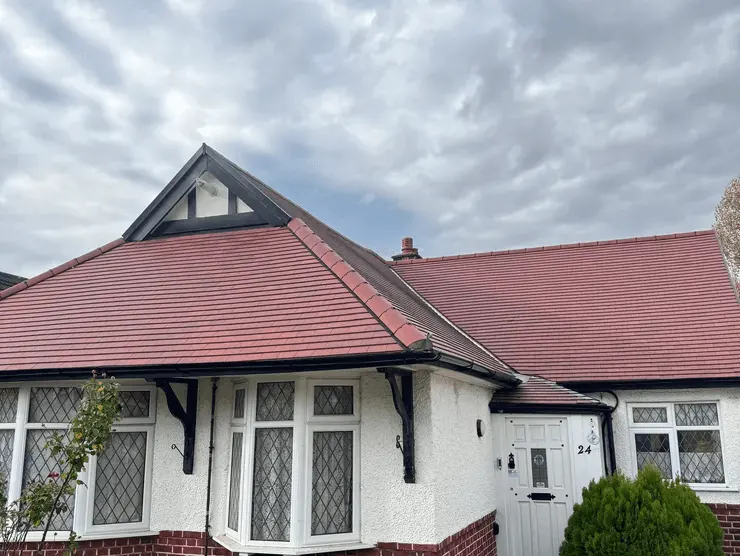
South of the station, Dora Road, Vineyard Hill Road and Kenilworth Avenue were built from the 1890s on a formal grid of two-storey semis, with Strathearn Road a terrace alongside the railway. Merton's Leopold Road character study describes red brick below and render or pebbledash above, bays and front gables finished with red tile hanging and timber bargeboards, raised gables between neighbours, and a number of mansard roofs on Vineyard Hill Road. Because of the slope, many east-facing houses on Dora Road and Vineyard Hill Road sit above the road, which puts the front gutter well out of reach of a short ladder.
North of the station, Ryfold Road, Braemar Avenue, Normanton Avenue, Ashen Grove and Lucien Road form a grid of terraces running down towards Durnsford Road. Merton's appraisal records that this ground was Ashen Grove Farm, established in 1633. In a terrace, gutters, stacks and party walls carry on from house to house, so a fault in one roof often shows first in the house next door.
Arthur Road, the oaks and the park edge
Arthur Road holds the oldest houses. Two south of the road date from about 1889 and most of the rest from 1900 to 1905, according to the character study, with gabled roofs or hipped roofs with sprocketed eaves, decorative bargeboards, red tile hanging and, on some, turrets and tall ornate stacks. The covering is mainly clay tile with some slate. On the north-east side the gardens fall sharply towards the park, so the rear slopes face open ground and catch more weather than the front.
The trees shape roof work across the whole area. Merton's appraisal names the park's old oaks, some of them around 200 years old, as its most important natural feature, and the long back gardens add many more mature trees. The result is leaves and acorns in gutters and valleys for much of the year, moss on shaded slopes and the odd branch on a roof after a storm. A regular gutter clear in Wimbledon Park is one of the cheapest ways to protect these houses.
Changing a roof in Wimbledon North, Leopold Road or Vineyard Hill Road
Two parts of Wimbledon Park sit in the Wimbledon North Conservation Area: most of Home Park Road with the park itself (Sub Area 2), and every property on Arthur Road between its two junctions with Home Park Road (Sub Area 3). Kenilworth Avenue, Vineyard Hill Road and Leopold Road are separate conservation areas, all on Merton's conservation areas list. Merton's 2006 appraisals for both Wimbledon North sub areas recommended bringing chimney removal and changes to roofing materials under planning control. Like-for-like re-roofing is normally maintenance and needs no permission, but swapping clay for concrete, taking down a stack or adding a front dormer is worth raising with Merton's planning team first.
Whatever the job, it starts with a look at the whole roof. A roof inspection shows the hips, valleys and stack tops, and Simranjeet, our Roofing Surveyor, goes through the photos with you. Where a fault turns up, roof repairs to clay tiles, hips and bay roofs are what houses of this age tend to need. Where tiles are sound we reuse them, and where they are not we look for the closest match in colour and size, so a repair does not stand out once the ladder comes down.
Frequently asked questions
Is Wimbledon Park in Merton or Wandsworth?
Both. The park is split between the two boroughs, with its northern quarter in Wandsworth. Home Park Road, Dora Road, Strathearn Road and the streets around the station, including Ryfold Road and Braemar Avenue, fall in Merton's Wimbledon Park ward and have SW19 postcodes. We work on both sides of the boundary.
My house is on Vineyard Hill Road. Is that the same conservation area as Home Park Road?
Mostly not. Vineyard Hill Road has its own conservation area, as does Kenilworth Avenue, though Merton's Wimbledon North appraisal lists one Vineyard Hill Road building, Hillcrest Lodge, inside that area. Check Merton's conservation area map for your address. In practice the approach is similar: repairs in matching materials are usually fine, and anything that changes how the roof looks from the street should be checked with Merton first.
My Home Park Road house sits below the road on the park side. Does that make roof work dearer?
It can. A scaffold at the back stands lower than one at the front and needs more lifts and careful footing on the slope, and tiles and waste take longer to move in and out. Looking at the roof first, from the road and by drone, means the access is planned and priced before anyone arrives.
Are the 1920s roofs on Home Park Road due for replacement?
Not automatically. Plenty need targeted repairs rather than a new roof. Our roof replacement page for Wimbledon Park sets out how to tell the difference.





