


 Google reviews

Two hundred years of oaks above Home Park Road
The oaks above Home Park Road are about a century older than the houses. The park's 25 oldest trees are some 200 years old and probably date from Capability Brown's landscaping, some 70 more trees are around a century old, and two of the veterans stand in the pavements of Church Road and Home Park Road. That is all set out in Merton Council's Wimbledon North appraisal, which calls the old oaks the park's most important natural feature. It also describes Home Park Road's gardens as full of mature trees, many left from when the ground was open parkland, and Horse Close Wood and Ashen Grove Wood survive within the park.
Oak leaves are tough and slow to rot, so in a gutter they mat rather than wash away. Acorns roll straight to the outlet and plug it. In spring, catkins and seed knit everything together into a dense layer that holds water. A gutter under a big oak can look clear from the ground and still be a third full of compacted debris along its length.
Hipped roofs make it worse. The Home Park Road houses have clay tiled hipped roofs, so the gutter runs round all four sides, and the corners, where two slopes drain into one point, are where leaves pile up first. Valleys behind front gables collect the same debris before it ever reaches the gutter.
Booking round the park's leaf fall
Checkatrade's gutter cleaning guide suggests once or twice a year as a starting point, and more often where a house is surrounded by trees. Under oaks, when the autumn clean happens matters as much as how often. For a house on the park side of Home Park Road or below the Arthur Road gardens, a sensible pattern is:
- Late autumn, after the oaks have dropped most of their leaves, to clear the main load before the winter rain.
- Late spring, once the catkins have come down, because they bind into a mat that blocks outlets.
- A check after a storm, when twigs and small branches end up in valleys and gutters.
The same guide puts a three-storey townhouse at around £165 to £300. A Home Park Road house with rooms in the roof has its gutters at a similar height and running round all four sides, and a sloping garden adds to the access.
Getting at the gutters on a sloping plot
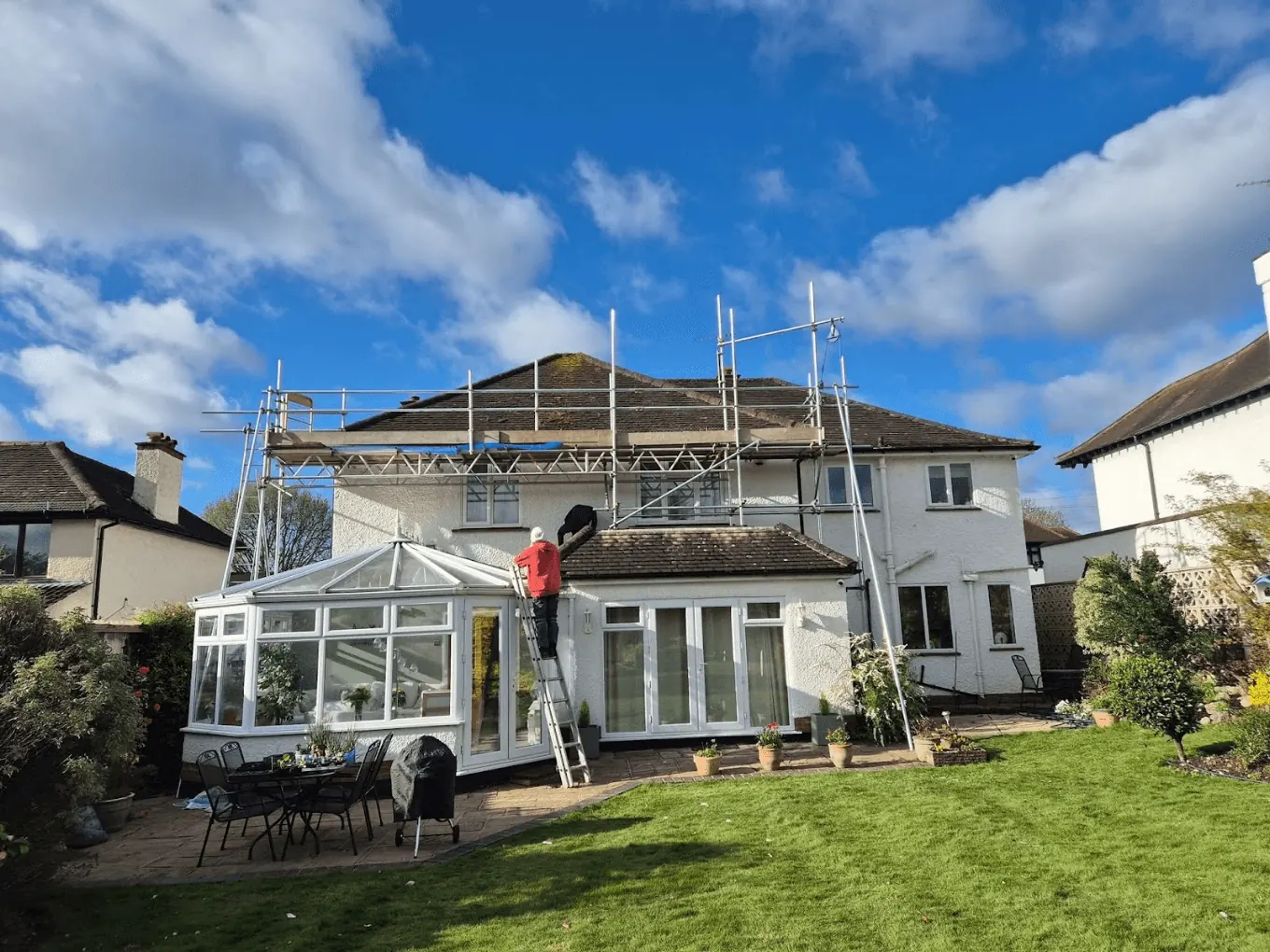
The ground here is rarely flat. Houses on the park side of upper Home Park Road sit below the road with gardens falling away, and Arthur Road's north-east gardens drop sharply towards the park, so a ladder at the back often stands much lower than one at the front. We look at access before the day and, where the gutters are high or the slope is awkward, we can use the drone first to see how full they are.
Each run is emptied by hand, all the way round a hipped house and up into any valley that feeds it. Then the downpipes are cleared and water is run through to prove the fall. Loose brackets, cracked joints or a soft fascia get pointed out with a photo. If something needs fixing, we can price gutter repairs or fascia and soffit work from what we found, and our article on how often to clean your gutters covers the timing in more detail.
Frequently asked questions
When should a house on the park side of Home Park Road book its clean?
Once most of the oak leaves are down, usually late in the autumn, and again in late spring after the catkins. Booking too early in autumn means the gutters fill again before winter.
Does the drop in the Arthur Road gardens make cleaning the back gutters harder?
It can. Where the garden falls away, the back eaves are higher above the ground than the front, and a ladder has to be footed on a slope. We plan for that from photos or a drone look, so the right equipment comes on the day.
Is a yearly clean worth it on a terrace north of the station, such as Ryfold Road, if there are no large trees nearby?
Usually, yes, but once a year is often enough. Without oaks nearby, moss, roof grit and the odd leaf build up more slowly, and a single clean in late autumn keeps the shared run moving.





