



 Google reviews

The Stoneleigh Trust's 1930s estate
Stoneleigh station opened on 17 July 1932, the first houses around it were built in 1933, and building stopped when war broke out in late 1939. Before that the land was farmland. Wikipedia's history of Stoneleigh places it within the Tudor Great Park of Nonsuch, which was sold off in 1731 and went back to farms. In 1860 John Jeffries Stone bought Bowling Green and Coldharbour farms, and his house, called Stoneleigh, gave the district its name.
After his death the property was held in trust, and his executors formed the Stoneleigh Trust to sell the land to developers. The Stoneleigh and Auriol Neighbourhood Plan records that the trust set design codes covering building lines, frontages, building heights, garden walls and fences, verges and grassy roundabouts. Plots then went to a number of builders. Epsom and Ewell History Explorer has a resident's memory of Carter's building houses on part of Stoneleigh Park Road and in Amberley Gardens, where a three-bedroom semi with an integral garage cost £1,000 in 1936.
For a roofer, the upshot is a suburb where most roofs are the same age and built to similar patterns, now well over 80 years old. A fault on one house is a fair guide to what its pair and its neighbours will face.
What sits on a Stoneleigh Chalet roof today
Over 75% of homes in the neighbourhood area are semi-detached and around 13% detached, according to the 2021 figures quoted in the Neighbourhood Plan. Many are in the style known as the Stoneleigh Chalet. The AECOM design codes for Stoneleigh and Auriol describe:
- steep roofs, mostly gabled, with hipped roofs in places
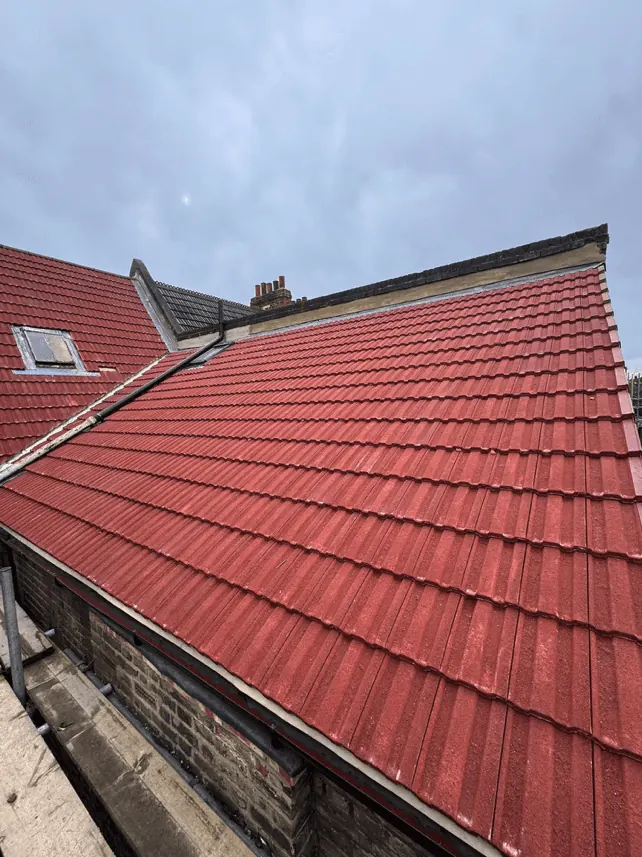
- pantiles and concrete tiles, mostly red or grey
- brick or stone chimneys, built for fireplaces in the downstairs rooms
- on some roads, larger dormers in Tudor-style white render and timber
Since then, a growing number of houses have been extended. A typical roof now has a 1930s main slope, a later loft dormer, a flat-roofed kitchen at the back and perhaps a side extension, each added by a different builder in a different decade. On houses like these, the joins between old and new are the usual weak points: dormer soakers, the upstand where an extension meets the house wall, and valleys over side extensions.
If you are not sure what state your roof is in, a drone roof inspection in Stoneleigh photographs the back slope and the dormer top without scaffolding. If the tiles are tired across the whole roof, our page on roof replacement in Stoneleigh explains re-roofing one half of a semi. For extension roofs that have started to leak, see flat roofing in Stoneleigh.
East of the line, west of the line
The railway splits Stoneleigh in two. To the east is the original estate around the Broadway, running towards London Road and Nonsuch Park, which forms the south-eastern edge. To the west is the Stoneleigh Hill Estate, built mainly on the former Cold Harbour Farm. Auriol Park sits in the north-west, and that corner falls in the KT4 Worcester Park postcode.
The ground rises and falls more than people expect, from about 25 metres at the western edge near Salisbury Road to about 52 metres at Stoneleigh Crescent, just north-west of the station. The AECOM codes describe the Auriol side as an undulating hill with an east-west ridge, and the Neighbourhood Plan notes roof lines stepping down the slope on Newbury Gardens. As a general rule, a roof on higher, open ground takes more of the wind than one sheltered lower down.
West of the line, the plots went to numerous builders, which is why styles change from road to road. On Westways, two pairs of houses rebuilt after a wartime bomb have a steeper roof pitch than the rest of the road.
Two other local factors shape roof and gutter work. The AECOM codes note many mature trees under Tree Preservation Orders, with woodland near the railway and Nonsuch Park. They also say the culverted Ewell Court Stream, which runs underground beneath Briarwood Road and Stoneleigh Park Road, still presents a flood risk to homes along its path. That is why our gutter installation in Stoneleigh pays close attention to where each downpipe ends.
The Broadway, Bluegates and Cunliffe Road
Stoneleigh Broadway was the estate's shopping street from the start. Local history records show the first block of about 18 shops on the south side finished by November 1933, with more in 1934 and in Station Approach. Wikipedia lists smaller parades too, at Cunliffe Parade on Vale Road and where Stoneleigh Park Road meets Kingston Road. On the Broadway, the Station pub, built in 1934 to 1935 as the Stoneleigh Hotel, is Grade II listed, with a steeply pitched tiled roof and big brick chimneystacks.
Not everything is 1930s. A small section near the Broadway was built in the 1960s, and the Cunliffe Road estate dates from about 1948. The Bluegates estate, between the A24 and Nonsuch Park on land that was once part of the grounds of Stoneleigh House, was built in the 1980s with two-storey semis under concrete-tiled gable roofs.
None of the borough's conservation areas covers Stoneleigh, so like-for-like roof repairs and re-roofing normally need no planning permission. Changes to the shape of a roof are different, and the Neighbourhood Plan, made in March 2026, now applies to those. Precise Roofing has been family run for over 20 years from Kenley Road in Morden, and Simranjeet, our roofing surveyor, can look at a Stoneleigh roof before anyone quotes for work on it. If water is coming in now, go straight to emergency roof repair in Stoneleigh, or call 0330 133 4111.
Frequently asked questions
Does the Stoneleigh and Auriol Neighbourhood Plan affect roof work on my house?
Repairs and like-for-like re-roofing are not normally affected. If your project needs planning permission, as some dormers and extensions do, the council will judge it against the plan's policies, including Policy 1 on building lines and roofscape and Policy 8 on surface water, and the AECOM design codes behind them. If you are unsure whether yours needs permission, check with Epsom and Ewell Borough Council.
Our house is on the Bluegates estate. Does its roof need different work from the 1930s semis?
The roofs there are younger and simpler: concrete-tiled gables rather than the steeper 1930s roofs. The things to watch are the verges at the gable ends and the gutters under the Nonsuch Park trees.
We live in the Auriol Park corner with a KT4 postcode. Are we still in Stoneleigh?
For most purposes, yes. Auriol Park is in Auriol ward and the Worcester Park postcode area, but it sits inside the Stoneleigh and Auriol neighbourhood area, so the same plan and design codes apply to roof changes there.
Where should I start if I do not know what is wrong with our Stoneleigh Chalet roof?
With an inspection. A drone survey and a look in the loft show whether you are dealing with one fault, such as a dormer flashing, or a roof that is worn across the board. From there we can quote for the right job.





