



 Google reviews

What we do in West Ewell
We are a family run roofing and guttering firm, and West Ewell's interwar semis, older terraces and post-war blocks keep us busy with the full range of work: slipped tiles and cracked hips put right through roof repairs, worn-out roofs stripped and re-covered, flat roofs on extensions and dormers, chimney lead and pointing, and gutters, fascias and soffits. Quotes are free and often the same day, and our work carries a 10 year guarantee. If water is coming in at night or at the weekend, the phone is answered around the clock on 0330 133 4111.
Not sure what your roof needs? A roof inspection in West Ewell is the place to start. Josh flies our drone when a rear slope or chimney top cannot be seen from the ground, so nobody needs scaffolding just to look.
From Marsh Lane to Fitznells Farm
At the end of the 19th century there was no West Ewell by name. The area was known as Upper and Lower Marsh, Chessington Road was Marsh Lane, and the land was farmed as Park Farm, Fitznells, Poplar Farm and Scott's Farm, as the Epsom & Ewell History Explorer sets out. The few homes were mostly cottages for workers at the gunpowder mills on the Hogsmill.
The streets you know today were planned at the end of the 1920s. A plan of Fitznells Farm drawn up in 1927 is the earliest map the History Explorer's author could find that uses the name West Ewell. In February 1933 Carshalton Beeches Estates Ltd bought about 125 acres of the farm, between the Hogsmill and Chessington Road, for £32,000, and sold it on in plots to builders. A 1935 layout with a grid of roads called 1st to 9th Avenue was thrown out in favour of the roads that run down towards the river now.
That is why West Ewell does not look like a single estate. Turner built Southville Close and Kingsmead, finished in 1929. A builder called Dracey put up the first house on Lansdowne Road. Station Avenue's first residents arrived in late 1935. Different builders did not always use the same tile, ridge or gutter, so two semis a few doors apart can need quite different work. Some Chessington Road plots were even built on by their owners, and our inspection page tells that story.
After the war, prefabricated homes shipped from Canada went up on Shawford Road, Gadesden Road and Cherry Way, with a designed life of ten years. They are long gone: the History Explorer says they were apparently reused afterwards as holiday homes on the coast.
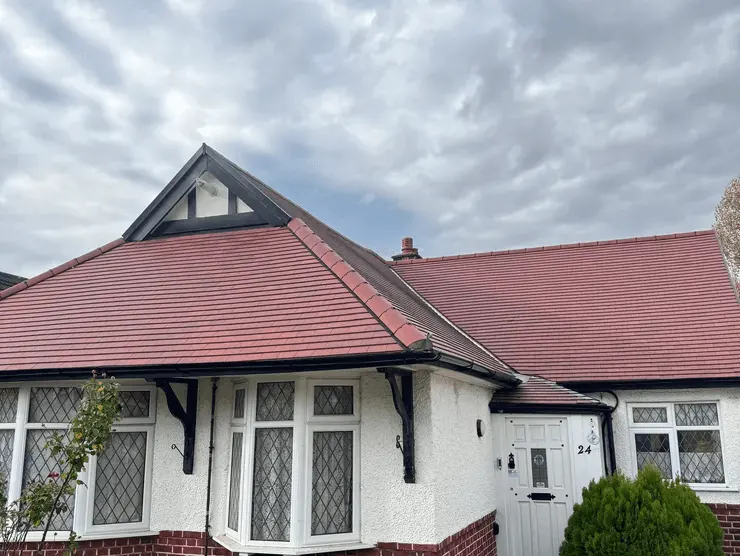
Older and newer roofs either side of the interwar plots
The interwar semis are the bulk of the area, but they sit between older and newer housing that needs a different approach.
- Chesterfield Road and Heatherside Road. Both were laid out in the late 1800s, and some Chesterfield Road houses date from 1890. Roofs this old have usually been patched by several hands over the years.
- Plough Road terraces. Ewhurt Terrace and Woodley Terrace went up in 1905 and 1906, with one long eaves line shared along each row.
- Belfield Road. Built in two halves, the Chessington Road end first and the rest after the war, so the two ends have different houses and different roofs.
- Post-war council houses. Council houses for hospital workers went up on Lansdowne, Chesterfield and Heatherside Roads after the war, now with several decades on their roofs.
- The Ruxley side. Ruxley Farm was demolished in 1959 and housing and flats were built on its land, as the History Explorer's Ruxley Lane page records. At the 2011 Census, flats were the largest single group of homes in Ruxley ward.
Interwar roofs and what they need
A West Ewell semi finished between 1929 and the late 1930s is now close to a century old, though many will have been re-covered at least once in that time. The tiles often outlast the nails and battens holding them, so slipped tiles, cracked hip and ridge mortar and lifting lead round the chimney are the usual signs that a roof is tiring.
Age alone is a reason to look, not a reason to replace. Plenty of these roofs are fine with a few repairs, and a full roof replacement only makes sense when faults are turning up across several slopes. We will tell you plainly which side of that line yours is on. Many semis have also gained something since they were built, such as a flat-roofed back extension, a side garage or a loft dormer, and those coverings tend to wear out long before the main roof.
The Hogsmill runs along the northern edge of the area, and the Hogsmill Local Nature Reserve has woodland copses as well as open grassland. Homes near it, or with big trees in or beside the garden, collect more leaves in their gutters, so a yearly gutter clean is worth booking there.
Planning and conservation
Epsom and Ewell Borough Council lists 21 conservation areas, and none of them is named for West Ewell or Ruxley. The five Hospital Cluster areas, such as Horton and Long Grove, cover the old hospital sites further west towards Horton Country Park. Re-covering a roof like for like is normally treated as maintenance and does not need planning permission. Changing its shape, adding a dormer or fitting roof lights is different, so check with the council before work starts if you plan anything beyond a straight re-cover.
Frequently asked questions
My house is on one of the old Fitznells Farm plots. Will the roof match the rest of the street?
Not necessarily. The farm was sold in plots to different builders, so the tile, ridge and gutter can change from one pair of semis to the next. We work from what is on your roof, not from what a neighbour had done.
We live on Belfield Road. Why does our roof differ from houses at the other end?
The road was built in two stages, the Chessington Road end before the war and the rest after it. The house styles change between the two halves, so repairs and replacement tiles need choosing for your half.
I own a flat in a block off Ruxley Lane. Can you look at the roof?
Yes. On most blocks the roof belongs to the freeholder, so we can inspect and report to you, the freeholder or the managing agent, and quote whoever is responsible for the work.
Our Plough Road terrace shares one gutter line with the neighbours. Do we all have to have work done together?
No. Each house can have its own length repaired or replaced, joined neatly to the neighbours' gutter. If several of you are thinking about it, though, one visit to look at the whole row is often the cheaper way to do it.





