


 Google reviews

What the planning rules mean for a roof here
The Ewell Village Conservation Area takes in nearly all of the old village, between the A24 by-pass and the railway through Ewell West station. Inside it, the council's appraisal counts 100 listed building entries, all Grade II apart from St Mary's Church, which is Grade II*. On any of those, changing the roof covering needs listed building consent.
Houses that are not listed are still covered by an Article 4(2) Direction, in force since February 2000. For family houses it removed permitted development rights for changing roof materials or adding rooflights on a slope facing a public highway, private road or waterway, and for extensions and porches on the front. Flats and commercial buildings already had fewer of those rights, so the direction was aimed at family houses. Repairs in the same material are normally maintenance and need no permission. A change of covering on the front is a question for Epsom and Ewell Borough Council, and the time to ask is before anything is ordered.
In practice that means the first conversation about a worn roof in the village is about what goes back on, not how fast it can be stripped. Our page on re-roofing a village house goes through the covering for each type of house.
Peg tiles in Church Street, Spring Street and the High Street
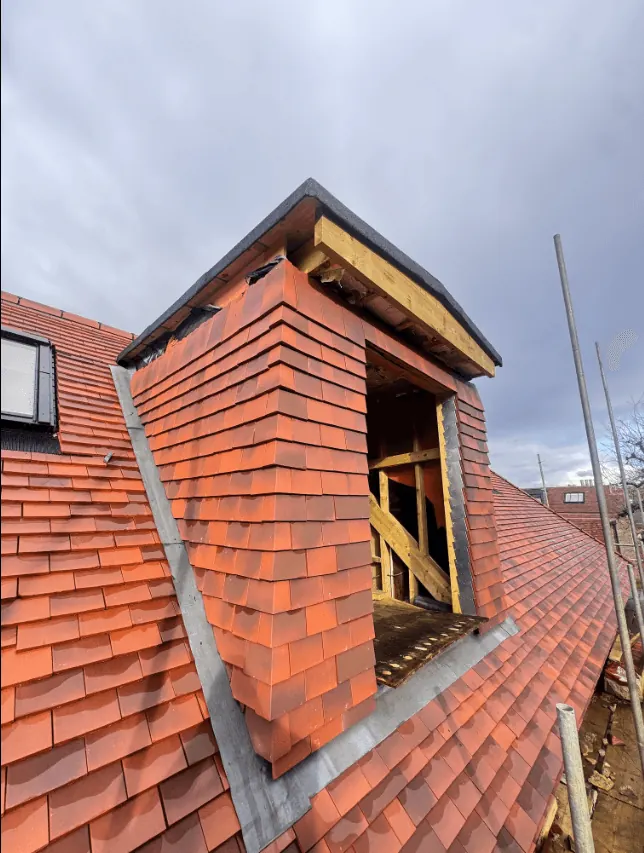
The oldest buildings are timber framed: The Star in the High Street, Fitznells Manor in Spring Street and the jettied range at 11-15 High Street. Their steep roofs are almost always covered with handmade clay peg tiles. No. 26 High Street is an open hall house of the early 16th century or earlier. Several houses in Church Street and Spring Street look Georgian from the road because their frames were refaced with mathematical tiles, clay tiles made to look like brick, so the roof can be far older than the front suggests.
Church Street also holds Ewell Castle of 1811, the 18th century barn with its queen post roof, the Watch House and Engine House in hammer-dressed greensand, and Glyn House, the 1859 rectory with steep slated roofs. On roofs like these the common job is a single slipped peg tile, put back with a handmade or reclaimed match. Our roof repairs in the village explain how that match is found.
Cottages in Mill Lane and West Street
The late 18th and early 19th century cottages are mostly timber, clad in painted weatherboarding, with later ones in brick. They are usually one room deep, with fairly shallow hipped roofs in slate or peg tiles and a brick stack in the middle of the roof. A stack in that position has lead on all four sides, and the tray on its uphill face is where many cottage leaks begin. Our chimney work on village cottages covers the lead, the pointing and the pots.
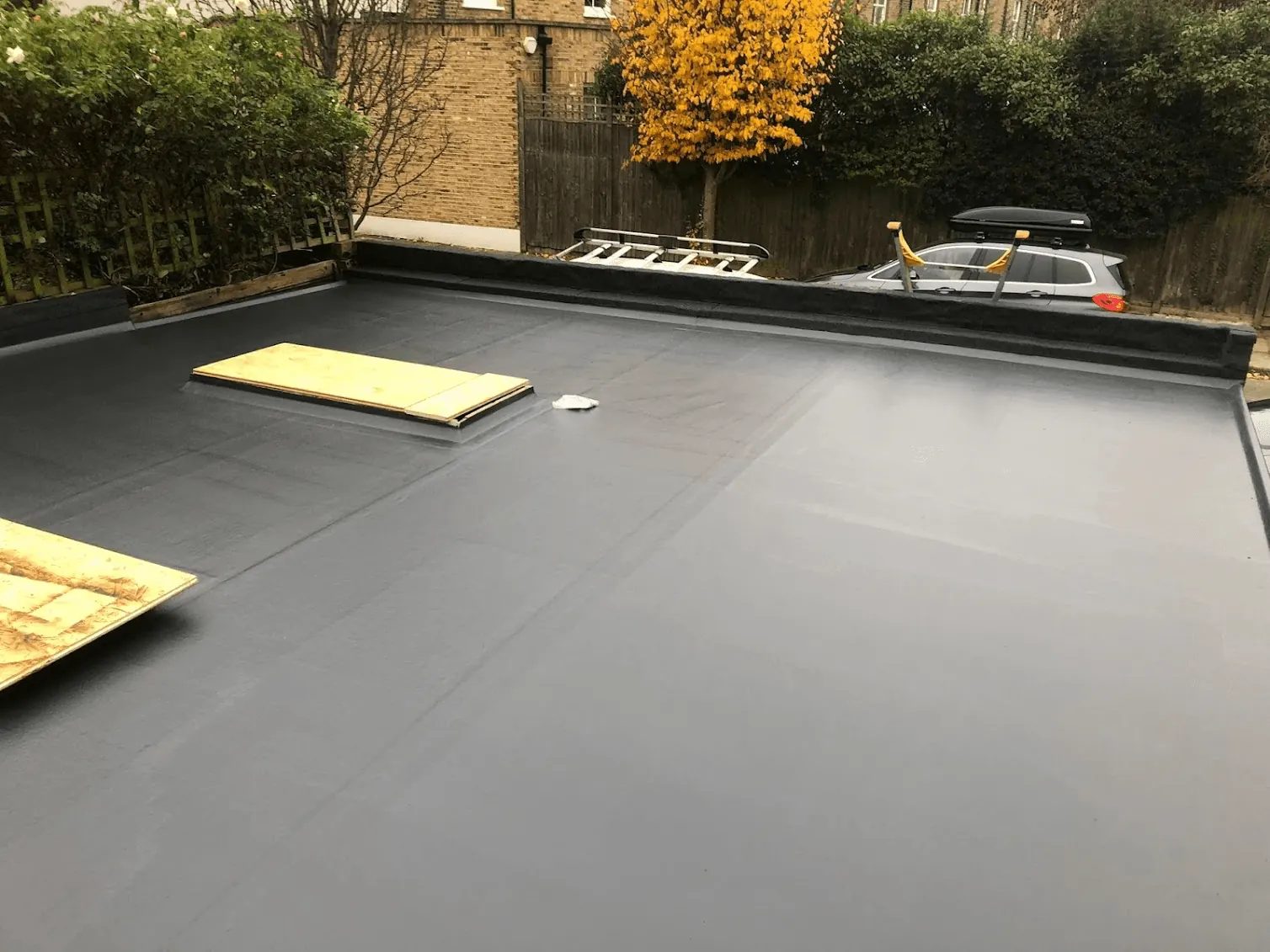
Many of these cottages once had a catslide roof at the back, and most of those have since been replaced and extended. Where a later extension meets painted boarding, the flashing detail matters more than the covering on top. Flat roofs on cottage extensions have their own page.
West Street also has Tudor Close, a group of picturesque mid-19th century cottages that may have been built as almshouses, and nos. 9 and 11, a pair dated 1880 with blue and red fishscale tiles hung on the upper walls under a pitched tile roof.
Slate on Epsom Road, and the inter-war houses
Cheap Welsh slate arrived with the railways in the mid-19th century and could be laid at lower pitches, so Ewell's roofs gradually became less steep. Epsom Road shows the change. Mulberry House and the pair at Elvaston and Bleak House are slated, while Hollycroft, a Grade II house of the mid-18th century, keeps a mansard roof in handmade peg tiles with prominent end stacks. The council's 2022 boundary map carries the conservation area south along Epsom Road past the by-pass junction to take these houses in.
The same road, with London Road and The Headway, also has well detailed inter-war houses, most of them detached or semi-detached, and there are three 1930s blocks of shops and flats where Epsom Road meets the High Street. These are 20th century roofs, but inside the boundary the Article 4 rules apply to the family houses just as they do to the cottages.
Bourne Hall and the Kingston Road end
North of the High Street the village opens out along the Hogsmill. Listed and locally listed cottages cluster around Lower Mill, 19th century cottages line Meadow Walk, and nos. 2-24 Kingston Road are a red brick terrace of about 1900. Bourne Hall, the circular library and hall with a central glass dome, went up between 1967 and 1970 and was listed Grade II in 2015.
Many of the trees in Bourne Hall park, around the two churches and in the grounds of Glyn House are 19th century specimen trees, and houses near them see heavy leaf fall in their gutters. Our gutter cleaning in Ewell Village deals with that. If you are not sure what is wrong with a roof, a drone survey gives you photos of every slope without scaffolding, and our roof inspections in the village explain what they show. To book, call 0330 133 4111.
Frequently asked questions
My house on Epsom Road is south of the by-pass junction. Is it in the conservation area?
It may be. The council's 2022 boundary map extends the area south along Epsom Road beyond the junction, taking in Hollycroft, Mulberry House and Elvaston and Bleak House. Check the map before planning any change of roof covering on the front.
Can a peg tile roof in Church Street be repaired with new machine-made tiles?
On a listed house that is unlikely to be acceptable, and on any of these roofs it would stand out. Handmade or reclaimed peg tiles blend in. We source a match before the old tiles come off.
I own a flat above a High Street shop. Who is responsible for the roof?
Usually the freeholder, but your lease decides it. If you report a leak to us, we can look at the roof and send our findings to whoever the lease names.
Does the Article 4 Direction stop me re-roofing my cottage in West Street?
No. It brings a change of material on the front slope under planning control. Re-covering in the same material is maintenance, though a listed cottage still needs consent for anything that alters its character.





