



 Google reviews

Matching the gutter to the house
A new gutter runs the full width of a front, and on a small cottage or a terrace it is one of the few lines that frame the roof. In a village with this much variety in a few streets, the right system depends on the house more than on price.
| House | What usually suits it |
|---|---|
| Listed timber-framed and Georgian houses, Church Street and Spring Street | Cast iron to match the original, after checking with the council |
| Weatherboarded cottages, Mill Lane, West Street, Kingston Road | Small half-round cast iron, or aluminium in a traditional profile |
| The terrace of about 1900 at 2-24 Kingston Road | One profile and colour along the row, ideally matching what survives |
| 19th century slate houses, Epsom Road | Cast iron, or aluminium in the original ogee or half-round |
| Inter-war houses, London Road and The Headway | uPVC or aluminium |
Cast iron lasts a long time if it is painted and kept clear, and its weight and slim edge look right on period fronts. Aluminium in a heritage profile gives a similar line for less weight and no rust. uPVC is light and cheap, and on a 1930s house it is the usual choice. MyJobQuote's gutter repair guide gives uPVC a life of up to 25 years and metal gutters up to 50 with proper care.
One line along 2-24 Kingston Road
The council's appraisal picks out nos. 2-24 Kingston Road, a red brick terrace of about 1900, for keeping most of its original windows and some of its front doors. A terrace like that reads as one building from the road. If one house swaps to a different profile or colour, the change shows along the whole row.
Where neighbours are replacing at different times, it is worth agreeing a profile once and sticking to it. Where one owner goes first, we match what the neighbours have, so the line stays continuous and the joint at the party wall can be made properly. A run that meets next door's gutter needs a proper union between the two, not one length lapped loosely over the other.
The same thinking applies on a smaller scale to the paired cottages in West Street and the groups of cottages around Lower Mill.
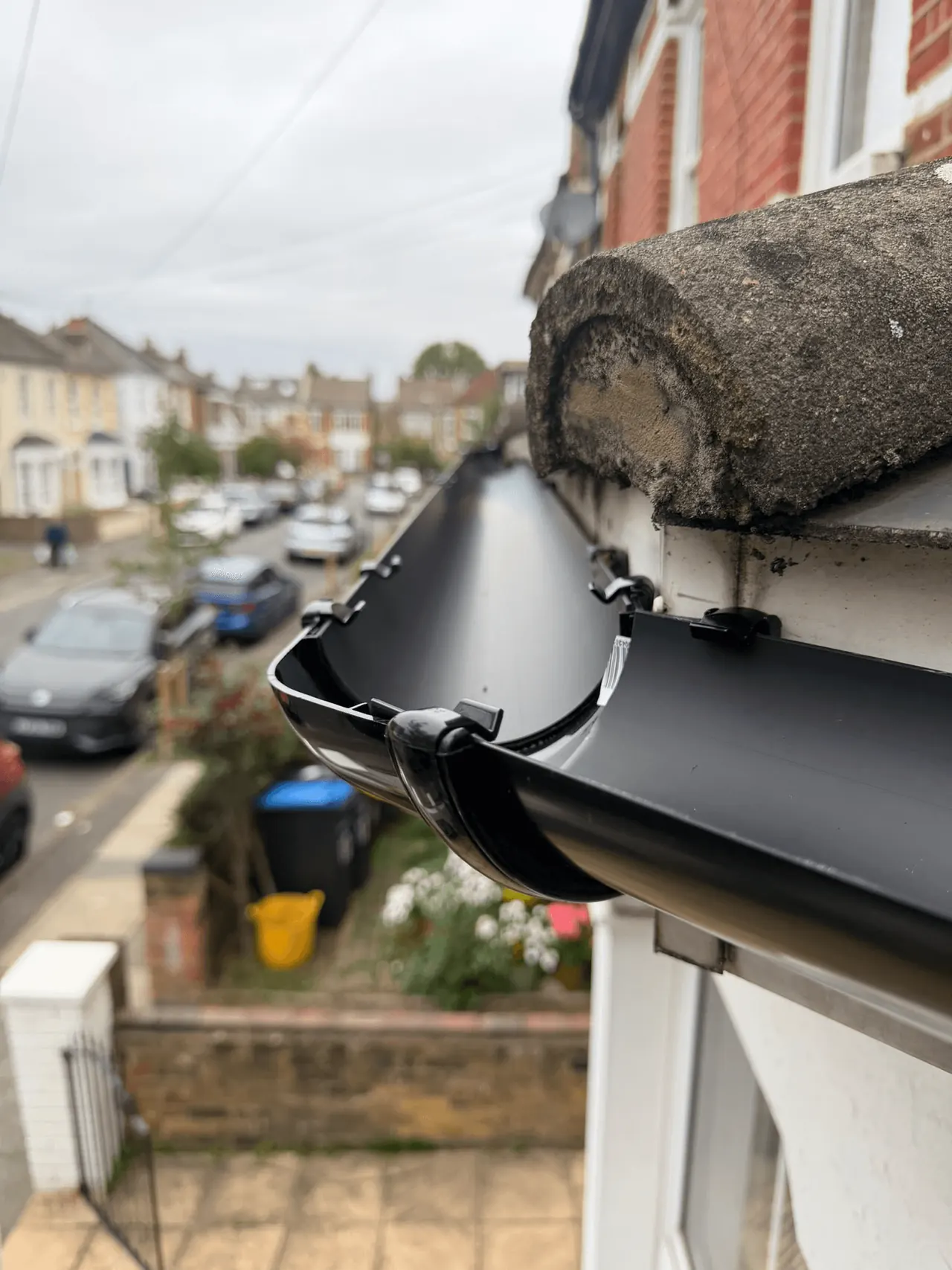
Listed fronts in Church Street and Spring Street
On a listed building, changing the material or profile of the rainwater goods can need listed building consent, so the starting point is whatever survives. Where old cast iron is still up, a matching replacement in cast iron is the safe route, and the council can tell you whether anything different would be acceptable. For context, the appraisal already lists uPVC windows on the listed no. 27 and the locally listed no. 84 Kingston Road among the area's negative features, which gives a sense of how plastic on a historic front is viewed. The appraisal does not mention gutters directly.
Brackets on these houses fix to fascias or rafter feet that may be very old. If the timber is soft it needs sorting first, and our fascia and soffit work in the village covers that. The new run is set with a steady fall to the outlets, the downpipes are connected to the drain, and the system is tested with water before we leave. For long straight eaves on the inter-war houses, see seamless gutters in Ewell Village. The main gutter installation page has more on profiles and materials.
Frequently asked questions
I live in the 2-24 Kingston Road terrace. Do I have to match my neighbours' gutters?
There is no rule that says you must on an unlisted house, but matching the profile and colour keeps the terrace looking like one building, which is what the appraisal values about it. It also makes the joint with next door easier to keep watertight.
Does the Ewell Village Article 4 Direction cover gutters?
No. The direction covers things like front windows, doors, porches and roof materials, not rainwater goods. A listed building is different: changing its gutters can need consent.
Which profile suits a slated house on Epsom Road?
Whatever survives from the original, often ogee or half-round. If nothing original is left, a neighbouring house of the same age is a good guide.
Can new gutters go up at the same time as a re-roof?
Yes, and it makes sense, because the scaffold is already there and the new roof edge can be set up for the gutter.





