



 Google reviews

The closes off Church Road
West of the town centre, the land between Church Road and the Wandle was rebuilt in the 1980s and 1990s on former industrial sites. Merton Council's Church Road character study describes the result around Brangwyn Crescent and Batsworth Road: houses in blocks of three to five, staggered round curved cul-de-sacs, in red or yellow brick with red or brown pantiled roofs, canopy porches and brown or white timber cladding on some.
Houses like these are where seamless aluminium earns its place. The eaves are plain, there is no period detail to match, and a coated aluminium finish can pick up the brown of the pantiles and cladding or the colour of the window frames. Each straight run is made in one length to suit the eaves it sits on, so the only joints are where the gutter turns a corner or drops into a downpipe. Fewer joints means fewer places for a seal to dry out and drip.
The staggered layout matters too. Where houses step forward and back along a curve, each one has its own runs and corners rather than one long line across the block, so we measure every house separately and set out the outlets for that roof.
Rear wings on Mitcham Park
The Edwardian semis on Mitcham Park sit on deep L-shaped plans, so as well as the front and back eaves there is a long run down the side of the rear wing. A sectional gutter on a run that length needs several joints. A seamless one needs none between the corners.
Mitcham Park is partly inside the Mitcham Cricket Green conservation area, though, and the front of a house there is a different matter from the side of the wing. On the street side, a traditional profile that matches the period is usually the better choice, and seamless can still go on the rear wing and back eaves where it is not seen from the road. Our page on gutter installation in Mitcham covers the period profiles.
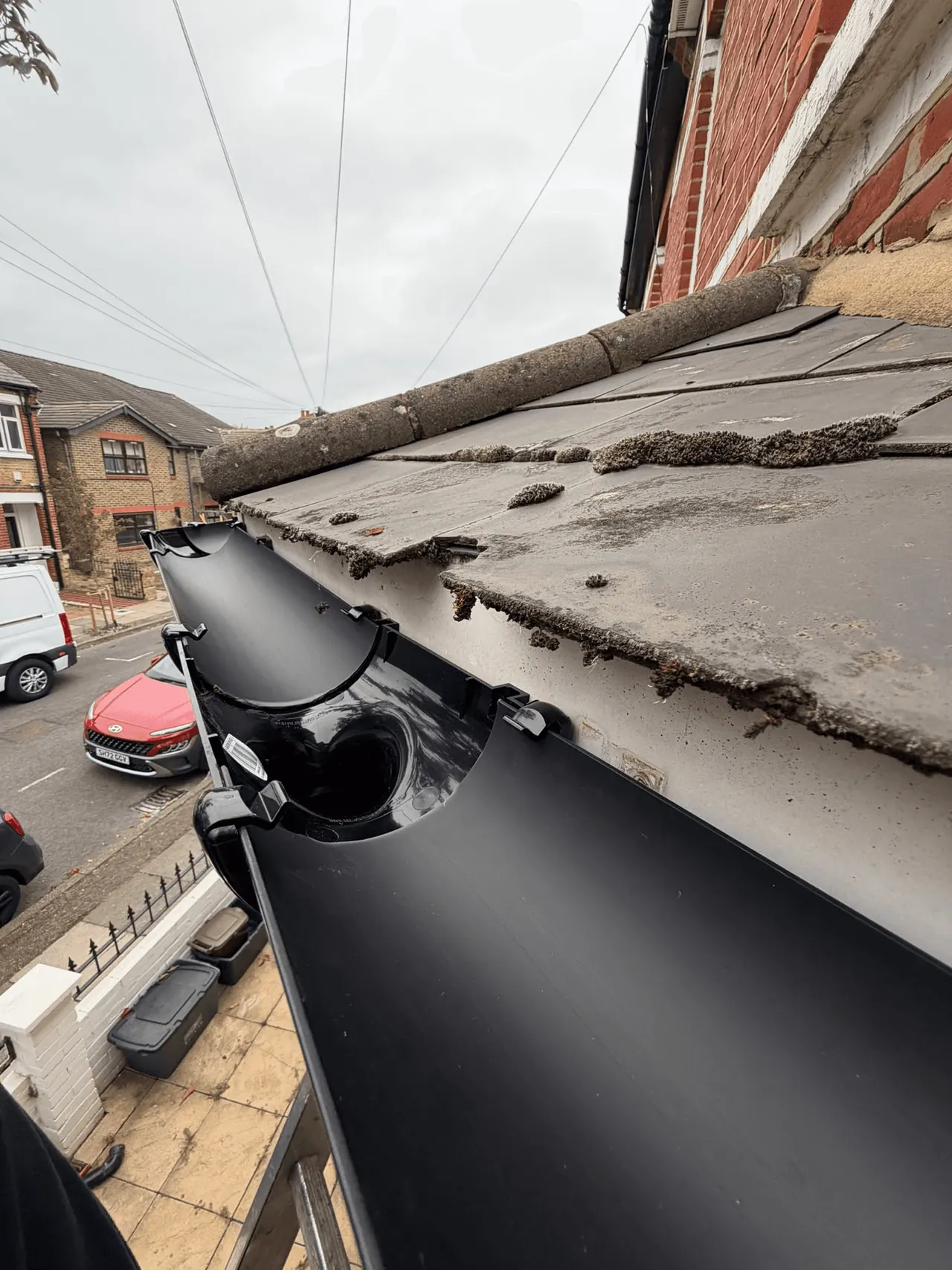
Where seamless saves very little
On a cottage round the Cricket Green with a short frontage and several corners, a seamless gutter saves one or two joints at most, and the extra cost is hard to justify. Those houses usually have, or should have, a cast iron or traditional-profile gutter on the front anyway.
On the shared-roof blocks off Lavender Avenue, where one gutter can run past several houses, a seamless run on your section still has to join your neighbours' gutters at each end. It removes the joints in the middle of your run but not the two at your boundaries, which is where shared runs tend to leak. It is still worth having if your section is long, but it will not solve a leak that starts next door.
Whatever the house, the gutter is only as good as the board behind it. We check the fascias before measuring, and if they are soft we replace them first through our fascias and soffits work. For a sense of cost, MyJobQuote's gutter replacement guide puts aluminium guttering at £55 to £78 per metre supplied and fitted, a figure for aluminium in general rather than seamless runs. The main seamless gutter installation page covers the pros and cons in full.
Frequently asked questions
Can the gutter match the brown pantiles and timber cladding on a Brangwyn Crescent house?
Aluminium gutters come with a coated colour finish, so a brown or dark finish to sit with the pantiles and cladding is usually possible. We bring the colour options to the survey so you can hold them against the house.
Is there a run too short for seamless to be worth it?
Seamless pays off on long straight eaves. If a run is short and broken by corners, as on a small cottage front or a porch, it saves very few joints, and a sectional gutter usually makes more sense there.
The rear wing of my Mitcham Park semi has a long side run. Is that where seamless helps most?
Yes. That side run is often the longest on the house, so it saves the most joints. If you are in the conservation area, we can fit seamless to the wing and back and keep a traditional profile on the front.





