



 Google reviews

Reading the age of a Tolworth house from its roof
Walk from Ellerton Road to Kent Way and you pass through about a hundred years of building. The terraces and villas west of Red Lion Road were going up from the late Victorian years, and Kingston Council's character study notes that some properties there date back to the 1870s. The 1927 bypass brought the interwar avenues, the Sunray Estate mostly followed after the war, and Kent Way and Chaffinch Close arrived in the 1970s and 1980s.
So a house on one side of Red Lion Road can be sixty years older than one a few minutes' walk away. Each generation of builder used different tiles, different fixings and different details at the edges, and each has its own weak point. Working out which generation a roof belongs to tells us where to look hardest.
Lenelby Road, Egmont Road and the older grid
The grid around Ellerton Road, Douglas Road and Egmont Road holds the oldest houses in the area, from small terraces to the large villas on Ewell Road, plus the Edwardian terraces set around the formal garden at Lenelby Road. On these, the trouble usually sits where one roof meets another. A rear addition tucked against the main back wall needs a flashing that has often been patched more than once. Valleys between slopes fill with silt. Chimney stacks are often the oldest part of the roof, and some have been pointed in hard cement at some stage.
Inside the loft, the finding that matters on these houses is the timber beside the stack and along the valley: tide marks on the rafters, or battens gone soft where old underlay has sagged and held water. That is what decides whether a roof needs a repair this year or a bigger conversation in five.
The hidden back slopes on Princes Avenue and Kingsmead Avenue
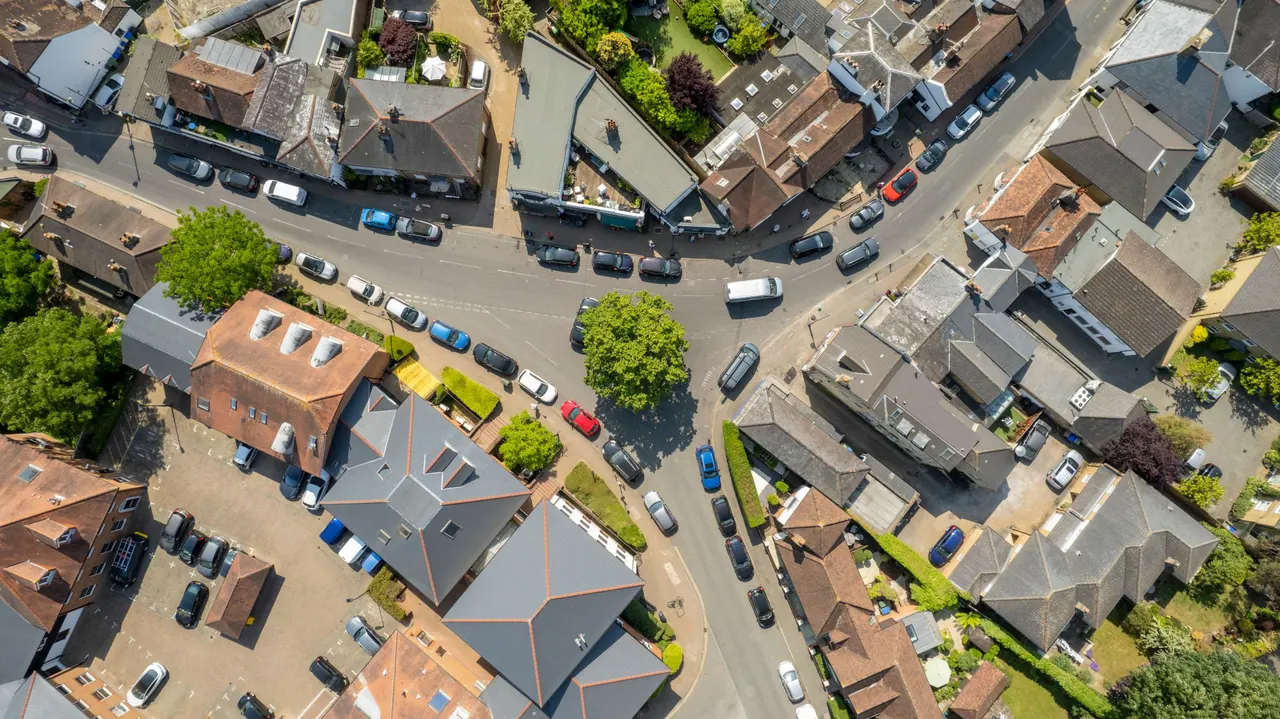
The 1930s avenues east of Red Lion Road are a different job. The council describes Princes Avenue as having gaps between pairs of semis and long back gardens that widen as the road nears the A3, and Kingsmead Avenue as a consistent line of two-storey hipped pairs. Where a house has had a loft conversion, there is a dormer and its flat roof on the back as well.
That rear slope is the part nobody sees. From a long garden you get an angle on the dormer face and not much of its roof. A drone helps here: it gets above the back slope and photographs the dormer roof, the lead on its cheeks, the hips and the party line between the two halves of the pair, with nobody on the tiles. Where the inspection turns up loose hips or a failed valley, our Tolworth roof repair page explains what happens next.
Sunray hanging tiles and the Kent Way garages
South of the A3, the Sunray houses have plain clay-tiled roofs, curved-tile chimney details and tile-hung first floors. The hanging tiles on the walls get the same attention as the roof, because a cracked hanging tile lets rain into the wall rather than the loft and can go unnoticed for years.
Kent Way, from the 1970s, has some garages in short terraces. Where those garage roofs are flat, we check the covering and the edge trims, since a fault over one garage can show up in the next.
Simranjeet, our Roofing Surveyor, or Josh, who flies the drone, then shows you the photos and explains which faults need doing now and which can wait. The main roof inspection page sets out the whole process, and if you are part way through a purchase, our guide to checking a roof before you buy lists the questions worth asking the seller.
Frequently asked questions
We are buying an Edwardian house on Lenelby Road. What should the inspection look at first?
The chimney stack, the junction where any back addition meets the main wall, and the valleys. On houses of that age those three account for most leaks. We also check the loft for damp battens and look at the gutters, since overflowing gutters soak the top of old brick walls.
Can you inspect a Sunray Estate roof without anyone standing on the clay tiles?
Yes. The drone takes close photos of the plain tiles, the chimney and the tile hanging without anyone setting foot on the roof. If one spot then needs a closer look, we plan access for that spot alone.
Our Kent Way house is from the 1970s and has never leaked. Is an inspection worth it?
Roofs of that age are around fifty years old, and the first signs of wear are usually at the ridge and along the verges, well before any water gets in. A check now tells you whether there is anything to plan for.





