



 Google reviews

Four building eras in one mile of KT9
Walk from Chessington North station to Chessington South and you pass roofs from the late 1930s, the 1950s, the 1970s and the 1980s. Kingston's character study describes the north of the area as pockets of housing built between the late 1930s and the 1950s, then again in the 1970s, with Ranyard Close's 1980s terraces tucked in among them. Each era used different tiles, underlays and details, and each is now at a different stage of wear.
That is why judging your roof by the one next door rarely works. A 1950s semi on Glen Road may have had a new covering in the last twenty years while the other half of the pair is still on its original felt. An inspection tells you which roof you actually own before you spend money on it, or before you agree a price to buy it.
Maisonettes and mansion blocks around Frimley Road and Bray Court
Frimley Road and Holmwood Road were built on the site of Chessington Court, one of the area's old houses. The council study describes the estate as maisonettes laid out in formal terraces with strong roof lines. Those long, unbroken roofs look tidy from the grass verge, but one covering shelters several homes, and a fault over one front door can show up as a stain two doors along.
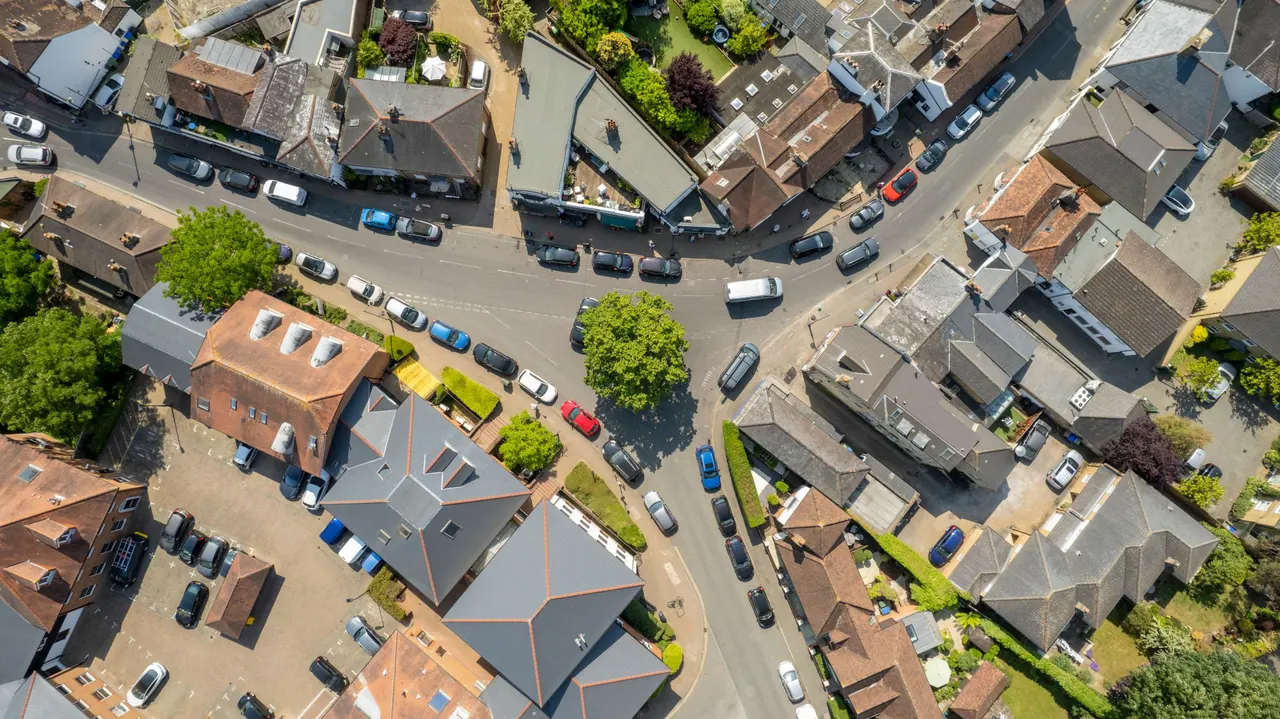
Near North Parade, the post-war Bray Court mansion blocks raise the same problem. Nobody can see the top of a roof like that from the pavement, and a ladder is no help. A drone flight around the block gives close photos of the ridge, the valleys, any flat sections and the gutters, and we mark on the photos which part of the roof sits over which flat.
On a shared roof, the lease decides who pays for a repair, not the roofer. What we can do is give the freeholder, managing agent or council the same clear evidence you get, so the repair is agreed sooner. Gutters on these blocks are often shared as well, which our page on gutter repair for Chessington maisonettes covers.
Suntrap houses and curved bays on Rhodrons Avenue
Rhodrons Avenue has some of the more unusual 1930s houses in Chessington: "suntrap" designs with curved bays and rendered walls. A curved bay usually carries its own small roof, and the joint between that roof and the wall above is easy to miss. Render also hides damp for longer than brick does, so a leak at the bay may only show as a hairline crack or a bubble in the finish.
On these houses we look closely at the bay roofs, and at any parapet or flat section a house may have, as well as the main tiles. The oriel windows and tile-hung gables on nearby Moorfield Road get the same attention, because the small roofs over windows are the parts most often overlooked in a quick visual check.
Under the tiles of a 1950s semi
On the 1950s semis around Glen Road and Cumberland Drive, the loft often says more than the outside. Daylight through the tiles, damp on the timbers and felt underlay that has torn between the rafters all show there first. Our main roof inspection page sets out the full checklist.
If the covering is near the end of its life, we say so and point you to our advice on re-roofing in Chessington rather than suggesting repair after repair. For a sense of the market, MyJobQuote's roof survey cost guide lists drone surveys at around £200 to £350 nationally. If winter is coming, our list of signs a roof needs work before winter is worth reading first.
Frequently asked questions
Our Frimley Road maisonette shares one long roof with the neighbours. Can you report on just our part?
Yes. We fly the whole run so we can see how water moves across it, then focus the report on the section over your home and anything that drains onto it. Faults next door that could reach you are flagged too, because rain does not stop at a boundary line.
Can the drone see the curved bay roof on a Rhodrons Avenue suntrap house?
Yes. A curved bay roof is awkward to reach from a ladder, and its joint with the wall above is hard to see from the street. The drone photographs it from above, along with any parapet or flat section, so we can show you where water could get in.
I am buying a 1950s semi on Glen Road. What would make you say it needs a new roof?
Brittle or torn felt across the loft, battens that are soft in several places, and tiles slipping on more than one slope. One or two of those can be repaired. All three together usually mean the covering is close to the end, which is worth knowing before you agree a price.
Is the chimney stack part of the inspection?
Yes. Stacks on Chessington semis often sit on the party wall, so we photograph both faces, the flaunching round the pots and the flashing where the stack meets the tiles on each side.





