



 Google reviews

Original gutters on the Chantry Road East estate
Chantry Road East was planned in the 1970s and 80s as one estate, with main estate roads and cul-de-sacs, houses mostly in small terraces on small plots, and long views east towards the Epsom Downs. Ranyard Close is 1980s terraces with open-plan frontages on a narrow street.
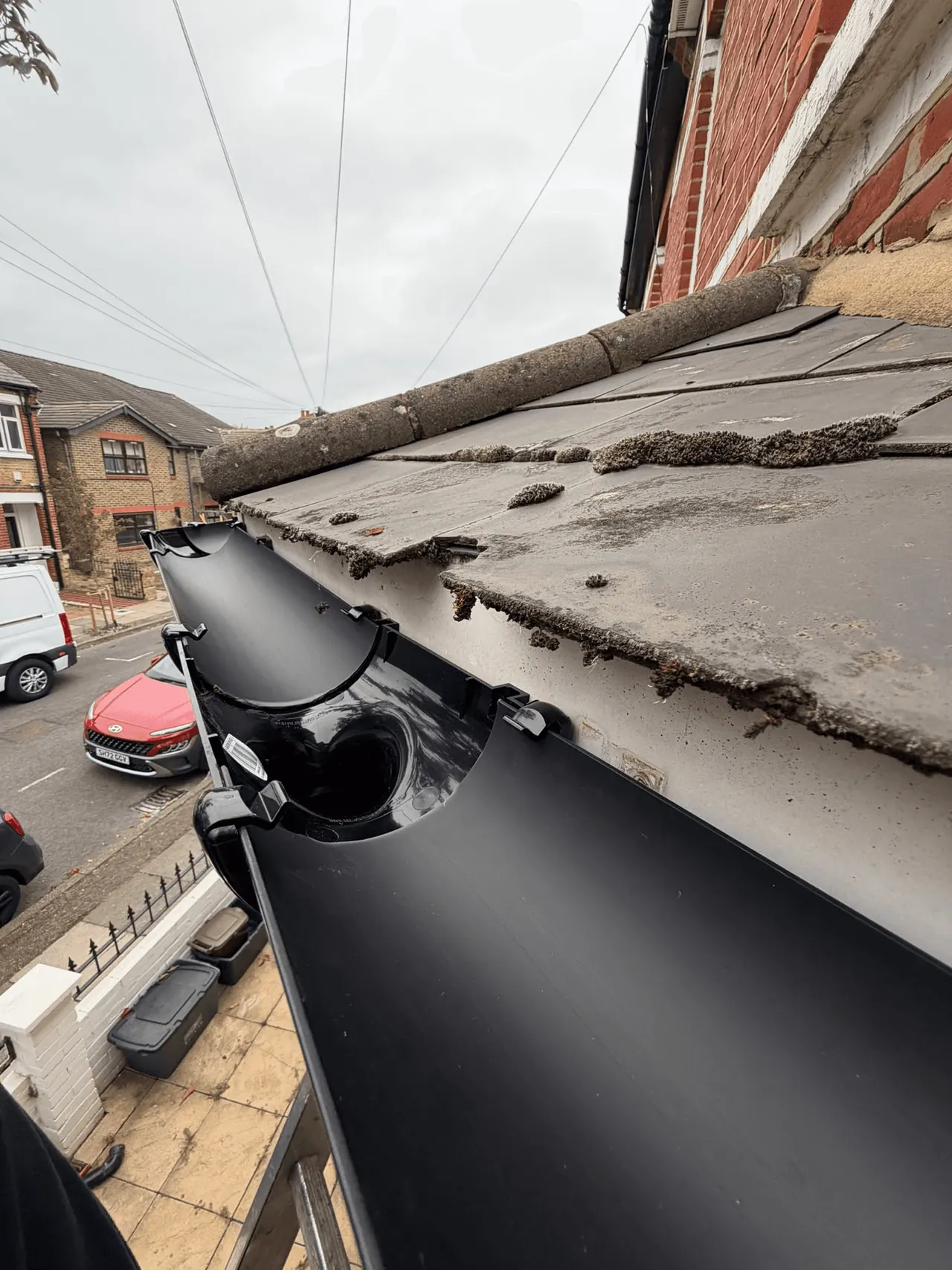
Where a sectional gutter from that time is still in place, its union joints are usually what fails: each one has a seal, and those seals have now been through decades of summers and frosts. When the whole run is due for replacement anyway, a seamless run removes the joints along the straight lengths, leaving joints only at corners and outlets.
The fascias on houses of this age are often the original timber or an early uPVC, so we look at them before anything else. A seamless run is rigid and long, and it needs a sound, straight board along its full length.
Open-plan fronts on Ranyard Close
Ranyard Close has open-plan frontages and planting in the front gardens rather than walls or hedges, so the front of each house is on show from the street, roofline included. On a row like that, one house with a new gutter in a different colour or profile stands out more than it would behind a front hedge. Seamless aluminium comes in a range of colours, so it is worth looking at what the neighbours have before choosing. If the rest of the row is white uPVC, a white aluminium run keeps the terrace looking like one building.
Because the fronts are open, any downpipe that has been cut short above the ground or misses its gully shows as a wet patch on the paving, and a new system is the time to reconnect it properly.
Glen Road semis around the open space
Glen Road, in the north of the area, has 1950s semis and short terraces laid out around a large central open space. Semis like these have a front and back eave on each half, usually with one corner at a hip or a gable end, so a seamless run per side covers most of the roofline.
Where only one half of a pair is being done, the run stops at the party wall line with a neat joint into the neighbour's gutter. If both owners go ahead at the same time, the outlets can be planned so the two halves drain evenly.
Seamless is not always the best answer. On a house with lots of short runs and corners, such as a hipped terrace or a house with several bay gutters, it saves fewer joints, and a standard gutter installation in Chessington may be the better value. We show you on your own roofline where seamless removes joints and where it does not, and price both if it helps.
If the boards need renewing first, our fascia and soffit work in Chessington can be done in the same visit. Our main seamless gutter installation page explains how the runs are formed and fitted.
Frequently asked questions
Our Chantry Road East house has a garage roof below the main gutter. Can that be seamless too?
Yes. A garage or porch with its own straight edge can have a short seamless run with its own outlet. We also check that the main downpipe does not empty onto the garage roof, which is a common cause of wear on the deck below.
Our Chantry Road East terrace still has its original gutters. Should the whole row be done at once?
It helps but is not essential. On a small terrace, one run per house can be joined neatly to the neighbours at the party wall line. If two or three owners go ahead together, the runs and outlets can be planned along the whole front, so each house drains to its own downpipe.
Ranyard Close is a narrow street. Is there room to form the runs outside?
Usually. The runs are often formed on site to the measured length, so we need space to park and work near the house for part of the day. On a narrow close with open-plan fronts, a word with the neighbours about parking on the day makes it easier.





