



 Google reviews

Long back eaves on the wider houses
Stand in the garden of one of the wider semis or detached houses near Ewell Court Park and look at the rear gutter. On many of them it is a long straight run with no hip to break it, and on a house of this age it is rarely the system it was built with. Sections have been swapped as they failed over the decades: a length of plastic here, a new downpipe there, sometimes a piece of the original metal still sitting in the middle.
Each of those joins is a seal that ages, and where old meets new the profiles rarely match. That is where the drips start, usually over the back door or a patio. A seamless run is formed from a coil of aluminium to the exact length of the eave, so the long rear run has no joint along it until it reaches a corner or an outlet. Aluminium doesn't rust or turn brittle the way old plastic does, and comes in a coated finish.
For a long-term owner that is the main argument: one length that doesn't need resealing every few winters. It costs more to fit than uPVC, so it makes most sense on the runs that have given trouble and on houses you expect to stay in.
Joints you lose and joints you keep
Seamless doesn't mean no joints at all. Every corner and every outlet is still a joint, so the benefit depends on the shape of the roof:
- Long rear and front eaves between gables, where a sectional gutter would have several joints and a seamless one has none until the end.
- A run with a mixed old and new section that leaks every winter at the same place.
- Small hipped houses with short lengths between corners, where the gain over a well fitted sectional system is modest.
If yours is the last kind, a standard gutter installation in Ewell Court in uPVC or sectional aluminium may be the better spend. When we measure, we count the joints each option would leave, run by run, so you can compare.
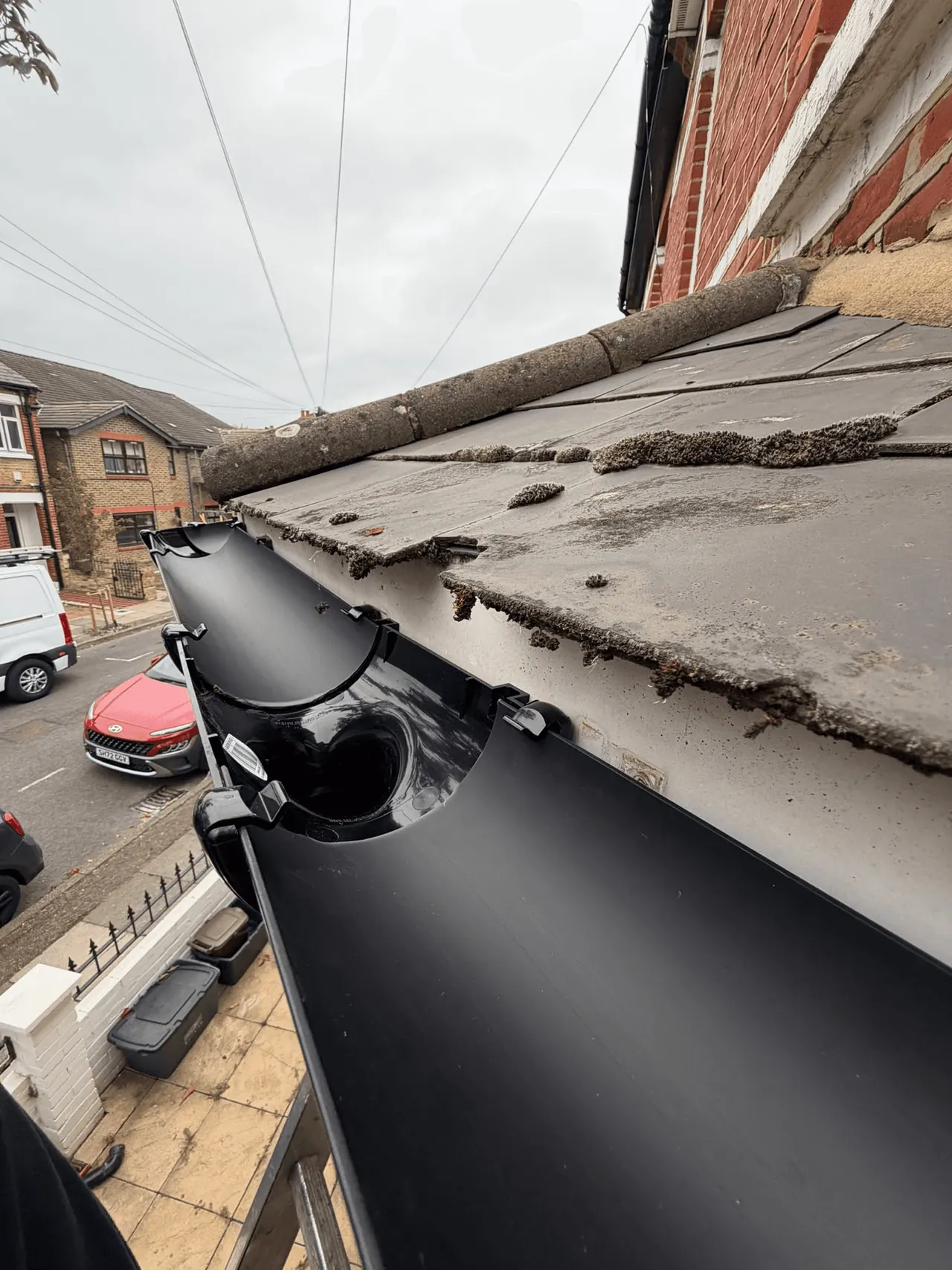
Under the trees round the lake
A seamless gutter still fills with leaves. On houses backing onto the park, the lake or the river path, the outlets and downpipes need clearing like any other gutter, and guards over the outlets can help. What changes is that a full gutter no longer has a joint along the run for the weight and the standing water to work open.
The board behind matters too. A new gutter needs sound timber to fix its brackets to, and on houses of this age the original fascias are often worth renewing at the same time; our fascias and soffits page covers that work. Our main seamless gutter installation page explains how the system is formed and fitted.
Frequently asked questions
Our semi near Ewell Court Park has old metal at the front and plastic at the back. Can we go seamless on one side only?
Yes, provided the two systems meet at a corner or outlet where the join can be made properly. The long rear run is often the one giving trouble, so it is a sensible place to start, with the front done later if you want them to match.
The back gutter on our house by the Hogsmill path drips at the same joint every winter. Would seamless stop it?
If the drip is at a joint along a straight run, yes: that joint would no longer exist. If it is at a corner or where the downpipe leaves the gutter, those remain joints in any system, and a repair to that one spot may be enough.
Our rear eave on Ewell Court Avenue runs behind an extension roof. Can one length still go on?
Often, if the eave itself is continuous. Where an extension roof meets the main wall under the gutter, we check how its water joins the main gutter and place an outlet or a stop end there, which can mean two lengths instead of one.





