



 Google reviews

A 2009 warning from the west end of the High Street
When Epsom and Ewell Borough Council wrote its town centre conservation area appraisal in 2009, it recorded the Albion pub at the west end of the High Street as at risk. The reason was not a dramatic failure. It was leaking drainpipes, which had caused damp patches and plants growing out of the side walls. That is a 17-year-old snapshot of one building, and its present condition is not something we have checked, but the pattern it describes is common in the town centre.
The street side of a building is hidden behind shop signs and fascias. The back faces a yard or an alley lined with bins, where nobody stands and looks up. A joint drips, the wall below stays wet through every winter, and by the time anyone notices there is green staining, vegetation in the brickwork and damp inside.
Skips, bins and narrow yards behind the shops
The same appraisal lists side alleys and yards with overflowing skips and rubbish containers among the town centre's negative features. Gutters and downpipes there take knocks that a house never sees. The faults that tend to show up on town centre buildings:
- Knocked and disconnected downpipes. Bins, delivery cages and skips catch the lower lengths and pull them off their clips or out of the drain connection.
- Cracked cast iron. Old cast iron lasts a long time, but joints rust and open up, and a section holding water can split in a hard frost.
- Failed hopper joints. Where a parapet gutter drains through the wall into a hopper head, the joint between outlet and hopper is a common leak.
- Brackets loose in soft mortar. On old brick, brackets driven into the joints work loose, the run sags and water collects at the low point.
- Perished seals on later plastic. On uPVC replacements, the rubber seals between sections dry out and drip.
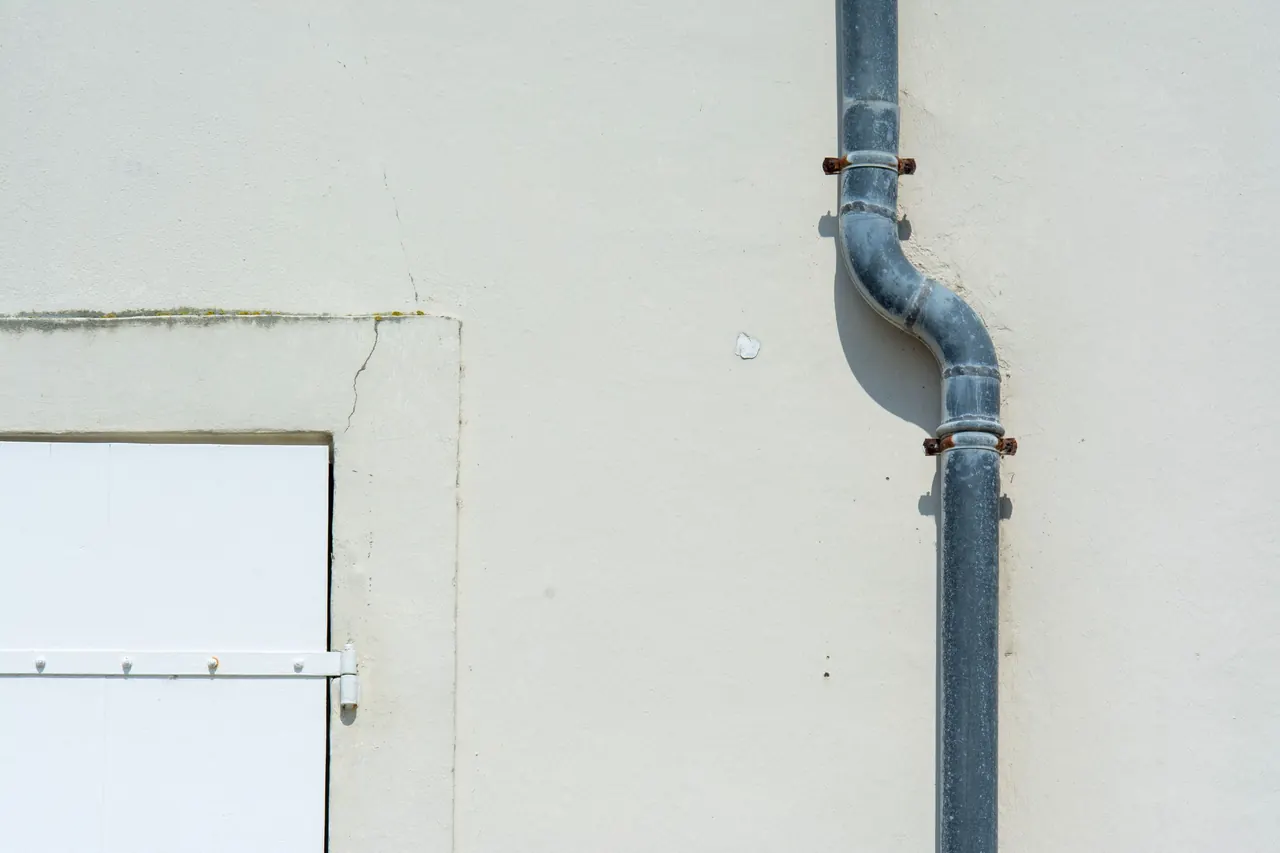
Cast iron in the Epsom Town Centre Conservation Area
On most of the older buildings in the conservation area, repair is the right first answer. A leaking cast iron joint can be taken apart, cleaned and resealed. A cracked length can be replaced with a matching cast iron section. A missing bracket can be replaced so the fall is restored. Patching cast iron with a plastic length is the kind of change the appraisal's call for traditional materials is meant to discourage, and on a listed building it would be an alteration.
Age still matters. MyJobQuote's gutter repair guide gives metal gutters such as cast iron a life of up to 50 years with proper care, against up to 25 for uPVC. Where a run is leaking at joint after joint, a new gutter installation for a listed front may be better value than repeated repairs.
Looking past the one drip on a tall building
We look at the whole run rather than the one drip, because a leak at one point often starts with a sag or blockage further along. On taller buildings, the gutters and the roof edge can be checked by drone first, so access is only arranged where it is needed. We are a family firm of over 20 years, and the quote costs nothing.
Water that has run behind a gutter for years often rots the timber it is fixed to, which our fascia and soffit service deals with. If the gutter is overflowing because it is choked rather than broken, the blocked gutter page is the one to read. For a leak that seems to come from behind the gutter itself, our article on water leaking behind a gutter explains the usual cause.
Frequently asked questions
The downpipe in the yard behind our High Street shop has been knocked off. Is that a big job?
Usually not. Refixing or replacing the lower lengths, fitting new clips and reconnecting the shoe or drain is a short job, as long as the yard can be kept clear while we work.
Plants are growing out of the side wall of our building off the High Street. Is the gutter to blame?
Very likely. Plants in brickwork mean the wall has been wet for a long time, and a leaking joint or downpipe above is the usual cause. We find the leaking point and repair it, so the wall can then dry out.
Green stains run down the wall under the hopper on my flat's building in South Street. What does that mean?
The hopper, or the joint where the parapet outlet feeds into it, is leaking or overflowing. We check whether it is cracked, blocked or undersized and repair or replace it to match.





