



 Google reviews

From Whitehall to the Harrow: what the roofs are made of
Cheam Village is the small old core of Cheam, gathered round the crossroads where The Broadway, the High Street, Ewell Road and Station Way meet. It runs north up Malden Road to St Dunstan's, west along Park Lane, and south down Station Way to the railway bridge. If you live in the wider SM3 area, including the Burton estates of South Cheam, our Cheam roofers page covers those streets. This one is about the village, where the roofs are older and more varied than anywhere else in SM3.
The oldest roof in the village belongs to Whitehall on Malden Road, a Grade II* timber-framed house of around 1500 with a crown-post roof, now a museum. Lumley Chapel in St Dunstan's churchyard is older still as a building, and Sutton Council's appraisal calls it the oldest surviving building in Cheam. Around them sit roofs from every century since:
- Weatherboarded cottages, 17th to early 19th century. Malden Road, the south side of Park Lane and Park Cottages on Ewell Road. Most are white weatherboard under steep roofs of handmade clay tiles, with the odd slate roof among them.
- Victorian and Edwardian terraces. Ivy Cottages of 1881 on Church Farm Lane, Wildes Cottages of about 1890 on Ewell Road, the Jubilee Road terrace and the Edwardian semis opposite the Red Lion on Park Road, with bays and hanging tiles.
- The 1920s and 1930s rebuild. The mock Tudor parades on The Broadway and Ewell Road, the Harrow pub of 1933, the former Express Dairy of 1930 (now Wells Court and Fitzalan Court), Tabor Court flats and the Arts and Crafts villas on Parkside.
- Later infill. 1960s terraces on Springclose Lane and The Leeways, 1970s maisonettes and flats, Rushmore Place from the 1990s and the 2016 Elizabeth House redevelopment.
That spread is why we never arrive with a fixed idea of what is wrong. A slipped tile on a 300 year old cottage, a failed valley on a 1930s shop and a split felt roof on a 1960s garage are three different jobs that happen to sit a few minutes' walk apart.
Listed, locally listed or just in the conservation area
Sutton Council's 2021 appraisal and management plan for the Cheam Village Conservation Area is the best record of the buildings here, and we lean on it throughout these pages. The area was designated in 1970, which makes it the third oldest of the borough's conservation areas. It was extended in 1994 to take in Tabor Court and the south side of Ewell Road, and again in 2018 to add the Jubilee Road terrace.
For roof work, buildings fall into three groups, and the rules differ for each:
- Statutory listed buildings, such as Whitehall, the Park Lane and Malden Road cottages, the Old Rectory and the Old Farm House. Repairs in matching materials are the norm. Anything that changes the character of the roof, from a new covering to a removed stack, needs listed building consent. Owners are also responsible for keeping these buildings wind and watertight, and the council can serve a Repairs Notice if one is neglected.
- Locally listed buildings, such as most of The Broadway parade, The Old Forge on Station Way and the Railway Inn. No listed building consent is needed, but the council wants their character kept.
- Everything else inside the boundary. Like-for-like repairs are rarely a planning matter. Changes that alter how a roof looks, and loft conversions, which lose their permitted development rights in a conservation area, need checking first.
We will tell you which group your building is in and whether we think a job needs the council's view before anything starts.
Two things matter more here than the paperwork. The first is matching: handmade tiles differ in size, colour and camber from machine-made ones, so on the old cottages we keep every sound tile and source close matches for the gaps. Our roof repair page for the village covers that work. The second is restraint. On a roof that has settled for two or three hundred years, a good repair works with the shape it has rather than trying to straighten it.
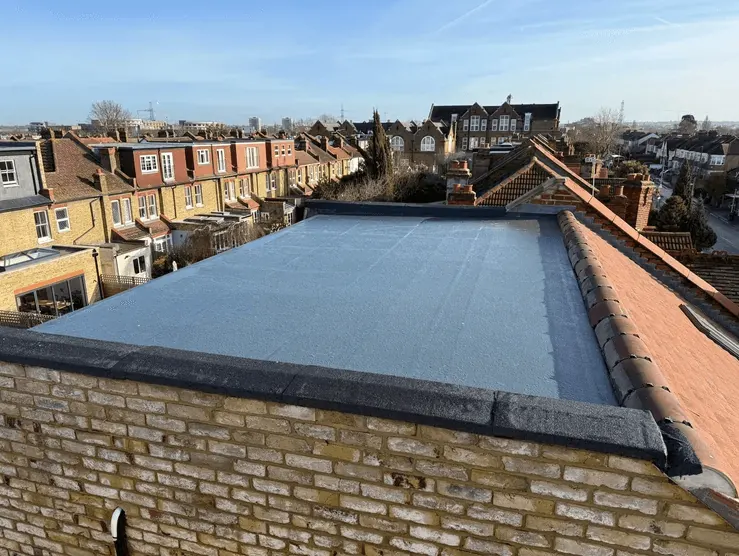
Shops, flats, trees and narrow lanes
The village is also a working shopping centre. Above many shops on The Broadway, the High Street and Station Way there are flats, so a roof or gutter problem can reach a tenant upstairs and a business below at once. Roof work there is planned around opening hours and a busy footway, and the scaffold, if one is needed, has to leave the pavement usable. If a whole parade roof is worn out, our page on re-roofing in the village explains how that runs.
Park Lane is narrow, with listed cottages close to the road, so access for ladders, materials and waste needs thought. Many rear slopes face back gardens and cannot be seen from any street at all, which is where a drone inspection helps: we photograph every slope and stack before deciding whether anyone needs to go up.
Then there are the trees. The north side of Ewell Road is tree-lined, Parkside has large trees in its back gardens, and the Old Rectory sits behind a walled garden with fine trees of its own. Gutters and valleys near them fill quickly in autumn, and our gutter cleaning page for the village covers when to book. If a tree overhangs your roof, the conservation area rules on cutting it back are set out on that page too.
The ground is not flat either. Whitehall and St Dunstan's stand on top of a rise, Park Lane drops west towards Cheam Park, and Station Way slopes south to the bridge.
We are based on Kenley Rd in Morden, about 3.3 miles away. To arrange a visit, call 0330 133 4111 or use our contact page.
Frequently asked questions
Is my house inside the Cheam Village Conservation Area?
Park Lane, Parkside, the listed end of Malden Road, The Broadway and the crossroads are all inside it, as are Tabor Court, the south side of Ewell Road and the Jubilee Road terrace. Elsewhere the line is irregular, and only parts of Station Way and Park Road are covered. Check Map One in the council's appraisal document, or ask Sutton's planning team, before assuming either way.
My Park Lane cottage is listed. What does keeping it wind and watertight mean for the roof?
In practice it means not letting small faults run. Slipped tiles, cracked flashings and blocked gutters on a timber-framed building let water reach the frame and the weatherboarding, and that damage costs far more to put right than the original fault. A yearly look at the roof and gutters is a sensible habit.
Can you work on the roof of a locally listed shop on The Broadway without closing it?
Usually, yes. We plan the access and any scaffold so the shop door and pavement stay usable, and agree times with the shop and the flats above before we start.
Are the Parkside villas listed?
No. The council's appraisal recognises them for their group value rather than listing them individually, so like-for-like roof repairs are straightforward. Changing their steep tiled roofs, stacks or boarded gables in a way that alters the look is where it is worth checking first.





