



 Google reviews

Eaves that dip on Malden Road
If the gutter on an old Malden Road cottage drips at the same joint every winter, however often it is resealed, look at the eaves above it. The listed cottages at 3 and 5 to 9 Malden Road are 17th and 18th century, white timber under red tiled roofs that Sutton Council's conservation area appraisal describes as uneven because they sag with age. Nobody would want them straightened. But a gutter is a straight thing, and it does not suit a wavy eaves.
When the eaves line dips, a gutter fixed along it follows the dip. Water collects in the low spot instead of running to the outlet. The joint nearest the low spot takes the weight of standing water, silt settles there, and sooner or later it drips. Reseal the joint and it will drip again, because the cause is the shape of the run, not the seal.
Many old cottages here also have no fascia board in the modern sense. The brackets are fixed to rafter feet or into the wall, often refixed several times over the years, and each refix leaves a slightly different line. On these buildings a good repair starts by stringing a line along the whole run and seeing where it actually falls.
What the drips land on
A leaking gutter matters more on some walls than others, and the village has most kinds:
- White weatherboarding on the Malden Road, Park Lane and Ewell Road cottages. A constant drip keeps the boards and the timber frame behind them wet.
- Roughcast on the Red Lion on Park Road and on Nos 21 to 25 Park Lane. Water behind a crack in render can sit there for months.
- Hanging tiles on the Edwardian semis opposite the Red Lion. Overflow runs behind the tiles and soaks the battens.
- Soft old brick on the late Victorian cottages north of the library, many in yellow London stock, which takes on water and stains green.
A green streak down a wall, a damp patch inside just below the ceiling, or a splash line on the ground are all worth acting on. Our article on water leaking behind a gutter explains a fault that is easy to mistake for a roof leak.
Fixing the run, not just the joint
On a sagging run we adjust or reposition every bracket along the length so the gutter falls steadily to its outlet, even if the eaves above it does not. Then we deal with the rest:
- resealing or replacing failed joints
- replacing cracked sections in a matching material and profile, cast iron where the cottage has cast iron
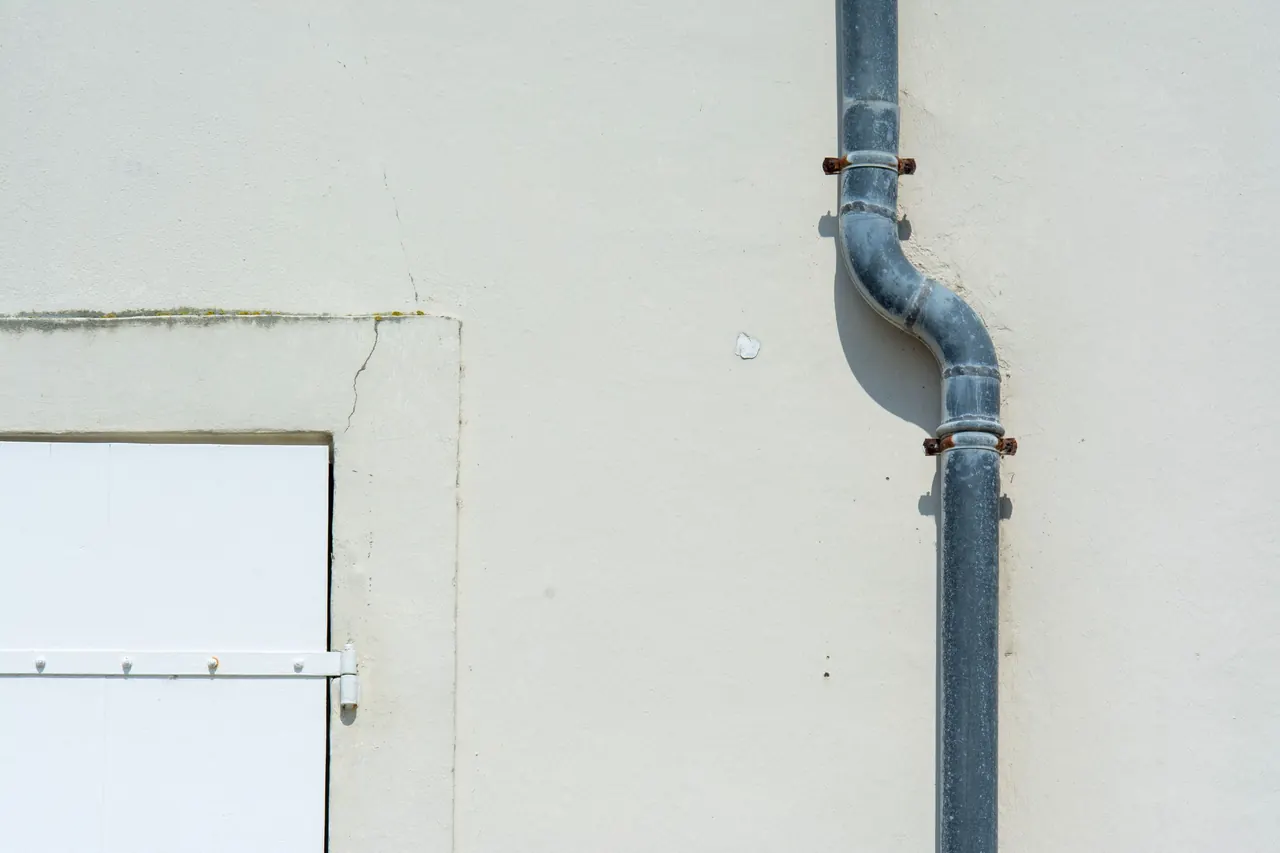
- refixing downpipes that have come away, so water goes to the drain
- clearing any build-up that has added weight
We run water through at the end so you can see it reach the outlet. On a listed cottage we repair like for like and avoid mixing plastic into a cast iron run.
Resetting a whole sagging run takes longer than resealing a joint, and the price reflects that. The UK average for a gutter repair is around £215 in MyJobQuote's 2026 guide, which is a national figure for a simpler job.
Soft boards behind the gutter are a separate job, explained on our village fascia and soffit page. If the gutter itself is brittle or too small for the roof, new gutters may be better value. Joints, brackets and downpipe repairs in general are covered under gutter repairs.
Frequently asked questions
The gutter on our Malden Road cottage has a belly in the middle. Can it be straightened without touching the roof?
Usually, yes. The roof stays as it is. We reset the brackets so the gutter runs on its own line to the outlet, which may mean it sits slightly lower at one end than the eaves suggests.
The hanging tiles on our Park Road semi are stained under the gutter. Is it the gutter or the roof?
Most often the gutter, either a joint dripping or water overshooting the back edge. We check both the gutter and the bottom course of roof tiles before deciding.
Our cottage has no fascia board. Can a gutter still be fixed properly?
Yes. Rafter brackets or wall-fixed brackets are the traditional way on cottages like these. We use the right fixing for your building rather than adding a board that was never there.





