



 Google reviews

Peg tiles that crack under a knee
A handmade peg tile is thinner at the edges than a modern tile, and old slate is just as brittle. Kneel on either to look at a ridge and you can break the thing you came to assess. The roofs around Park Road, Mint Road and Woodmansterne Lane are among the oldest in the area, and several of the houses are listed. Rosehill on Park Road, a mid-18th century house, sits under a plain tile mansard, and Woodmans Cottage further along has double valley plain tile roofs over weatherboarded walls.
Reigate and Banstead Borough Council's draft appraisal of the conservation area describes the pre-Victorian roofs as gabled peg tile at about 50 degrees, and the mid-Victorian ones as low hipped slate. A 50 degree slope cannot be walked at all without ladders and boards. For an inspection, that is the wrong trade.
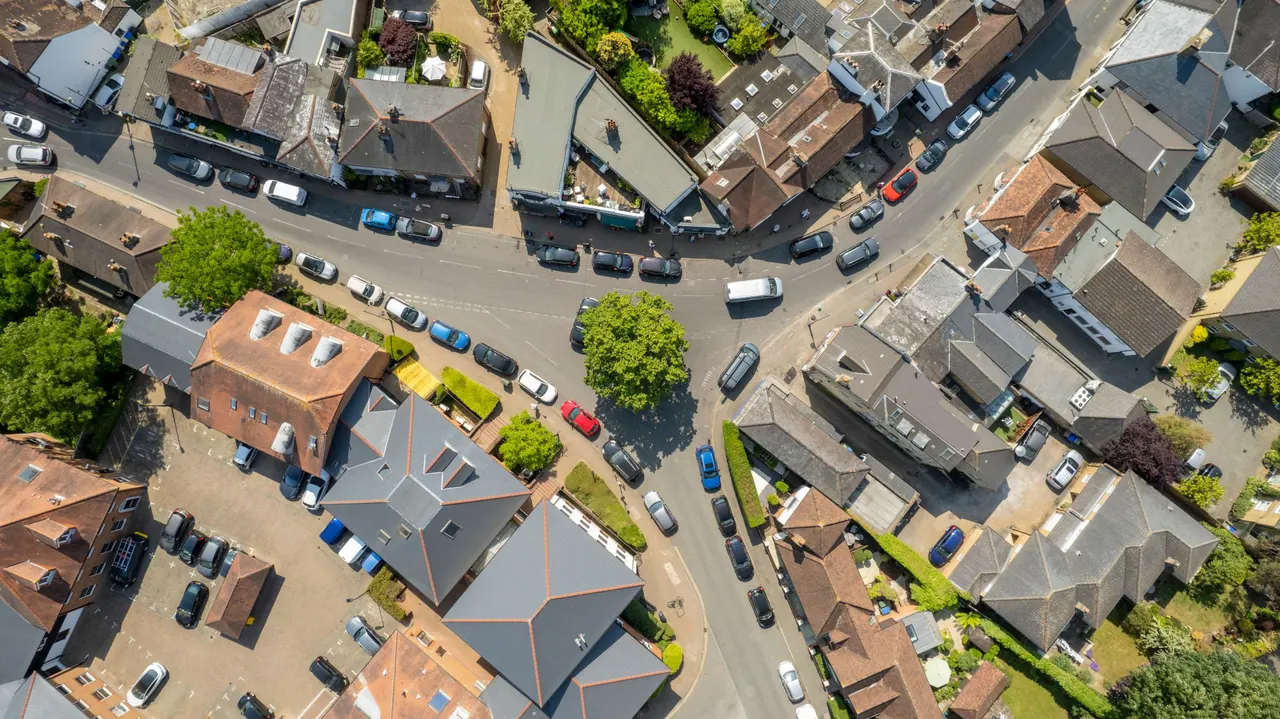
So on village roofs the camera goes up instead of a person. The drone gets close enough to show slipped and cracked tiles, open joints at the ridge, lead that has lifted at a chimney and moss packed into the valley of a double roof, and nothing on the roof is disturbed.
Rear slopes on Nork's hipped houses
West of the A217 the problem is different. After the Nork estate was sold in 1923, builders bought plots one at a time, so the interwar houses around Nork Way were not built to one pattern. Hips, valleys, bay roofs and tile types change from one house to the next, and each roof has had its own repairs since. A neighbour's new roof tells you nothing about yours.
The slopes that cause trouble on a big hipped Nork house are usually the rear ones, which you cannot see from the road or from the end of a long garden. That is also where the valleys collect leaves from the trees behind, and where a garage or kitchen extension often hides a flat roof of its own. Our guide on having a roof checked before you buy covers what a standard survey tends to leave out.
Reading a Banstead loft
Where there is a hatch, the loft finishes the picture. On an interwar Nork roof, look for torn or brittle early felt at the eaves, or no underlay at all, and for battens that have gone soft where a tile has been slipping. On a village cottage, the underside of a peg tile roof often shows daylight between tiles, which is normal for that kind of roof. The question there is whether the timbers below are dry. A dark patch on a rafter points to a slope, and the photo of that slope shows the cracked tile or open joint above it.
Simranjeet, our Roofing Surveyor, goes through the footage with you and explains what is sound, what needs watching and what needs fixing. Before flying, the wind, the trees and any overhead cables are checked, and if conditions are not safe on the day the visit is rearranged.
If a fault turns up, the usual next step is a Banstead roof repair. If the covering is worn across the whole roof, our page on re-roofing in Banstead explains what that involves. The main roof inspection page has more on how a survey runs.
Frequently asked questions
Will you need to walk on the peg tiles of my house on Park Road?
Not for an inspection. The drone shows cracked, slipped and missing tiles and lifted lead closely enough to judge them, so the old roof is not put at risk just to look at it. If a repair is needed later, boards and ladders spread the load.
I am buying an interwar house in Nork. Can it be inspected before I exchange?
Yes, with the owner's permission. Tell us your timescale when you call. Every slope is photographed, the loft is checked if there is safe access, and you go through the findings so you know what you are taking on before you commit.
Does a listed building on Park Road need consent just for an inspection?
No. Looking at a roof does not change it. Consent questions only come up if the inspection leads to work that alters the building, and on a listed house it is worth asking the council before any repair that goes beyond like for like.
My Nork house has a flat-roofed garage behind it. Is that included?
Yes. Garage, extension and dormer roofs are photographed along with the main roof. Flat coverings wear out much faster than tiles, so on an older house they are often the first thing on the property to need work.





