



 Google reviews

Keeping the stacks of Park Road and Mint Road
A crumbling stack on a village cottage is usually a repair job, not a removal. Reigate and Banstead Borough Council's appraisal of the Banstead Conservation Area asks residents to retain features such as chimneys and chimney pots, and to use appropriate materials when repairing older buildings. The council's own guidance adds that a satellite dish on a chimney stack in a conservation area needs its consent.
The village stacks are varied. The listed houses on Park Road include end stacks on Park Cottage, two stacks rising off the ridge behind Woodmans Cottage, and ridge and end stacks on the mansard-roofed Rosehill. The brick and flint artisan cottages nearby date mostly from the early and mid 19th century, so their stacks have been weathering for well over a century.
Soft brick and hard cement
Old brick is softer and more porous than modern brick. When a stack like that is repointed in hard cement mortar, the joints stop letting moisture out, so the water leaves through the face of the brick instead. Frost then lifts the face off, a little more each winter, and the bricks spall while the cement joints stand proud. From the ground it looks like the brick is the problem. The pointing is the cause.
The repair is to rake out the hard joints carefully and repoint in a softer mortar suited to the brick, then reset or rebuild any courses that have lost their faces. On a listed house the council may want to agree the mix. On a steep 50 degree peg tile roof, access is planned so the old tiles around the stack are not broken on the way up.
Back gutters behind Nork stacks
Nork's interwar houses were put up by many builders, so their stacks vary: a shared stack on the party wall of a pair of semis, a stack rising partway down a slope on a detached house, a tall stack at the gable end. Most have had at least one round of repointing or new flashing, not always well done.
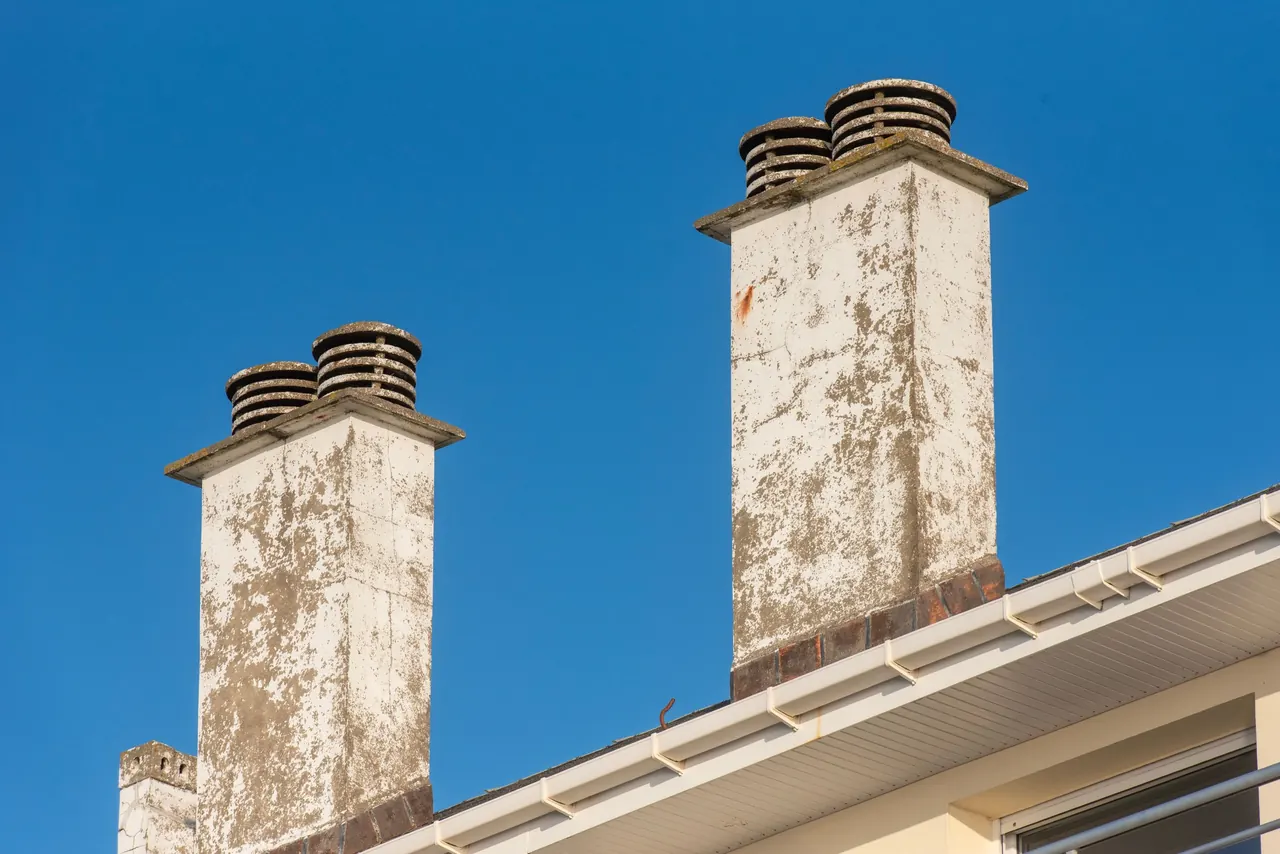
A stack that rises out of a slope has a small back gutter behind it, and in Nork's tree-filled gardens that fills with leaves, needles and moss, then overflows into the roof. The result looks like a chimney leak and is really a blocked gutter the size of a shoebox. Clearing it is the first step. If the lead there is worn or laid too flat, re-forming it in new lead stops water backing up under the tiles.
The other faults are lead flashing lifted by wind or split by movement, flaunching round the pots cracked so water gets in and the pots loosen, and old mastic smeared over joints, which looks fine from the ground and leaks in driving rain. A leaning pot needs dealing with quickly. Where a flue is no longer used, a ventilated cowl keeps rain and birds out while letting air through.
The stack is photographed on all sides by drone first, which shows whether the job can be done from roof ladders or needs a scaffold round the stack. As a guide, MyJobQuote's chimney flashing guide lists £150 to £250 for a patch repair to the leadwork and £350 to £460 for full replacement, both national figures without scaffolding. Our chimney maintenance guide lists what to check on a stack each year. If the leak turns out to be in the tiles around the stack, our Banstead roof repair page covers that, and the main chimney repairs page explains the work in more detail.
Frequently asked questions
Can I fix a satellite dish to my chimney in the Banstead Conservation Area?
Not without asking. Reigate and Banstead Borough Council says a dish on a chimney stack in a conservation area needs its consent. Outside the conservation area the rules are looser, but check before fitting one.
The stack on my Park Road cottage has been pointed in hard cement. Does that matter?
It can. Hard cement on soft old brick traps moisture in the brick, which then spalls. Where that is happening, raking out and repointing in a softer mortar suited to the brick is the better repair, and on a listed house the council may want to agree the mix.
Leaves pile up behind the chimney on my Nork roof. How do I stop the leak?
Clear the back gutter behind the stack, then check that the lead there is sound and laid to fall. If it is worn or too shallow, re-forming it in new lead stops water backing up under the tiles. A clear-out each autumn after that keeps it working.





