



 Google reviews

The terraces off Abbeville Road
West of Clapham Park, the Lambeth side of Clapham South is mostly terraces on the side streets around Abbeville Road. Until the 1870s the south side of the common was lined with large houses in their own grounds, with farmland behind. Lambeth's character statement for Abbeville Road records that Clock House Farm was sold in 1875, that the southern end of Abbeville Road near Cavendish Road was laid out first, and that Hambalt Road, Narbonne Avenue and Shandon Road were laid out and lined with terraced housing during the 1880s.
On those terraces, many roofs are around 140 years old. Natural slate lasts well, but the iron nails, battens and valley lead holding it do not, and most of the faults that matter sit at the back, around the back additions and the party-wall stacks, where nobody sees them from the street. Many of these houses have also gained a loft dormer or a side return, which adds flat roofs and new junctions to an old roof. Our page on roof repairs around the back additions goes through what usually fails and how it is fixed.
Flats over the Abbeville Road shops
The shopping parades on Abbeville Road followed in the 1890s, the west side in the early part of the decade and the east side in 1894 and 1895. They have been a conservation area since 2003. All are yellow stock brick, and most are three storeys, with a shop below and two floors of flats above. Because individual builders put them up a few plots at a time, the roofs vary from block to block: hips, steep pitches, rows of small gables, corner turrets facing Shandon Road, and at Nos. 55 to 71 a parapet that hides the roof completely. A parapet roof is the one most likely to leak without warning, because its gutter cannot be seen from the street. Our blocked gutter repair page covers how those are cleared and fixed.
Lambeth's statement also notes that many parade roofs keep their original slate or clay tile, and that the concrete tiles put on some of them look bulky and uneven by comparison. If your parade roof is due for replacement, that is worth knowing before you choose a covering.
A parade building is usually shared: a shop, two or more flats, and a freeholder or managing agent. Agreeing a repair between them often takes longer than the repair itself. What helps most is a set of photographs that everyone can see, so the discussion is about the fix rather than about whether there is a problem. A roof inspection by drone gives you that without anyone needing scaffolding just to look.
Clapham Park, from Cubitt to the estate
East of Abbeville Road is Clapham Park. Thomas Cubitt took on over 200 acres of Bleak Hall Farm in the 1820s and laid out broad, tree-lined roads, now Kings Avenue, Clarence Avenue and Poynders Road, for large Italianate villas. The plan was never completed. Cubitt's own house, Lincoln House, was demolished in 1905, and Rodenhurst Road was laid out on its site with large double-fronted Edwardian semis.
After the Second World War, the London County Council rebuilt the northern part of Clapham Park in a Modern Movement style, and it became the largest single council estate in Lambeth. Some of the plots on the southern part were built up with terraced and semi-detached houses instead. From 2000 the area was Lambeth's New Deal for Communities neighbourhood, and since 2006 the estate has been run by a housing association, now Metropolitan Thames Valley. Agnes Riley Gardens, off Poynders Road, is the public park on its southern edge.
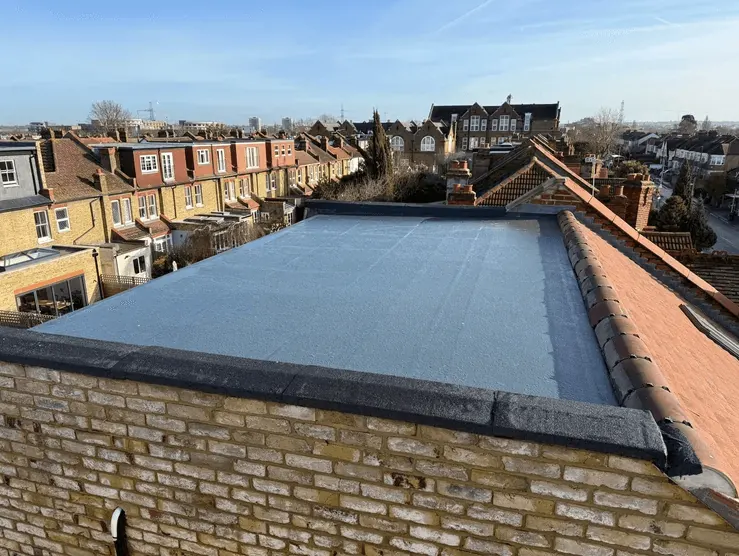
So in Clapham Park a roofer might be dealing with a big roof and several chimney stacks on an Edwardian semi, or flat roofs over the garages, porches and extensions of the later houses. Our Clapham South flat roofing page covers those, along with the side returns on the terraces.
At the far north end of Kings Avenue, towards Clapham Park Road, a few of the original early Victorian villas survive inside the Clapham Park and Northbourne Road Conservation Area. Lambeth's appraisal there lists natural slate, hipped roofs with overhanging eaves, impressive chimney stacks and original cast iron gutters as features to keep. That corner shades into Clapham proper, and repairs to the villas there follow that guidance.
The station, and where Balham takes over
The area takes its name from Charles Holden's 1926 tube station on the edge of Clapham Common, which stands in Wandsworth. The station and the streets west and south of it, along Nightingale Lane and towards Balham, are covered by our Balham pages. This page covers the Lambeth streets to the east.
We are Precise Roofing & Guttering, a family run firm on Kenley Rd in Morden, about 4 miles away as the crow flies. If you know what is wrong, the Clapham South service pages go into each job: chimney stacks on Rodenhurst Road, gutters and hoppers behind the terraces, fascias on the villas, and the rest. If you are not sure, start with an inspection and decide once you have seen the photographs. If water is coming in now, ring 0330 133 4111. Otherwise use our contact page and tell us your street, the type of house and what you have noticed.
Frequently asked questions
Is Clapham South in Lambeth or Wandsworth?
Both. The station building and the streets to its west are in Wandsworth. The streets this page covers, around Abbeville Road and in Clapham Park, are in Lambeth, mostly SW4, with parts of Clapham Park in SW2 and the southern edge in SW12. For planning and building control, the council that matters is the one your house is in.
Why do the roofs on Abbeville Road change from one block to the next?
Because the parades were built speculatively, a few plots at a time, by different builders. Lambeth's statement notes that some builders put up more than one terrace, so features repeat, but each block has its own roof form.
Is my house on Rodenhurst Road Victorian or Edwardian?
Edwardian. The road was laid out after Lincoln House was demolished in 1905, so the houses date from after that. That affects what the roof was originally covered with and how the stacks were built.
My address is near Clapham South station. Is it Clapham South or Balham for you?
Check which council sends your council tax bill. If it is Wandsworth, our Balham pages describe your streets. If it is Lambeth, this page and the Clapham South service pages are the ones written for your house.





