



 Google reviews

Buying a terrace off Abbeville Road
From the pavement, most of the terraces on Hambalt Road, Narbonne Avenue and Shandon Road look much alike: a front slope of slate, a ridge and a chimney. The roof that decides the bill is behind. Each house has a back addition with its own lower roof, a valley or flashing where it meets the main wall, a stack on the party wall and, on many, a loft dormer added decades after the house was built. None of that can be judged from the street, and a buyer's survey can end up noting only that the rear roof was not seen.
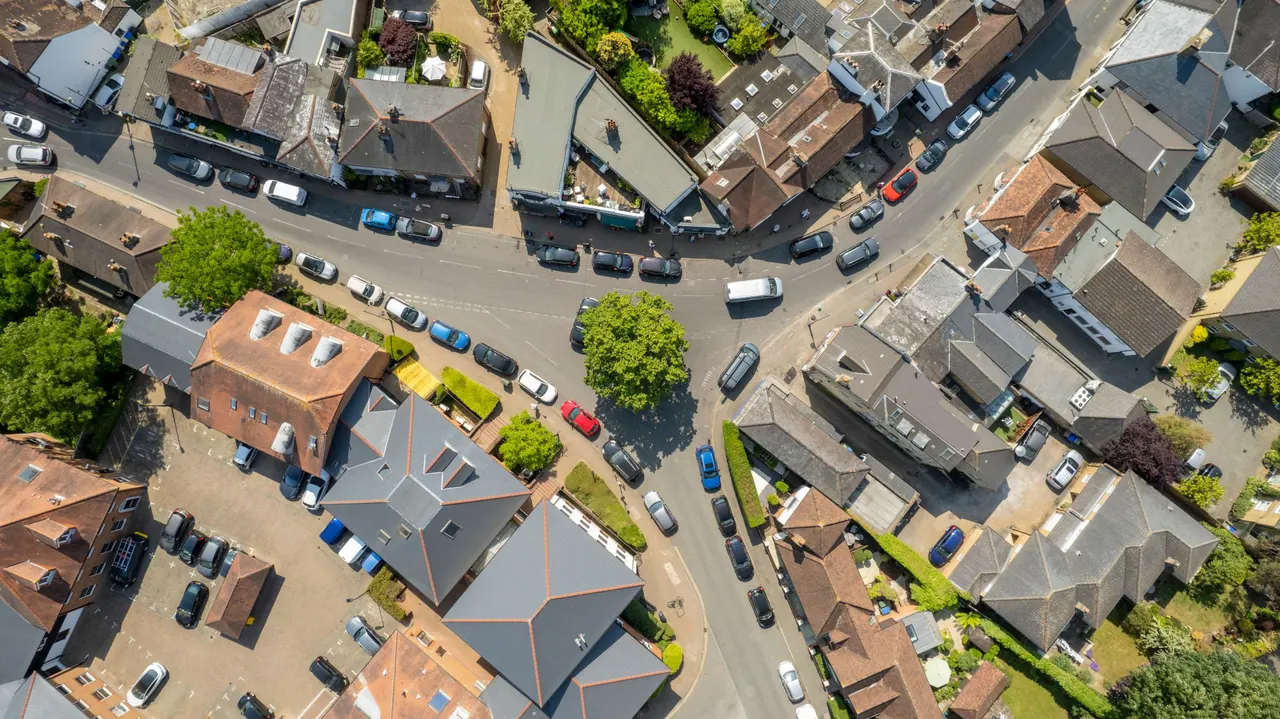
These streets were laid out in the 1880s, and a photograph of Narbonne Avenue from around 1908 in Lambeth's appraisal shows them tightly packed even then. With no side passage on a mid-terrace house, getting a ladder to the back means going through the house. A drone gets a camera over the rear slopes in one visit, without anyone climbing and without paying for scaffolding just to look.
The faults that turn up on roofs of this age are set out on our Clapham South roof repair page. The point of an inspection is different: it tells you which of them, if any, apply to the house you are buying, before you exchange.
What you receive
You get the photographs, taken slope by slope, so you can see the front, the back addition, the valley and the stack for yourself rather than taking our word for it. Where there is a loft, we go up and look at the underside: damp staining, daylight through gaps, the state of the battens and rafters, and wet insulation. Where the loft has been converted, we check the eaves cupboards and the top-floor ceilings instead.
The findings are written in three groups: what needs doing now, what can wait a year or two, and what is fine. For a buyer, that list is something to take back to the seller or the agent. For an owner, it is a way to plan the work in an order that makes sense. The main roof inspection page sets out the full checklist.
Parade flats with a roof you cannot see
The flats above the Abbeville Road shops sit three storeys up, under roofs that change shape from block to block. At Nos. 55 to 71 a parapet hides the roof completely, so the gutter behind it can fill and overflow with nobody on the pavement any the wiser. From above, the camera sees over the parapet to the slopes and the gutter, including whether the outlet is clear.
A parade roof is normally shared between the shop, the flats and a freeholder. A dated set of photographs gives them one record to work from; our roof replacement page explains how a shared re-roof is usually agreed.
Rodenhurst Road and the Clapham Park houses
East of Abbeville Road, Clapham Park mixes several eras. Rodenhurst Road is a street of large, double-fronted Edwardian semis. Further south, the later terraced and semi-detached houses on Clapham Park's southern plots have plainer roofs, with flat-roofed garages, porches and extensions alongside.
On these the first question is whether the covering is the original one or a later replacement, because that changes what to look for. A re-covered roof may have sound tiles and tired flashings. An original one may have the reverse. We also look at the flat roofs below the main slope, which are often in worse shape than the roof above them.
Frequently asked questions
My buyer's survey on a Narbonne Avenue house says the rear roof was not inspected. Can you look before exchange?
Yes. That usually means the surveyor could not see the back addition or the rear slope from the ground. We photograph them by drone and check the loft, and you get the photos and the now, soon and later list to take back to your solicitor or the seller.
Can you see the gutter behind the parapet on an Abbeville Road parade?
Yes. From above, the drone can see over the parapet to the roof slopes and the gutter behind it. If that gutter is already overflowing, our blocked gutter repair page explains what happens next.
My terrace on Shandon Road has a loft conversion, so there is no loft to look in. What can you check?
We check the outside by drone, then look at the eaves cupboards and the ceilings of the top room for staining. Damp along a wall under the dormer cheek usually points to the flashing on that side.
Is a Rodenhurst Road semi checked any differently from a terrace?
A double-fronted semi has a wider roof and longer gutter runs, and the other half of the pair shares the ridge. We photograph the whole roof, including next door's side of the shared ridge, so you can see whether a fault starts on your half.





