



 Google reviews

White-painted fascias by Canbury Gardens
A grey streak running down from a gutter joint across a white fascia is usually the first thing an owner notices on the riverside. The council's Canbury Gardens appraisal records that the older buildings along that stretch have white painted timber bargeboards, fascias and balconies, with red brick and some white render. Kept up, that timber looks crisp. Left a season too long, it shows every failure.
Painted boards rarely rot from the front. Water gets in behind: from a leaking gutter joint dripping onto the top edge, from rain driven in under a verge, or through a crack in the paint where two boards meet. The signs to look for are:
- paint that blisters and flakes in one spot while the rest is sound
- a gutter that has started to sag, because its brackets are losing grip in soft wood
- a fascia that gives when pressed with a thumb at the corner of the house
- gaps opening under the eaves where a soffit board has dropped or split
Very often a gutter fault started it, and a dripping joint mended early through our gutter repairs in Kingston can save the board behind it. Our post on water leaking behind a gutter explains the usual routes in.
Soffits that drop on Victorian houses
On the Victorian streets round the Fairfield, soffits are often narrow timber boards fixed to the feet of the rafters. When those rafter ends stay damp for years, under a leaking gutter or a slipped slate at the eaves, they soften and the soffit loses its fixings. One end drops first, which leaves a gap that birds and wasps soon find.
A dropped soffit is worth opening up rather than just nailing back. We take the board down, check the rafter feet behind, cut out and repair any rotten timber, and then fit the new soffit. Where the roof space is short of air, a ventilated soffit keeps it moving through the eaves.
Deep eaves and carved boards in Coombe Wood
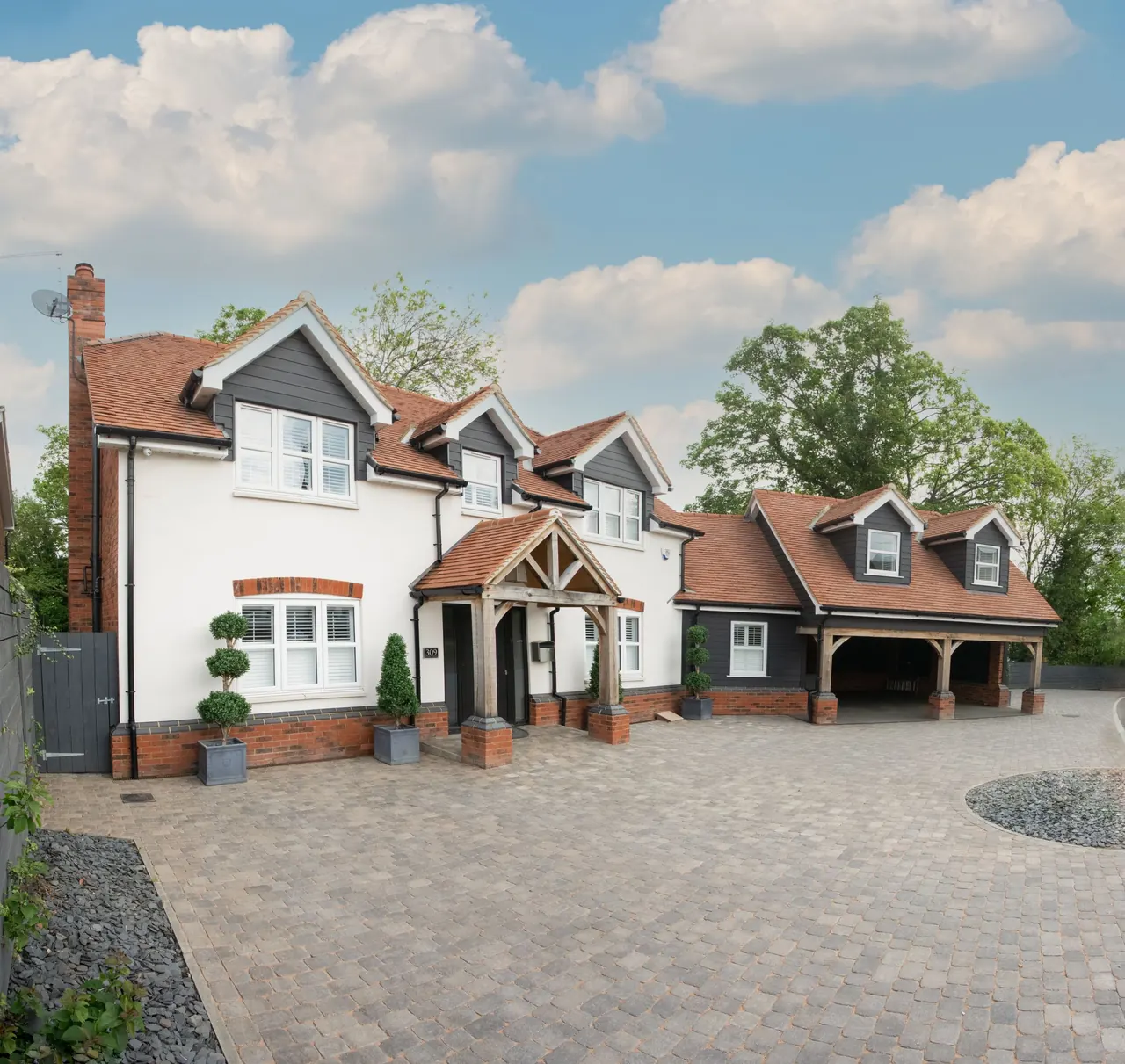
Up the hill, rooflines get grander. The council's page on the Coombe Wood conservation area picks out Ballard Coombe, first built in 1906 and rebuilt after a fire in 1927, for its deep sprocketed eaves and many gables, and Coombe Croft, finished in 1884, for its diapered brickwork and decorative bargeboards. On Kingston Hill the council's assessment notes a Victorian house called Fairlight, close to the road, with heavily carved bargeboards.
Sprocketed eaves kick out at the foot of the slope, so the fascia and soffit sit further from the wall and take more weather than on a plain eaves. On a house with many gables there is also a great deal of exposed timber: a bargeboard down both verges of every gable, and a fascia and soffit along every stretch of eaves. A drone roof inspection shows the state of all of it, including the gables at the back, before anyone prices a repair.
Where most of a carved board is sound, cutting out the rotten section and splicing in new timber keeps the carving. Plain uPVC in place of carved timber changes the look of a house like this a lot.
Capping, uPVC and the conservation areas
Covering existing boards with thin uPVC capping only works on timber that is completely sound; over rot it just hides the problem. Where the boards are soft along most of their length, or the gutters are coming down anyway, replacing the full run is better value. We take the gutters down, remove the old boards, put right any rot in the rafter ends, fit new fascias, soffits and bargeboards, and refit the gutters. uPVC comes in white, black, grey and woodgrain.
The Old Town, Fairfield/Knight's Park, Riverside North, Kingston Hill and Coombe Wood conservation areas have no Article 4 Directions, according to each area's page in the council's conservation area list, so a change of material isn't automatically controlled. Changing a visible elevation in one is still worth raising with the council first. Our main fascias and soffits page compares the options and the published national guide prices.
Frequently asked questions
A carved bargeboard on a Kingston Hill house has rotted at the bottom. Does the whole board have to go?
Not usually. The rot is often in the lowest part, where water runs off the verge. That section can be cut out and replaced in timber, leaving the carving above intact. If the pattern runs into the rotten part, we explain what can be matched before anything comes off.
Can painted timber fascias near Canbury Gardens be swapped for uPVC?
There is no Article 4 Direction in Riverside North, so the switch isn't automatically controlled, but the council's appraisal treats white painted timber as part of the riverside's look. If you are weighing up uPVC on the front, a word with the Royal Borough first is sensible. At the back, out of view, it is rarely an issue.
Why has the soffit on a Caversham Road house dropped at one end?
Usually because the rafter ends it is fixed to have rotted, or the board got wet and swelled off its fixings. We open it up, check the rafter feet, and repair that timber before fitting the new soffit.





