



 Google reviews

Austin Vernon's estates below Sydenham Hill
Below Sydenham Hill, Peckarmans Wood and Great Brownings are mid-century modern estates designed for the Dulwich Estate by Austin Vernon and Partners. They were built in a different spirit from the Village. Their eaves are plain, without the brackets, gables and decorative bargeboards of a Victorian or Edwardian house, and their windows and cladding are of their own time rather than copies of anything older.
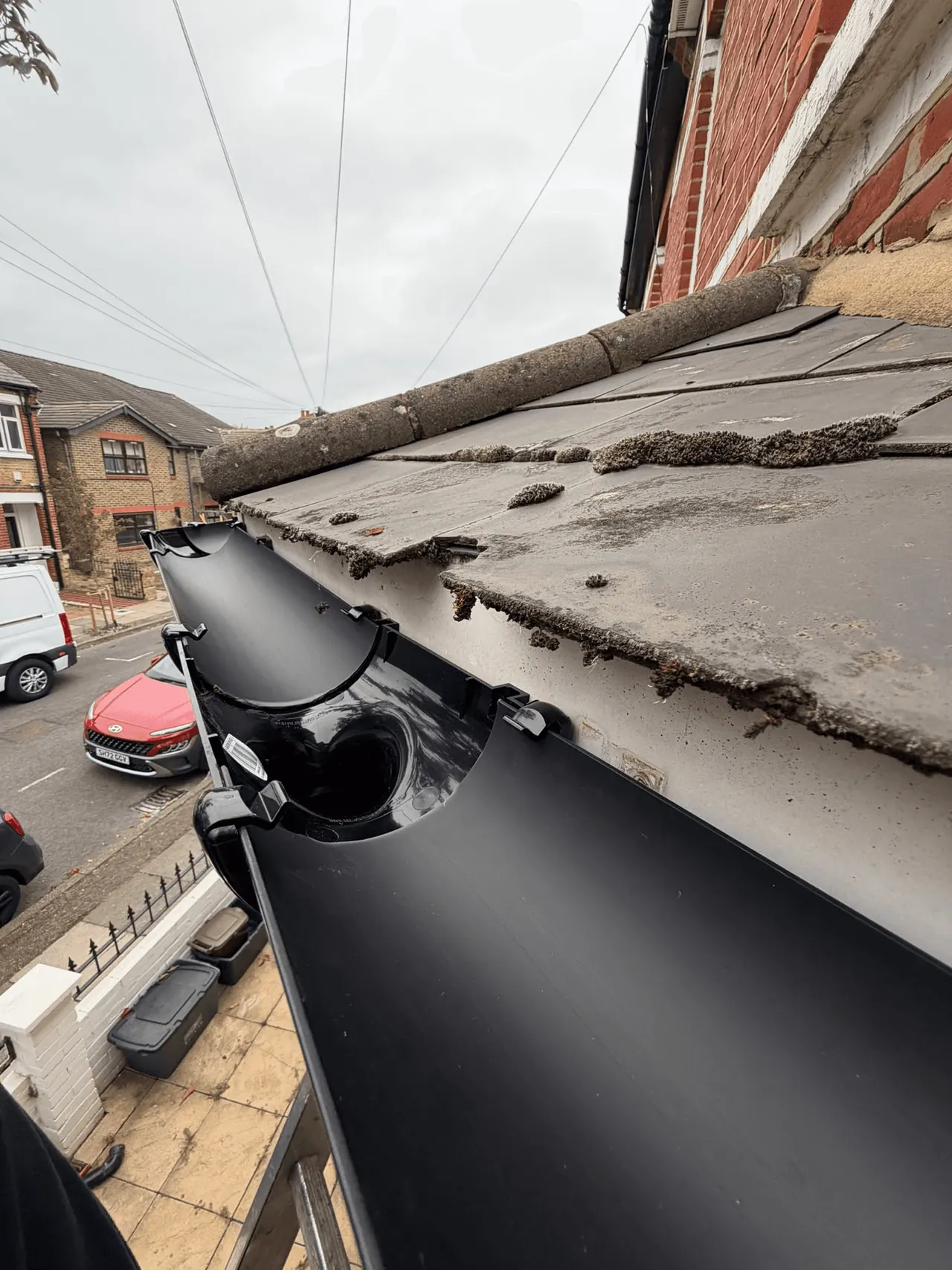
On houses like these, a coated aluminium gutter does not look out of place the way it would on a Georgian front. Coated aluminium comes in a range of colours, so a new run can be chosen to sit with the window frames and cladding rather than standing out as plain white plastic. Because each run is formed to length, often on site, the only joints are at the corners and outlets.
Leaves, seeds and twigs from two woods
The bigger reason to think about it here is what lands in the gutter. Dulwich Wood and Sydenham Hill Wood, on the slopes of Sydenham Hill, are together the largest surviving part of the ancient Great North Wood, and Dulwich Wood is owned and managed by the Dulwich Estate. Mixed woodland does not drop its leaves in one go. Catkins, seeds, leaves and twigs arrive through spring, summer and autumn, and the shade keeps roofs damp enough for moss.
A sectional gutter has a joint every few metres. Each one is a small lip for debris to catch on and a seal that can dry out and drip. Taking those joints out does not stop leaves arriving, but it does remove most of the places where a blockage starts and a leak forms. Even so, a gutter under the trees still needs clearing. For the clearing itself, our page on blocked gutter repair in Dulwich deals with the blockages the woods cause.
Front of the house, back of the house
Most of Dulwich is not mid-century. On the Georgian houses of the Village and College Road, and the Victorian cottages of Boxall and Turney Roads, Southwark's guidance for the conservation area encourages traditional materials, especially on listed buildings, and painted cast iron is usually the right answer at the front. Our page on gutter installation in Dulwich covers those houses.
The back of the house can be different. A new single-storey rear extension behind a period house, out of sight from the street, often has a long, plain eaves line, and that is a sensible place for a one-piece aluminium run while the front keeps its cast iron. A change of gutter material on a house under the Scheme of Management still needs the Estate's approval, as our Dulwich roofing page explains, so put the colour and profile to the Scheme office before ordering.
The same goes for post-war houses elsewhere. Court Lane was bomb damaged in the war and is now part Edwardian, part post-war, and the later houses there are plainer than their neighbours. Whether a seamless run suits one of them depends on the eaves and the Estate's view, not on the age alone.
A seamless gutter is only as good as the board it hangs on, so soft fascias are replaced first, and our page on fascias and soffits in Dulwich covers that work. We price each run from the measured length in a free quote, and our installations carry a 10-year guarantee. The seamless gutter service page explains how the system is formed and fitted.
Frequently asked questions
Would a seamless gutter suit my Peckarmans Wood house?
If the eaves run long and straight, it usually does. If the roofline is broken up with lots of short runs and corners, the benefit is smaller, because the joints at corners remain. We look at the roofline and tell you which it is.
Does the Dulwich Estate allow aluminium gutters on a mid-century house?
The Estate decides house by house. A change from the existing material or colour is a change of appearance, so it goes to the Scheme of Management office first. Matching the colour to the existing windows makes the case simpler.
Why not fit seamless aluminium on a Georgian house on College Road?
Mostly because of how it looks. Southwark's guidance for the conservation area encourages traditional materials, especially on listed buildings, and asks for replacements to match the originals as closely as possible. On those houses that usually means cast iron.





