



 Google reviews

Long eaves along the side returns
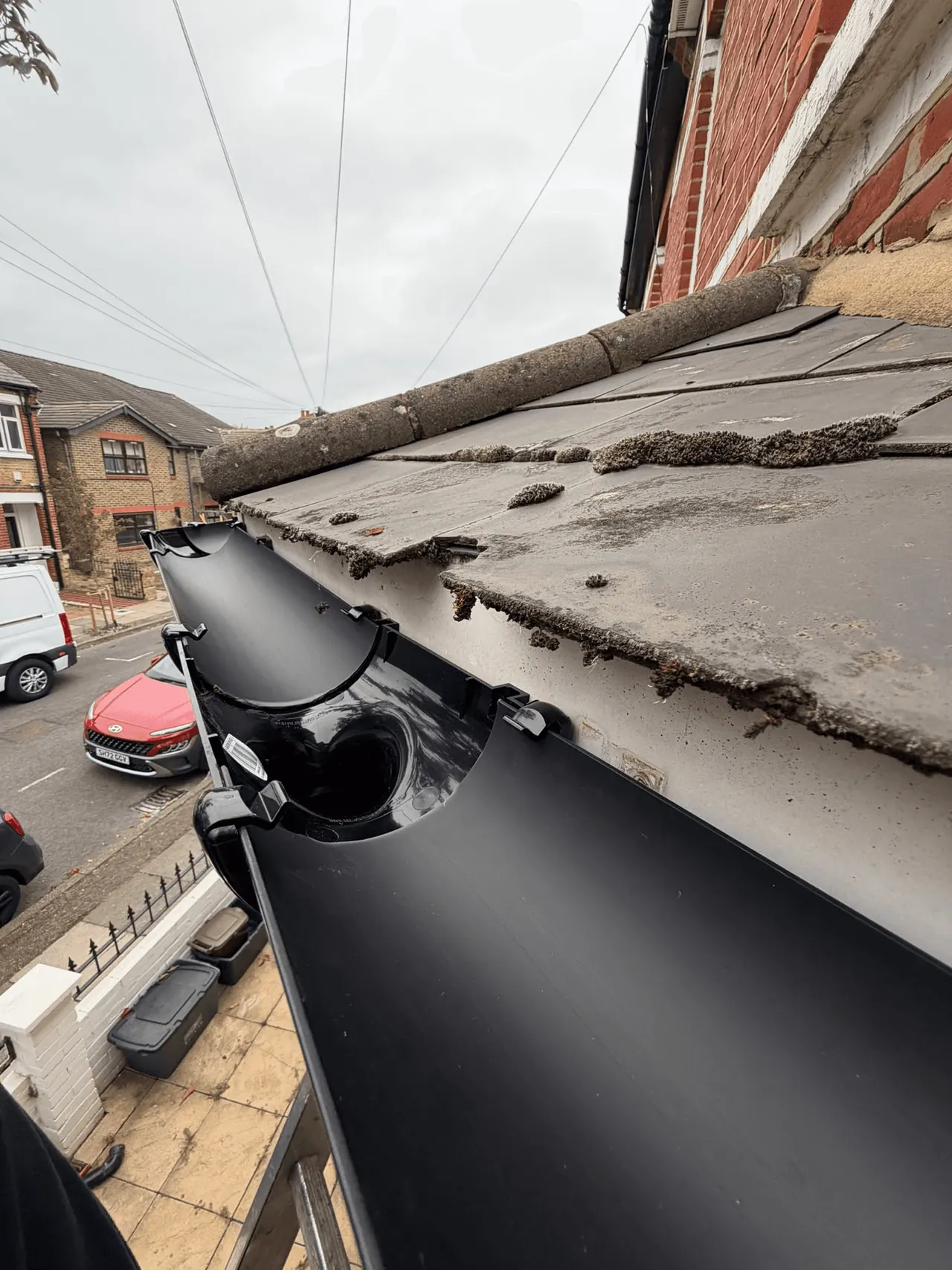
The narrow strip beside the rear addition is where most East Dulwich terraces have grown. A kitchen extension built along the side return often runs most of the depth of the plot, and its eaves form one long, straight line beside the boundary wall. That is exactly where a seamless aluminium gutter makes the most difference, because a sectional gutter on a run that long needs several joints, and each one sits over the boundary or next door's side.
When one of those joints starts to drip, the water lands on the party wall, in the gap between the extension and the fence, or in your neighbour's garden. Nobody notices until the brickwork is stained or the neighbour mentions it. A run formed to length in one piece takes those joints away, leaving joints only at the corners, the stop ends and the outlets.
Other places it suits on these houses:
- Wraparound extensions, where the run turns one corner and carries on along the back.
- Garden rooms and outbuildings at the end of the garden, with simple straight rooflines, often under garden trees.
- Several neighbours together. Where two or three houses replace their front gutters at the same time, one continuous run along the terrace can be formed, with everyone's agreement.
- A joint that leaks every winter. If the same joint has been resealed year after year, taking it away may be the real fix.
Extension eaves usually carry a timber or uPVC fascia, and a new gutter is only as good as the board it fixes to. We check it first and can renew it through our fascias and soffits work if it has gone soft. If the flat roof the gutter drains is itself tired, our flat roofing page covers re-covering it at the same time.
The narrow fronts
The street side is a different matter. East Dulwich was laid out in building plots: Ideal Homes, the University of Greenwich's history of south-east London's suburbs, records that the British Land Company sold Friern Manor Farm as 200 building plots, and the result was mostly small to medium terraced houses. The front of a single terrace house gives a short run of gutter, often only a few metres between the neighbours' gutters on either side, so a sectional gutter already has very few joints there.
Some of these fronts also have brick eaves with no fascia board, and a long rigid run needs a straight, sound fixing line. We will tell you when your front is one of those and point you to a standard gutter installation instead. On the period fronts of The Gardens conservation area and on listed houses, a traditional profile in cast iron is usually the better choice for the street side, with seamless kept for the back and for extensions out of view.
Post-war buildings on Friern Road
Not every building here is Victorian. Wartime bombing damaged parts of East Dulwich, and Ideal Homes records that the prefabs put up at the south end of Friern Road after the war lasted far longer than intended, before the site was redeveloped as the Friern Road Estate. A post-war block or infill house with plain eaves and no bays or corbels is worth measuring for seamless runs. Where a building is council or housing association property, the landlord arranges the work.
Because each run is made to length, the measuring and the position of the downpipes are settled before anything is formed. Our seamless guttering page explains the system and how it is fitted.
Frequently asked questions
Our side return off Lordship Lane runs the full depth of the garden. Where would the downpipe go?
Usually at the garden end, where it can reach a gully or water butt, with a second outlet if the run is long or the roof is wide. We plan the outlets before forming the run so it falls the right way.
Can a seamless gutter go on the corbelled brick eaves of an East Dulwich terrace?
It is awkward. Corbelled brick rarely gives a straight, even fixing line, and a long rigid run shows every dip. A traditional bracketed gutter usually suits that front better, with seamless kept for the back.
Can one run cover the rear addition and the main roof on our terrace?
Not as a single piece, because they sit at different heights. Each roof gets its own run, joined only where one discharges into the other.





