



 Google reviews

Small flat roofs on the bays of Oakhurst Grove
Some of the oldest flat roofs in East Dulwich are on the front of the house. Southwark's appraisal of The Gardens conservation area describes the three-storey pairs on Oakhurst Grove, where the bays are alternately gabled and flat-roofed, and some carry small French-style turret roofs instead. Victorian bays elsewhere in the district often have the same kind of small flat top over the ground-floor window.
These little roofs are easy to forget. They sit below the main gutter, so they catch drips and overflow from above, and many still carry an old covering that has not been looked at in years. When one fails, the water usually shows as a stain on the bay ceiling or as damp in the brickwork above the window. Because they are on the front, any re-covering has to look tidy from the street, with a neat edge detail and a proper upstand where the roof meets the wall.
Behind the terraces: side returns and rebuilt back additions
Most flat roofs in East Dulwich are at the back. The 1870s and 1880s terraces were built with pitched slate roofs, and the flat roofs came later, added as families extended. A typical house in the grid between Lordship Lane and Peckham Rye can have:
- a side return or wraparound kitchen extension, often with a rooflight
- the top of a rear loft dormer, two or three storeys up
- a rebuilt rear addition with a flat roof in place of the original pitch
- a garden room or shed at the end of the garden
Each has its own weak points. On a side return, the roof meets the wall of the rear addition on one side and the boundary wall on the other, and most leaks start at those upstands rather than in the middle of the roof. Rooflight upstands are another common leak point. Where the roof has sagged or was laid with too little fall, water sits for days and wears the covering faster, and our article on water pooling on a flat roof explains when a puddle matters. Where the extension drains into a small hopper or a shared gutter on the boundary, leaves from neighbouring gardens can stop the flow and back water up under the edge trim. If that is the cause, our blocked gutter repair team can clear it on the same visit.
Dormer roofs are the hardest to keep an eye on, because nobody can see them from the garden. A drone inspection lets us check the whole surface, the edges and the junction with the main slope without scaffolding.
Patching versus a new covering
A roof that is sound apart from one split or one failed joint can usually be repaired. A roof that leaks in several places, or has a soft, spongy deck underneath, is better stripped and re-covered, because patching it just moves the leak along. We show you photos of what we found and explain which applies.
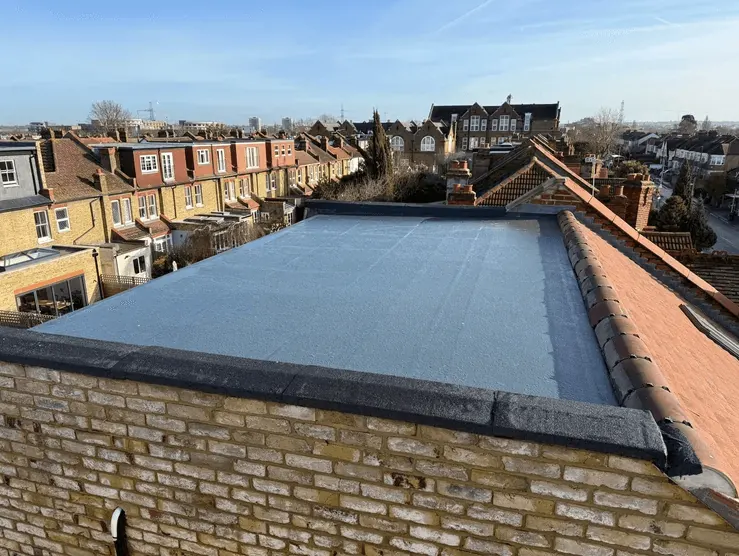
When a roof is re-covered, we strip the old covering, check and replace any rotten decking, and lay one of three systems:
- GRP fibreglass, a seamless hard finish that suits dormers and small bay or extension roofs, laid in reasonably dry weather
- EPDM rubber, laid in large sheets with very few joints, good for wider side returns
- Torch-on felt, widely used for garages, sheds and like-for-like replacements
Materials alone are a useful yardstick: MyJobQuote's London flat roof guide gives a published guide figure of £80 to £120 per square metre for EPDM, supply only, with labour on top. If you are adding a new extension or dormer rather than re-covering an old one, see our roof installation page, and the GRP, EPDM and felt comparison sets the three systems side by side.
Frequently asked questions
The covering on our Oakhurst Grove bay roof has split. What can it be re-covered in?
Small splits can often be repaired. If it needs a new covering, we talk through GRP, EPDM and felt, and what will sit well on a conservation area front. On a listed or sensitive front it is worth asking Southwark before the old covering comes off.
The flat roof over our kitchen on a Lordship Lane terrace drains into next door's gutter. Is that a problem?
Only if their gutter cannot cope or is not maintained. If water backs up at the boundary, the fix may be a new outlet on your side or an agreement to clear the shared gutter. We check where the water actually goes before suggesting either.
Our mid-terrace house has no side access. How do materials get to the back?
Usually through the house, with floors and doorways protected, or occasionally over the roof. Tell us about access when you call and we agree the route before the job starts.





