



 Google reviews

Shop flats on Landells Road, Goodrich Road and Lordship Lane
When the farms of East Dulwich were sold for building after 1870, the developers put up shops as well as houses. The Ideal Homes local history project described the corner of Landells Road and Goodrich Road as typical of the area in the mid-1990s, down to its purpose-built and still successful shops. Lordship Lane has a long run of them too, the shopping strip Wikipedia notes for its independent shops, cafés and restaurants.
Most of these buildings have flats above, and their gutters are often the most neglected on the street. The shop has no reason to look up, the flat upstairs cannot see the back gutter, and the freeholder may live elsewhere. A leaking joint at the back can run for years, staining the wall, soaking the brickwork around a window and rotting the timber at the eaves before anyone reports it.
At the front, a drip from a shop gutter lands on the pavement, the shop sign or a customer. At the back it usually lands on a yard, a flat roof over the shop's rear store or a bin area, which is why so many go unnoticed until the inside wall of the flat turns damp.
Cast iron and old plastic on the terraces in between
Away from the shops, the Victorian terraces carry a mix of original cast iron and later plastic, and the faults follow the material:
- Cast iron joints. Sections are bolted together with a seal in each joint. Over decades the seal dries and rust opens the gap. Many joints can be cleaned out, resealed and rebolted.
- Brittle plastic. Older uPVC cracks at the union clips, and the rubber seals perish in the sun.
- Loose brackets. On brick eaves, the brackets are fixed into the brickwork or the rafter ends. When one works loose the gutter dips, water collects at the low spot and spills over.
- Lost fall. A gutter that has settled level, or sloped the wrong way, holds water instead of running it to the outlet.
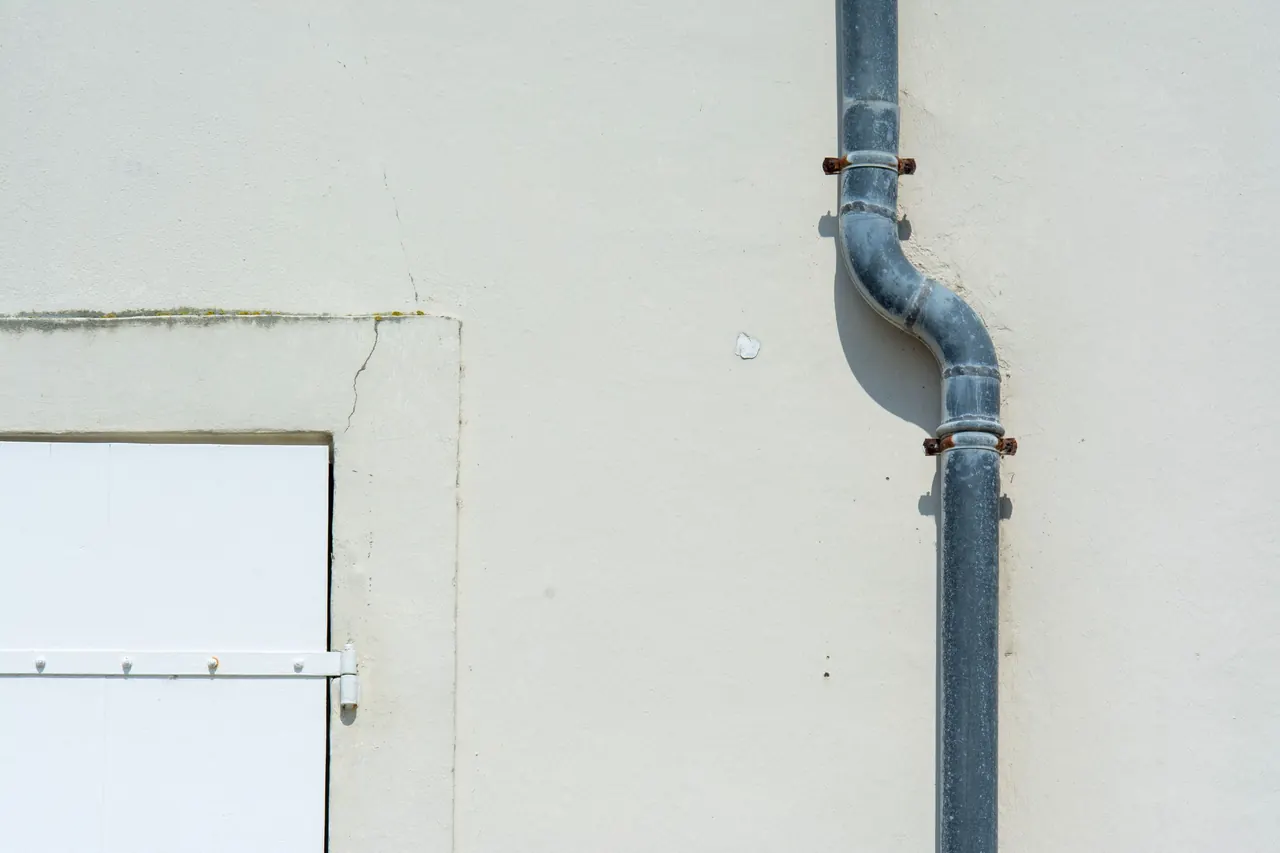
- Downpipes. Cracked cast iron pipes, pipes that have come away from the wall, and offsets that leak where they bend around a bay or a string course.
- Mixed materials. Where your cast iron meets next door's plastic, the adaptor between them is a weak point.
If water runs down the wall behind the gutter rather than over the front, our article on water leaking behind a gutter explains why that often points to the eaves rather than the gutter itself.
When a repair is the right answer
If the run is generally sound and the problem is one joint, a few brackets or a cracked length, a repair is the sensible choice. A cracked cast iron section can be replaced on its own, and a dropped run can be rehung on new brackets with its fall reset. If the gutter is cracked in several places, has lost its fall along the whole run, or the eaves behind it have rotted, replacing it costs less in the long run, and our gutter installation page covers that. Rotten boards behind a gutter are dealt with through our fascias and soffits work.
Call 0330 133 4111 and tell us roughly where the water is going. We arrange a visit and give you a free quote, often the same day, after looking at the whole run, the brackets, the downpipes and the eaves behind them, not just the drip you called about. On a three-storey building with a high back gutter, we can look at it by drone first. The faults that turn up on any age of gutter are covered on our gutter repairs page.
Frequently asked questions
Who pays for a gutter repair above a Lordship Lane shop with two flats over it?
Usually the freeholder, as the gutters are part of the structure, though the lease decides who pays in the end. We can quote the freeholder or managing agent directly and send photos so the flat owners see the same thing.
Our shop gutter drips onto customers at the front door. Is that a quick fix?
Often it is a single joint or a dropped bracket, which is a short repair. If the whole front run has lost its fall, it needs rehanging, which takes longer but still does not usually mean a new gutter.
Our cast iron gutter near Goose Green joins next door's plastic one. Can that join be made to stop leaking?
Usually, yes. An adaptor made for the two profiles, fitted with a fresh seal and a bracket either side, normally cures it. If the end of the cast iron length has rusted thin, we replace that section first so the adaptor has something sound to grip.





