



 Google reviews

Shared runs on the terraces south of the railway
The terraces between the railway and Stafford Road, at Tharp Road, Mellows Road and along Sandy Lane, were built as rows, and their gutters were hung as rows too. Each house now owns its own length, but they meet at every party wall, and over a century most rows have been replaced piecemeal. That leaves a run that changes material or profile two or three times along its length, with a joint at each change.
Those joints are where most terrace gutter faults begin. The seal in a uPVC union dries out and cracks. Two profiles that never quite matched have been bridged with mastic. A cast iron section has rusted at its spigot. The drip lands on one house's step but may come from the joint on the other side of the wall, so we look at the run either side of the leak before deciding where to work.
The fix depends on what we find:
- Dried-out seals: the joint taken apart, cleaned and remade with a new seal or union.
- Mismatched profiles: the mastic bridge replaced with the proper adaptor for the two systems.
- Lost fall: a dropped bracket refixed so water runs to the outlet instead of sitting in a dip.
- A cracked length: that section replaced on its own if the rest of the run is sound.
Paved fronts and loose downpipes
Sutton's 2024 draft character study notes that many front gardens in the Sandy Lane / Upper Road sub-area have been paved for parking. When the paving went down, a lot of downpipes lost their neat connection into a gully. Some now end in a shoe just above the blocks, some were knocked out of line by a car, and some have cracked at a joint halfway down.
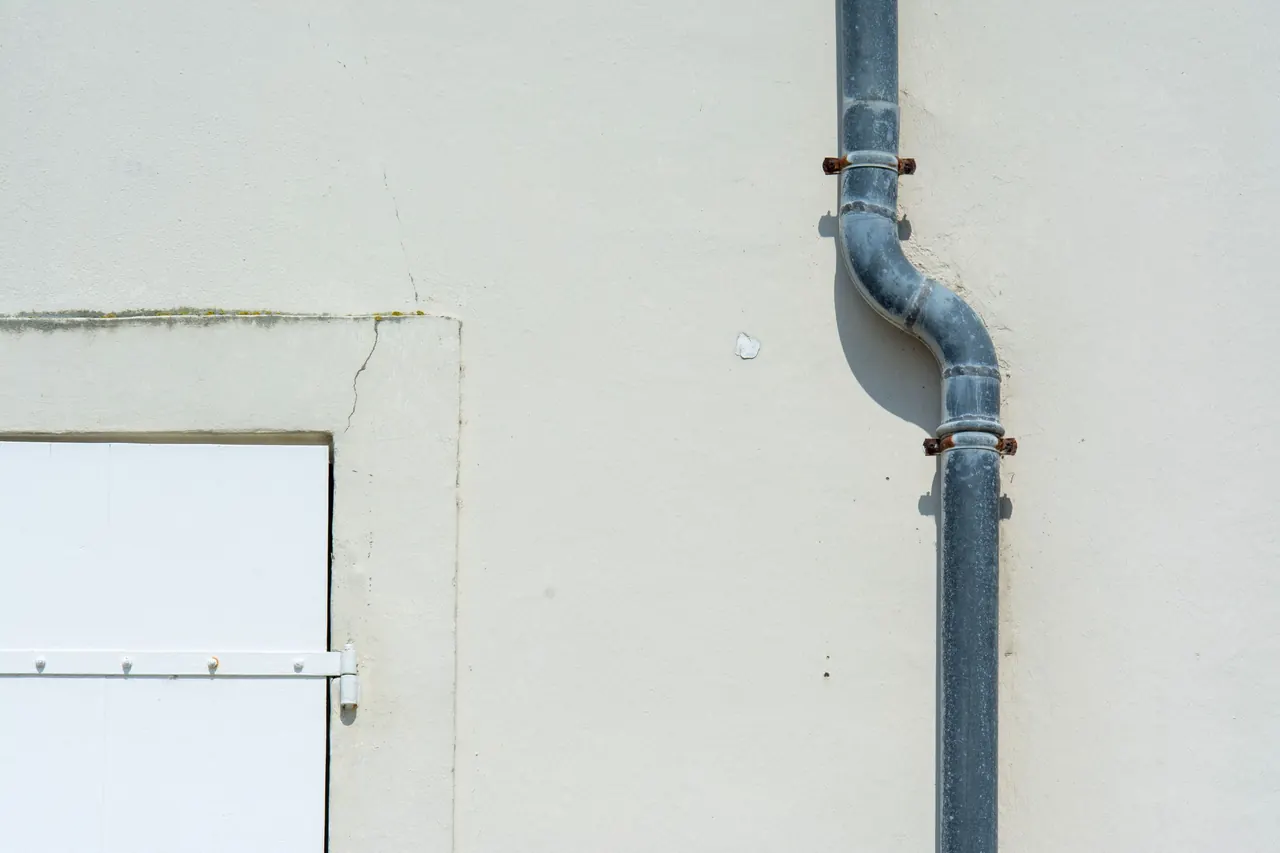
A downpipe that pours onto paving puts the water against your front wall and doorstep instead of into the drain. A cracked one soaks the brickwork behind it, and the first sign is often a green streak or a damp patch inside. We reconnect pipes to the gully, replace cracked lengths, and refix brackets that have worked loose from soft mortar.
Cottage gutters on old fixings
On Upper Road, Sandy Lane North and Plough Lane, some of the cottages date from the 1850s and 1860s, according to the local history society's study of Beddington and Bandon. On houses this age the gutter may hang from old iron brackets driven into the brickwork or from a timber board that has been patched many times. The gutter itself can be fine while its fixings are not. We replace failed brackets one at a time where we can, rather than taking down a run that still works.
If the board behind is soft, though, new brackets will not hold, and the fascias and soffits need dealing with first. If several sections are cracked and the uPVC has gone brittle all along, a new gutter installation is the better use of your money than repairs that buy one more winter.
As a guide, MyJobQuote's gutter repair guide puts resealing or repairing a leaking joint at £60 to £150. If water is running down the wall behind your gutter rather than over the front, our article on water leaking behind a gutter explains the usual causes. The main gutter repair page lists every repair we carry out.
Frequently asked questions
The gutter over my bay on Mellows Road drips at one bracket. Is it the bracket or the gutter?
Usually the bracket, or the board it is screwed to. If a bracket has dropped, the gutter sags at that point and water pools and spills there. We refix or replace the bracket and check the fall either side, and only replace the gutter if it has split.
Our downpipe on Sandy Lane North has come away from the wall at the bottom. Does it need a new one?
Not always. If the pipe is sound, it can be refixed and reconnected to the gully. If the bottom length has cracked or the shoe is broken, we replace that piece only.
Why does the gutter leak at the corner of my hipped roof off Sandy Lane South?
The corner is where two runs meet in an angle joint, and on a 1930s or post-war hipped roof there are several of them. If the seal has perished or the angle has slipped, water collects and leaks there. We remake the joint and check that both runs fall away from the corner.





