



 Google reviews

A stain above the bay window on North Street
A brown mark on the ceiling of a front bay, or damp in the plaster just above the window head, is a common fault on bay-fronted Victorian houses like those around Wrythe Green. The main roof above can be sound. The water is usually coming in at the small roof over the bay, where it meets the front wall.
The yellow-brick pairs at 61 to 67 North Street show how bay roofs drift apart over time. Sutton Council's 2020 draft appraisal singles out the yellow brick, which it calls relatively rare in the borough, and notes that the roofs over the bays have lost their uniformity across the four houses. That is what happens when each bay is mended separately, decades apart, with whatever was to hand.
The weak joint is where the bay roof tucks under the brickwork. On many houses of this age it was sealed with a mortar fillet, a wedge of mortar along the angle. Mortar and brick move at different rates, so the fillet cracks away from the wall and rain runs down behind it and into the bay. Painting over the crack or adding mastic buys a season or two.
The lasting repair is to cut the fillet out and fit lead flashing, chased into a mortar joint in the wall and dressed down over the bay roof. If the bay covering itself has worn out, whether tiles, slate, lead or felt, we re-cover it at the same time rather than flashing onto a tired roof.
Hipped pairs on West Street and Wrythe Green Road
The same houses are mostly square in plan under hipped roofs, as are Nos 136 and 138 West Street and the Waterloo Place and Ivy Cottages pairs on Wrythe Green Road. A hipped roof has four bedded hips, and over time the bedding mortar cracks and lets the lowest hip tile work loose. We re-bed only the tiles that have moved, and fix the foot of the hip so it cannot slide, rather than redoing a sound hip for the sake of it.
Where the covering is slate, as the listings record for 1 and 2 Wrythe Green Road and for Woodcote House, the other common job is a slate that has slipped because its nails have rusted through. Slates are refixed one at a time with clips. If they are coming loose across a whole slope, it is time to talk about stripping and re-nailing that area instead.
For a listed house, like-for-like repair keeps the same materials and pattern. Woodcote House's slate roof is shaped to follow its bay, and a repair there means slates cut to that shape, not a sheet of lead or felt dressed over it.
Tiles on the streets beyond the Green
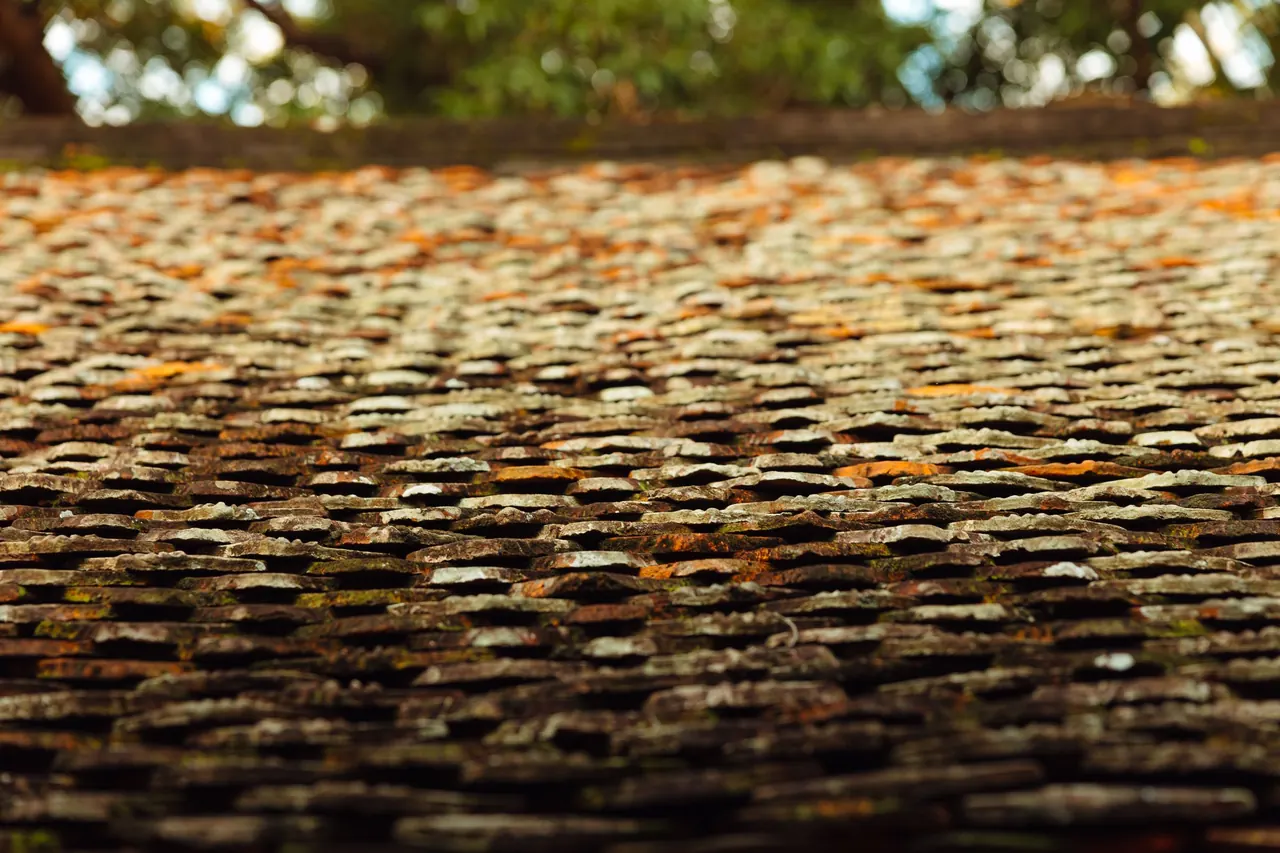
Away from the conservation area the houses are mostly interwar, with clay or concrete tiles, hips and two-storey bays. Their faults are slipped tiles where nibs or nails have failed, cracked ridge bedding, and leaks at valleys where an extension or dormer has been added. Where a slope cannot be seen from the ground, we put the drone up before saying what needs doing.
If the leak turns out to be around a stack, the chimney page for The Wrythe covers the stacks here. When faults are turning up all over a roof, our guide on repair or full replacement explains how to weigh it up, and our main roof repair page goes through the common fixes.
Frequently asked questions
Why does water show above my bay window on North Street when the roof looks fine?
Because the bay has its own small roof and its own joint against the wall. A cracked fillet or a lifted flashing there lets water run behind the brickwork and into the bay, well away from the main roof.
Do I need consent to repair a roof in the Wrythe Green Conservation Area?
Like-for-like repair is normally maintenance and needs no planning permission. On a listed building, or if you want to change the covering, check with Sutton Council first.
Can a slate roof shaped around a bay be repaired without spoiling it?
Yes, with slates cut and fixed to follow the shape, as the original was. On a listed house such as Woodcote House, keep to the same material and ask the council before anything beyond like-for-like.





