



 Google reviews

Trees round the villas off Cheam Road
The council's Heritage Study describes the Landseer Road villas as surrounded by mature trees and grass verges, and the draft character study notes good street trees across Sutton West. Those trees are a big part of why the streets look the way they do. In a gale, roofs near mature trees are among the ones most at risk, from a falling limb or from leaves and twigs blocking a valley in the middle of a downpour.
On a tall villa, damage high on the roof is hard to judge from the garden. Keep everyone out of the rooms under it and away from that side of the house, and ring 0330 133 4111. If something is still hanging in a tree over the house or the road, call the emergency services first.
A street tree that has dropped a limb should also be reported to the council through its tree enquiries page, which gives a phone number for a tree that is an immediate danger. Trees in private gardens are the owner's responsibility, not the council's.
Ridge stacks in Benhilton
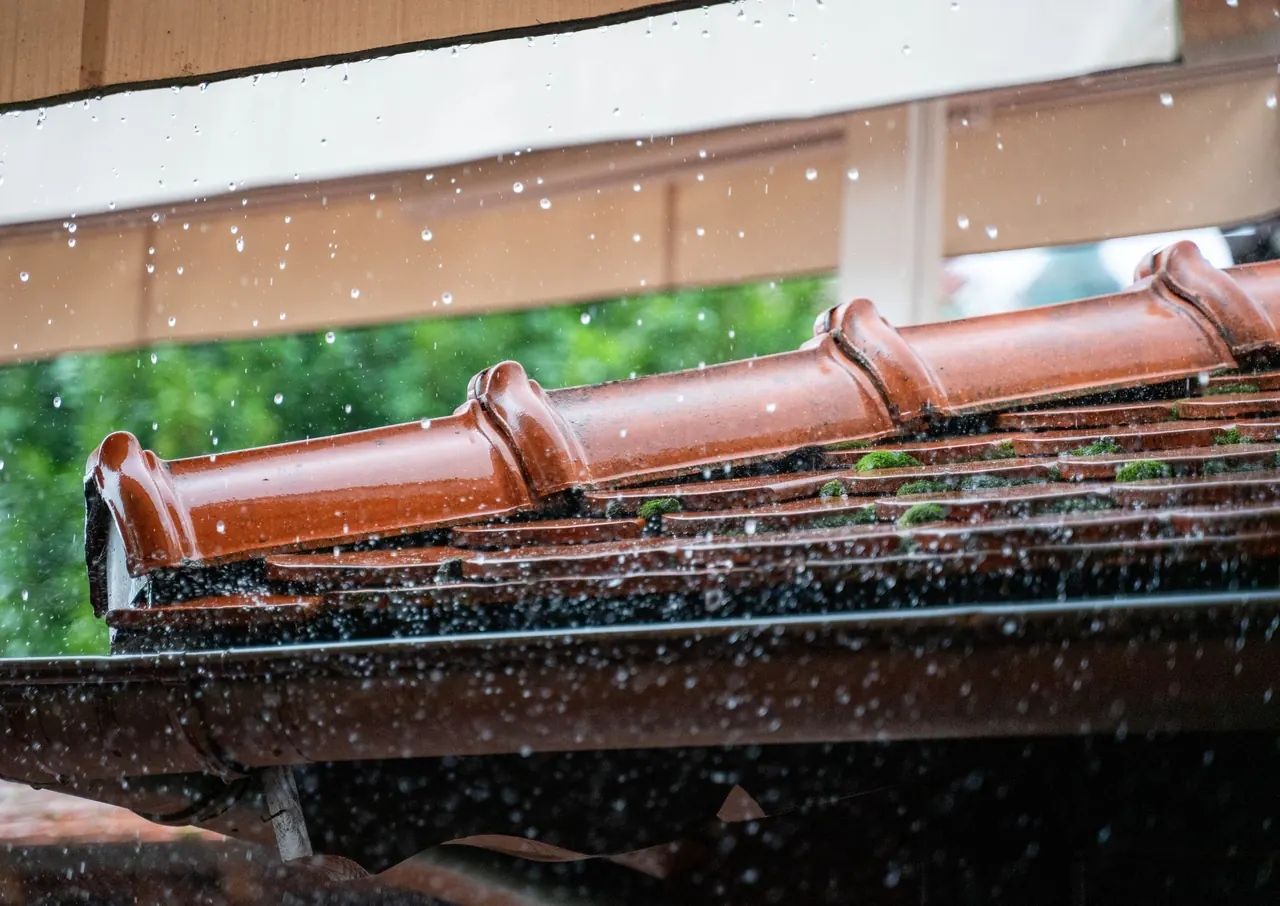
The Garden Suburb houses in Benhilton carry big chimneystacks on or just below the ridge. On Nos. 16 to 22 Woodend the stacks rise through the hips at either end of the terrace. A stack that stands up on the ridge takes the wind full on, and cracked flaunching or a loose pot that has held for years can give way in one night.
If you hear something come down, or see pieces of pot or mortar in the garden, keep clear of that side of the house. Falling masonry from a ridge stack can go through a lower roof or a conservatory. Our chimney repairs page covers the permanent fix once the stack is safe.
Flat roofs on South Sutton blocks and extensions
South Sutton is mostly 1970s and 1980s court blocks of three to four storeys. Where one of them has a flat roof and a section of covering lifts, water can reach several flats on the way down, and the freeholder or managing agent needs to know straight away. The same thing happens on a smaller scale on the felt roofs of single-storey extensions behind Sutton terraces. Wind gets under a loose edge, peels the felt back, and the next shower goes straight onto the deck.
Where you can do so safely, move belongings away from the drip and take photos as you go, which helps later with the insurer. Do not go onto the roof yourself.
On the night, and afterwards
Liam, our Lead Roofer, or another of the team assesses the damage and does what is needed to stop the water and remove any danger: refixing or replacing loose tiles, sheeting an open section, sealing a lifted flat roof edge, clearing a blocked valley, or taking down loose masonry that could fall. In high wind the roof is made safe and weathertight first, and the permanent work follows when it is safe to finish, with a free quote for it. The full sequence is on our main emergency roof repair page.
Once things are dry, a roof inspection shows whether anything else was loosened on the slopes you cannot see, and our guide to spotting roof damage after a storm covers what to look for from the ground.
Frequently asked questions
Can you make a Garden Suburb roof safe without breaking the Article 4 rules?
Yes. Temporary measures to stop water getting in are not a change of roofing material, and making a roof safe always comes first. The permanent repair then goes back in matching red tile, as the council's management plan expects.
Will you go up a three-storey Landseer Road roof in a gale?
Not if it is unsafe. We do what can be done safely from inside the loft and from the ground to slow the water, then go up as soon as the wind drops.
A pot has come off a stack on Woodend. Is the rest of the stack safe?
Not necessarily. If one pot has gone, the flaunching round the others may well have cracked too. Keep clear of that side of the house until the top of the stack has been checked.





