



 Google reviews

Four kinds of roof within a mile of the station
The oldest built-up corner of Norbury is the junction of London Road and St Helen's Road. Croydon's heritage review dates four Victorian villas and three Dutch-gabled semis there to around 1890. Everything else came quickly after the trams arrived in 1901. The population went from 475 in 1901 to 15,538 in 1931, so a large share of the roofs here are now roughly a hundred years old.
That gives Norbury four broad roof types, and each one ages in its own way:
- The Norbury Estate. Two-storey Edwardian cottage terraces west of London Road, with steep roofs in natural slate or handmade clay tile, terracotta ridges, street-facing gables and tall brick stacks.
- London Road and the St Helen's Road streets. Victorian villas, three and four storey shopping parades finished in the 1920s and 1930s, and single-storey flat-roofed shops with homes above.
- Beatrice Avenue and the Victorian side streets. Arts and Crafts semis and terraces built from 1902 to 1910, and compact terraces on narrow streets either side of the main road.
- The interwar semis. Planned estates of semi-detached houses on the old North Surrey golf course between the railway and Green Lane.
The Norbury Estate and its roof rules
The estate runs west from London Road along Tylecroft Road, Newlands Road and Northborough Road to Darcy Road and the Merton boundary, with Granden Road, Isham Road, Bavant Road and Norton Gardens in between. The London County Council bought thirty acres in 1900, took over the brickfield already on the site, and fired bricks for the cottages from it. By March 1920 there were 642 homes. The western half is laid out around three small squares, opening onto Isham, Northborough and Tylecroft Roads.
It became a conservation area in December 2008, and Croydon's management plan is unusually specific about roofs. Re-roofing should be in natural slate or plain clay, with the original slates and tiles kept for the street side. Concrete tiles are ruled out. Stacks should not be lowered or rendered. Cast iron gutters should stay, and replacements should be black metal. Dormers that can be seen from the street will be resisted.
For a roofer that changes the order of work. Before quoting, we sort out which slates or tiles on the front are original and worth lifting and relaying, and where matching material will be needed at the back. A full re-roof on the estate is planned around that sorting. Our Norbury re-roofing page goes through it in more detail.
The estate has its own access quirks too. The terraces between Isham Road and Granden Road sit on raised walkways reached by steps, built so that each row keeps a level ridge. In places there are brick retaining walls up to 1.5 metres high beside the pavement. Ladders and scaffold have to be planned around both.
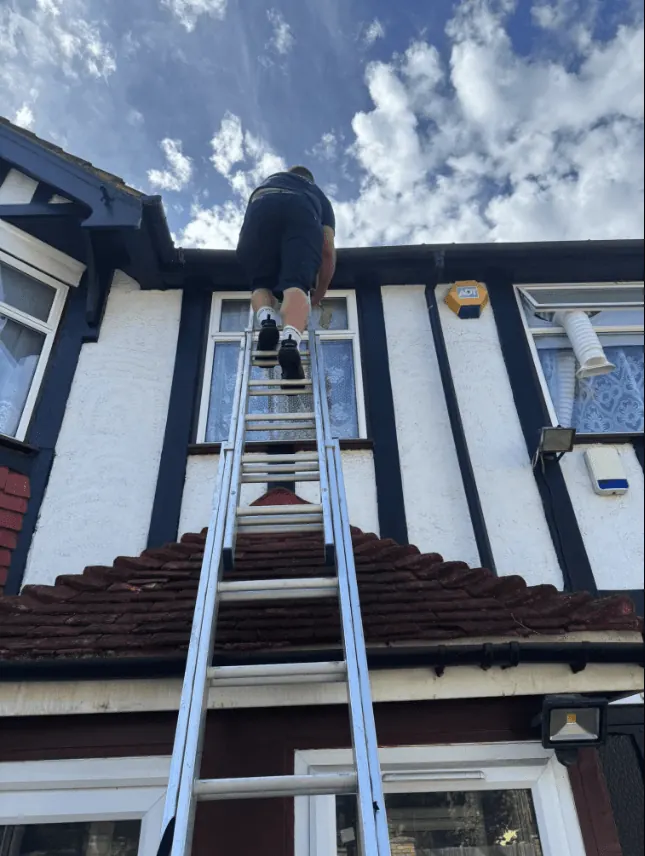
London Road parades and the flats above them
London Road is Norbury's high street and the busiest roofscape in the area. Croydon protects a stretch of it, with St Helen's Road and Norbury Crescent, as a Local Heritage Area. The Queen Anne style parades have gabled roofs with bargeboards and half-timbering. No. 1374 is a Victorian villa with a shop below, a mansard roof and red and white striped chimney stacks. Nos. 1411 to 1423 were designed as a single building with a high parapet, and the shops at Nos. 1443 to 1489 are single storey with flat roofs and homes set back above them.
The roof problems here are about height and hidden water. A parapet gutter can fill and overflow into a top-floor flat without anyone seeing it from the street, and a flat shop roof sits right under a bedroom window. We can survey these roofs by drone first, and we deal with whoever holds the lease or the freehold, so the right person sees the photos.
Semis on the old North Surrey golf course
Between the wars, the former North Surrey golf course between the railway and Green Lane was built over with planned estates of semi-detached houses. Croydon's character appraisal notes their regular form, some integral garages and, on some streets, rear service alleys. They sit outside the conservation area, so owners have a wider choice of tiles, gutters and roofline boards.
What these houses tend to need is different from the estate. Hip and ridge mortar on the tiled, hipped roofs, flat roofs over garages and kitchen extensions, and gutters that turn a corner at each hip are the usual work. To the south-west, the houses of around 1930 in Pollards Hill South, around Briar Road, are a Local Heritage Area of their own, and our Pollards Hill page covers that side of the hill.
Norbury Park sits on the flat site of another former golf course, with Norbury Brook running in a culvert underneath. In the north-east corner, on the edge of Streatham Common, Norwood Grove is a registered park with a Grade II listed house, and both were added to Historic England's Heritage at Risk register in 2024.
Where to start with your roof
We are a family run firm based on Kenley Road in Morden, about 4 miles west of Norbury. If you know what is wrong, call 0330 133 4111 or use the contact page. If you only know that something is wrong, a roof inspection in Norbury is the cheapest way to find out what you are dealing with, and on a terrace it often makes sense to look at the neighbours' side of a shared stack or gutter at the same time.
For gutters, the tree-lined estate roads fill faster than the narrow streets by London Road, where moss off the roof does most of the blocking. Our Norbury gutter cleaning page covers how that changes the timing.
Frequently asked questions
Who is responsible for the roof if my Norbury Estate house is still council owned?
Croydon's appraisal notes that many estate houses are still in council ownership. If you are a council tenant, roof and gutter repairs are normally the council's job as landlord, so report them to the council first. If you bought your house, the roof is yours, and so are the conservation rules that come with it.
Do I need permission to re-roof a house on the Norbury Estate?
Like-for-like repairs and re-roofing in natural slate or plain clay do not normally need planning permission, and they are what the management plan asks for. Changing to concrete tiles is not considered acceptable, and street-facing dormers are resisted. If anything about the look of the roof would change, speak to Croydon's planning team before work starts.
Is Beatrice Avenue covered by the same rules as the Norbury Estate?
No. Beatrice Avenue is a Local Heritage Area, not a conservation area, so like-for-like repairs need no extra permission. Under Local Plan policy DM18 the council does take the street's character into account on any planning application, which matters if you want to change the roof's shape or covering.
Can you look at the roof over my flat above a London Road shop?
Yes. A drone can usually see the parapet gutter, the valleys and the stacks without anyone going through the shop. We then agree access for any work with whoever is responsible under the lease.





