



 Google reviews

How West Norwood's roofs were built
In 1851 the parish district of St Luke's, Norwood, had 647 houses. By 1901 it had 6,431. The railway reached Lower Norwood in 1856, as the station and the area were then known, and over the next half century the large houses and their grounds gave way to streets of terraces, pairs of villas and shopping parades.
That burst of building is still the shape of West Norwood's roofs. Lambeth's appraisal of the conservation area describes natural Welsh slate as the main covering, London roofs with a hidden valley behind the front wall, shallow hipped roofs on detached houses, overhanging eaves in timber, and brick chimneystacks with terracotta pots on most 19th century buildings. Many of the Victorian streets beyond the conservation area are built the same way.
Roofs of that age are rarely worn out all at once. What goes first is the nails, the lead, the mortar and the gutters, and on these houses many of those parts are out of sight from the pavement.
The centre sits in a hollow, too, with hillsides rising to the east, west and south. Houses on the higher streets tend to catch more wind, while those in the dip around Auckland Hill and along the old line of the Effra by Elder Road take the run-off.
St Luke's, the cemetery and the streets between
St Luke's Church, built between 1822 and 1825, stands on rising ground between Norwood High Street and Knights Hill, and its spire is the landmark of the old centre. Across the junction is the entrance to West Norwood Cemetery, opened in 1837, with Robson Road along its northern edge; its grounds hold some of the oldest trees in the area.
Around these two sit the streets most people picture as West Norwood. On Norwood Road, the mid-Victorian group at 543 to 551 has parapet walls with the roofs and gutters hidden behind them. Chestnut Road was laid out around 1850 and keeps a few early villas with deep eaves. Norwood High Street has a row of two-storey stock brick cottages at nos 9 to 19, and Dunbar Street has model cottages built in 1865. Robson Road, along the cemetery's northern edge, is lined with two-storey terraced cottages with bay windows.
The things that tend to go wrong on these houses are the same few, in different proportions on each street:
- Slate fixings. Iron nails corrode, slates slide, and a run can lift in a gale. A few is a roof repair; slipping all over usually means a re-cover.
- Hidden gutters. Parapet gutters and central valleys block where nobody can see them and overflow inwards.
- Chimneys. Lead flashing, pointing and the flaunching under the pots, often over a century old.
- Leaves. The cemetery's oaks, holm oaks and conifers, the large trees by St Luke's churchyard and tree-lined Chestnut Road fill gutters in autumn, and the holm oaks add more in late spring.
- Flat roofs at the back. Back additions, side returns and dormers, many added decades apart.
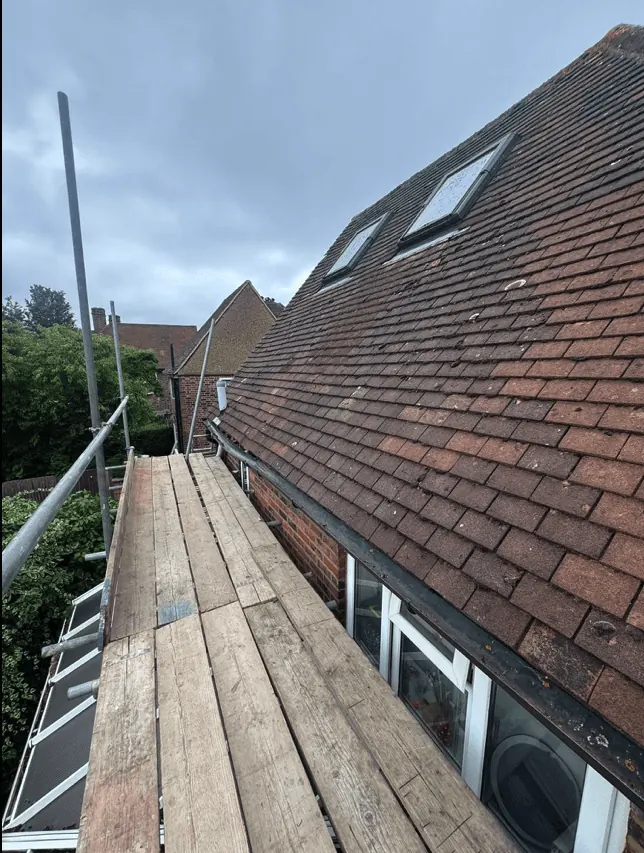
Lancaster Avenue and the Blake Estate
To the north, towards Tulse Hill, Lancaster Avenue has its own conservation area, designated in 1994. Charles Blake, a City solicitor, began building here in 1864 with Lancaster Villas, a run of Italianate semis with shallow hipped roofs, followed by a second phase from 1879 and smaller terraced houses in 1906. By the 1880s his Blake Estate also took in Chatsworth Way, Idniston Road and Arduli Road.
The council's 2017 appraisal records that most of these houses started out under Welsh slate and many now wear concrete or fibre cement tiles, that their broad chimneystacks rise from the party walls, and that their gutters and downpipes would first have been cast iron. The street follows a hillside, so on its south side the land drops away behind the houses. Each of those details changes how we approach a re-roof, a gutter or a rear flat roof here.
From Elder Road to Dunelm Grove
Bombing in the Second World War left gaps in West Norwood, and the council built new homes after the war. The Elder Road Estate went up in 1947 and 1948 using prefabricated methods, the Knight's Hill Estate on the corner of Crown Dale was finished in 1953, and York Hill gained council flats on cleared bomb sites in the early 1950s.
The latest is the Dunbar and Dunelm estate, built by Lambeth between 1977 and 1980: 120 homes, mostly brick houses under large slate roofs, some built into the cemetery wall. Each estate has its own roof details and its own weak points, so we treat them on their own terms rather than as if they were the Victorian houses next door. Lambeth's 2020 draft appraisal proposes bringing the Dunbar and Dunelm estate into the conservation area to protect its roofscape, so changes to its roofs, gutters and eaves are best matched to the neighbouring houses and checked with the council first.
Precise Roofing & Guttering is a family run firm based on Kenley Rd in Morden, about 5 miles from West Norwood. A roof inspection in West Norwood is a sensible first step on any of these houses: Josh flies the drone over the rear slopes, valleys and stacks, and we follow it with a look in the loft. Gutter work runs from seasonal clearing under the cemetery trees to new cast iron. You can see everything we do on our services page or read about the team.
Frequently asked questions
Is my house on Robson Road in a conservation area?
Only a short section of Robson Road is inside the West Norwood conservation area at present, though Lambeth's 2020 appraisal, still in draft, proposed adding nos 1 to 70. Lambeth's conservation area maps show the current boundary.
I am buying a flat in a converted villa on Chestnut Road. What should I ask about the roof?
Ask who is responsible for the roof and the gutters, when the slate and lead were last worked on, and whether there is a reserve fund. A drone inspection before you exchange shows the condition of the slopes and the stacks.
Are the post-war estate roofs here different to work on?
Yes. The prefabricated Elder Road houses, the 1950s blocks and the Dunelm Grove houses of 1977 to 1980 were each built in their own way. We look at the construction first and repair to suit it, and on Dunelm Grove we keep to the slate and brick look that Lambeth's draft appraisal singles out.
What should I check on a Victorian house near St Luke's before winter?
From the ground, look for slipped slates, a pot out of line and gutters with plants in them. Have the hidden gutters and the stack looked at properly once a year, ideally after the leaves are down.





