



 Google reviews

From Lonesome to a textbook suburb
Before 1924 this was open country. The Streatham Vale Property Occupiers Association history lists Kidners Dairy Farm, Greyhound Lane Farm and Elm Farm, which stood where Farmhouse Road is now, and two gravel pits on the line of Aberfoyle and Broadview Roads. The lane that crossed it was called Lonesome Laine.
Building started in 1924 at the top of the Vale, by the railway bridge, with the first houses on Aberfoyle Road. By 1928 nearly 2,000 houses stood on the old fields, most of them bought by first-time buyers for around £500. Builders such as R H Miller, who put up the stretch from Abercairn Road to Eardley Road, worked fast. The University of Greenwich's Ideal Homes study calls the result a "textbook" suburban townscape of uniform terraced housing.
For a roofer, that speed is the main thing to know about the Vale. Houses put up together by one builder were usually roofed the same way. Where a roof has never been stripped, its nails, battens, ridge mortar and leadwork all date from the 1920s, so a fault on one house in a row is a fair guide to what its neighbours may need next.
Roads with their own stories
The fronts may match, but the roofs behind them do not always share a history. A few roads stand apart.
Sherwood Avenue. V1 flying bombs damaged 154 houses in the Vale, and a stretch of Sherwood Avenue was destroyed and rebuilt after 1952, so roofs there are younger than the ones either side. Two houses on one road can be a generation apart under matching fronts.
Houses bought during the motorway years. Plans for an M23 terminal and ring road, first drawn up in 1966 and dropped in 1976, left the Vale and Norbury blighted, and the GLC acquired large numbers of homes for temporary housing. Lambeth later took them over, and many were sold to their tenants. On those houses the roof may have been maintained by the council for years, then by a private owner, so its age and condition can differ from the house next door.
Glenister Park Road and Woodgate Drive. Glenister Park Road was built in the 1920s with the rest of the estate. Woodgate Drive came much later, from a housing scheme behind the road that Lambeth agreed in the early 1990s, so its roofs are decades younger than those on the older roads around it.
The Merton side. The Vale runs over the borough line. Streatham Vale Park, opened in 1931 on old brickworks land, sits just inside Merton, and so do Byards Croft and Oxtoby Way, built around 1939 on the former Tudor Sports Ground, a decade after the core of the estate.
Tree-lined roads. In 1927 residents voted for tree-lined roads, and 1,137 street trees were planted over the next three years. The ones that survive are now large, and their leaves are a common cause of blocked front gutters each autumn.
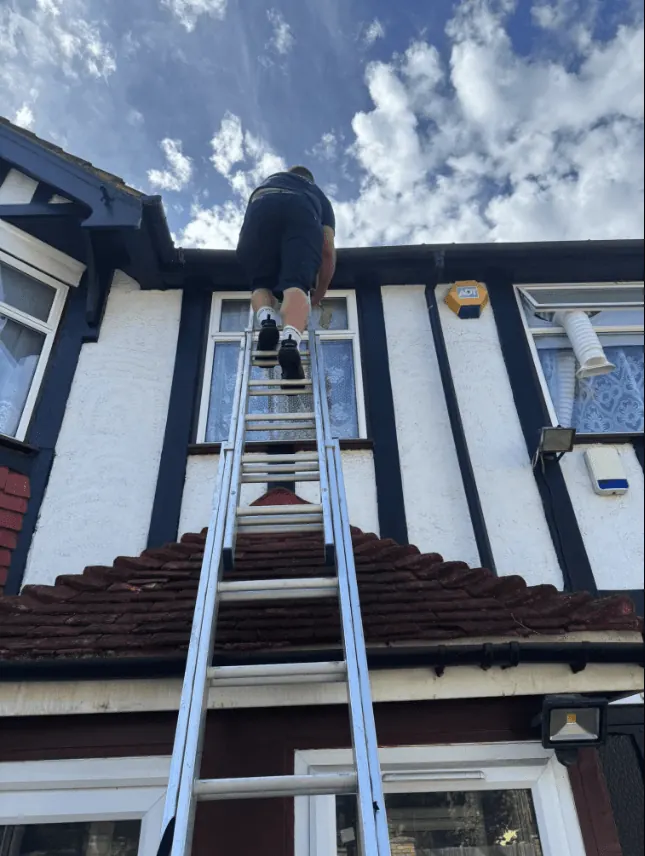
Where to start on a Vale roof
If you are not sure what state the roof is in, or you are buying here, a roof inspection is the place to begin. Slipped tiles, a loose ridge or a leak at a valley are jobs for roof repairs on 1920s roofs, and a roof that needs fixing somewhere new every winter may be ready for a full re-roof. Kitchen extensions, old coal sheds, coal-fire stacks and gutters each have their own page for the Vale, listed below. If water is coming in now, go straight to emergency roof repair.
We are a family run firm based on Kenley Road in Morden, a little under 3 miles west of the Vale. Quotes are free, and we can often call round and price a job the same day. On a terrace we look at where your roof meets next door's, and if a fault runs across the line we show you the photos so you can talk to your neighbour before anything is booked. If the back of the roof is hard to reach, we fly the drone rather than put up scaffolding just to look.
You can read more about the family and the team, or ring 0330 133 4111 to book a visit.
Frequently asked questions
Is my Streatham Vale roof the one the builders put on in the 1920s?
Quite possibly. Many houses here still have their first roof, especially where a family has owned the house for a long time. Others will have been re-covered after war damage, during years of council ownership, or by later owners. A look at the tiles, the ridge and the battens from the loft usually tells us which, and what that means for how long it has left.
Next door on our Vale terrace is having a new roof. Should we do ours at the same time?
It is worth thinking about. The houses were built together, so if next door's roof has worn out, yours may not be far behind. Doing both at once can also make the junction over the party wall neater. If yours still has years in it, we will say so.
A big street tree stands outside our Vale house. How often should the gutters be cleared?
Under a large crown, a clean in late autumn once the leaves are down and another in spring is sensible. Our gutter cleaning page for the Vale explains what each visit covers.
Our house is on the Merton side of the Vale. Does that change anything for roof work?
The roofing is the same job, but any planning or building control questions go to Merton Council rather than Lambeth. Like-for-like re-roofing is normally treated as maintenance, and if you are planning a dormer or other change, check with the right council first.





