



 Google reviews

The Edwardian terraces from Moyser Road to Welham Road
Much of Furzedown was built on the estate centred on Furzedown House, the late Georgian house that still survives on Spalding Road. When building on its grounds began in the early 1900s, Moyser Road, Pendle Road and Pretoria Road were the first streets laid out. The local builders Swain and Selley, who also put up hundreds of houses in Tooting, started on Welham Road in 1904, offering homes with a scullery and a bathroom with hot and cold water. Some of the streets that followed were not finished until the late 1920s.
These are mostly terraces and pairs with slate or tile main roofs and a narrower back addition behind. A roof of this age that has never been fully stripped is still held on by its original nails, usually with no underlay beneath. The faults that follow are slipped slates or tiles where those nails have rusted, crumbling ridge bedding, tired lead in the valley where the back addition meets the main roof, and stacks that have gone decades without repointing. Behind many of them sits a later kitchen extension with a flat roof, right where the rear gutters discharge. Our page on roof repairs in Furzedown goes through those faults one by one.
Wandsworth's council estate of 1926 to 1928
In July 1919 the Minister of Health told Parliament that Wandsworth Borough Council was negotiating to buy the Furzedown Estate for working-class housing. Between 1926 and 1928 the council built hundreds of homes here: parlour-type houses, cottage-type houses and maisonettes, the largest concentration of social housing built in Streatham before the Second World War. Wandsworth had already opened Furzedown Recreation Ground, beside Furzedown Drive, in 1924.
These roofs are plainer than the Edwardian ones, with simpler slopes and fewer valleys, but they too are now close to a hundred years old. Ridge mortar, chimney flaunching and lead, and any original timber at the eaves are the parts that tend to need attention first, along with concrete tile re-covers that have themselves aged. On the maisonettes, one roof covers two homes, so the lease matters as much as the leak. The roof repair page sets out how that works.
Streatham Park: clay tiles, listed houses and protected trees
In the north-east corner of Furzedown, south of Tooting Bec Common, is Wandsworth's Streatham Park conservation area, designated in 1987 and extended in 1989. It takes in Clairview Road, West Drive, North Drive, Ullathorne Road, Abbotsleigh Road, part of Thrale Road, Fayland Avenue, Rambler Close and Mulberry Close. The houses are larger and more varied than elsewhere in Furzedown: Edwardian gabled pairs on Clairview Road, detached inter-war houses on Abbotsleigh and Ullathorne Roads, late Victorian three-storey villas on Thrale Road, four early 20th century houses on Fayland Avenue, and architect-designed houses on North Drive and West Drive. Among them are Voysey's Dixcote, listed Grade II*, and Leonard Stokes's Yew Tree Lodge, Grade II. Furzedown Lodge on Furzedown Drive, Grade II, with its hipped slate roof and tall stacks under bracketed cornices, is also inside the conservation area.
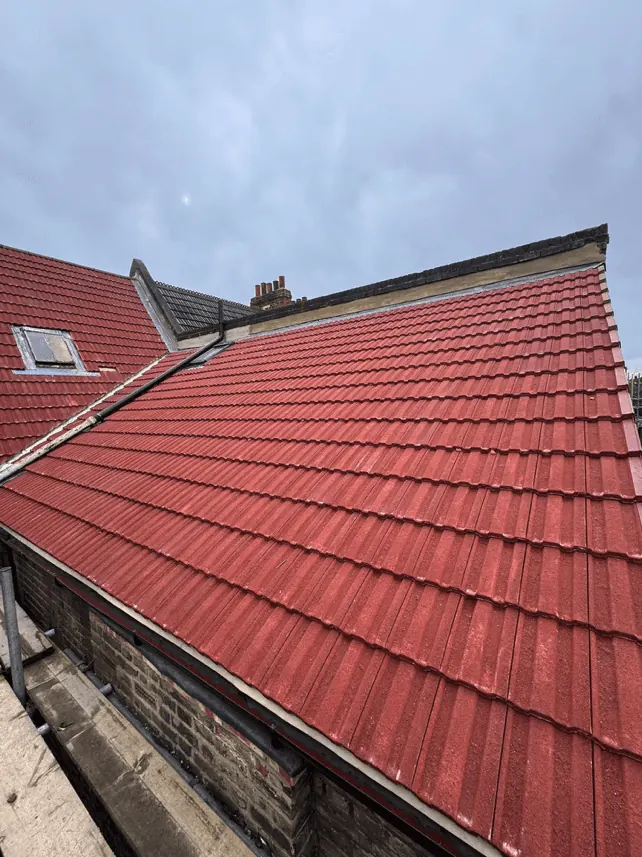
Roofs here are mainly plain clay tile, with a number replaced in concrete, and a few houses have tiles hung on bays, gables and dormers. Wandsworth's guidance asks for re-covered roofs to match the original, for good tiles to be kept for re-use, for chimneys to be kept, and for original materials to be looked after or reinstated. Like-for-like roof repairs are normally maintenance. Changing a covering, or altering a chimney on a flat or maisonette, is the kind of change to check with Wandsworth's planners first, and any roof extension to a house there needs planning permission.
Tree Preservation Order 53, made in 1984, protects 250 trees and three groups across the area. Around West Drive, street and garden trees are a big part of what blocks gutters in autumn, which our Furzedown gutter cleaning page deals with.
Furzedown House and the old golf course
Just outside the conservation area, Furzedown House on Spalding Road, now part of Graveney School, is listed Grade II, with hipped slate roofs and a limestone conservatory under a felt-clad barrel roof. Any work on a listed building needs listed building consent, and that conversation comes before a quote.
The western side of Furzedown has a different back story. From 1892 part of it was a golf course designed by Tom Dunn, until the club moved to Mitcham Common in 1906. The roads over the old course were laid out mainly between 1900 and 1930, which is why the house ages there run in much the same band as the rest of Furzedown.
Whichever part you live in, a roof inspection in Furzedown is a sensible first step if you are unsure what the roof needs. Josh flies our drone, so rear slopes, valleys and chimney tops can be seen without scaffold. You can see finished jobs on our work page or reach us through the contact page.
Frequently asked questions
Which roofs in Furzedown are listed?
Dixcote at 8 North Drive is Grade II*. Yew Tree Lodge on West Drive, Furzedown Lodge on Furzedown Drive and Furzedown House on Spalding Road are Grade II. Historic England's list is the place to check a specific address.
Is Wandsworth's Streatham Park conservation area the same as Lambeth's?
No. Lambeth has a separately named Streatham Park and Garrads Road conservation area. If your house is in Furzedown, Wandsworth's planning service is the one to ask about boundaries and guidance.
Are the 1920s council-built houses roofed differently from the Edwardian ones on Pendle Road?
Generally they have simpler roofs with fewer valleys. The Edwardian terraces have back additions, more valleys and more lead, so there is more to go wrong on them.
Does Furzedown House's slate roof tell me what my own roof should be?
No. Furzedown House is much older than the streets around it and is listed in its own right. Your roof should match what your house was built with, which on the Edwardian streets is usually slate or tile, and in Streatham Park mainly plain clay.





