



 Google reviews

Flat roofs on the estate north of South Lodge Avenue
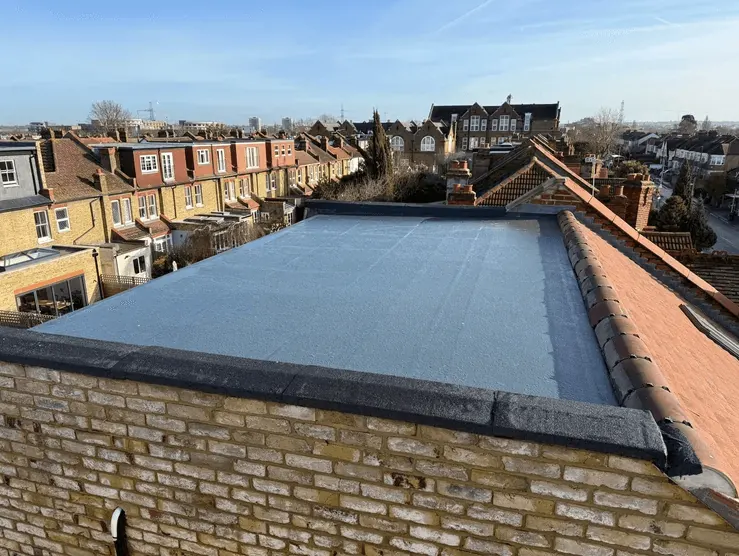
For freeholders on the Pollards Hill estate, most roof work is flat roof work: an outlet that has silted up, a junction with next door that has opened, or a covering that needs repair or re-covering. A Merton planning committee report describes the original terraces as three-storey blocks of flat-roofed housing, often fronting courtyard parking. The closes are named after counties of England and Wales, Cheshire Close, Glamorgan Close, Monmouth Close and Radnor Close among them.
Three things follow for the roofs:
- A flat roof gives no visible warning from the ground. Trouble usually shows first as a stain on a top-floor ceiling.
- At three storeys, the roof is out of reach of an ordinary ladder, which is why we usually start with a drone.
- Roofs in a terrace run into each other, so a fault at a junction can surface in the neighbour's house rather than the one with the problem.
Moat, which took on part of the estate in 1998, ran a regeneration programme of 796 homes that included new insulated roofs, external wall insulation and new windows. Merton approved the scheme in 2016, and the contractor's case study gives completion as 2019. Of those 796 homes, 410 are freehold. If yours is one, the roof and gutters are yours to maintain. If you rent from Moat, report roof faults to Moat. Our flat roofing page for Pollards Hill goes into the repairs in detail.
How the estate came to be flat-roofed
The estate was designed by a team in Borough Architect Bernard Ward's department. According to the Mitcham News & Mercury of September 1972, it had 562 houses and 288 flats, its first tenant moved in on 28 January 1971, and it won the RIBA South East Region Award for housing a large number of families without building tower blocks. Low, dense terraces with flat roofs were how it did that. The library and community centre on the estate was extended and refurbished in 2009 with a new external envelope.
Before that, Mitcham Borough Council had already built on what was left of the Pollards Hill golf course. Merton's photo archive records six-storey maisonette blocks, from Westmorland Square in 1950 to Bovingdon Square in 1956. Moat has since demolished four 1950s maisonette blocks in its wider regeneration. Blocks of that size are managed buildings rather than houses an owner re-roofs, so these pages concentrate on houses.
Semis around the Chestnut Grove roundabout
Merton's character study says Pollards Hill developed from the 1930s on former farmland and Pollards Hill Wood, and that away from the estate it is cohesive rows of interwar suburban houses with front and back gardens. The south-west of the neighbourhood radiates from a roundabout where five roads meet: Chestnut Grove, Sherwood Park Road, Wide Way, Recreation Way and South Lodge Avenue.
These are pitched, tiled roofs on semis and short terraces, many with pebbledash or render. Houses of this age and type tend to need ridge and hip bedding renewed, lead or cement fillets at the chimney replaced, extension flat roofs re-covered, and fascias and gutters renewed as the timber behind them gives out. Where a roof has never been stripped, it may still sit on its original battens, and our roof repairs in Pollards Hill page covers the faults that brings.
South of South Lodge Avenue, much of the original estate has been rebuilt, and Merton's report notes that several of the newer houses have oversailing mono-pitched roofs: single slopes that overhang the walls. Their gutters and soffits carry more than most.
Merton side or Croydon side
Pollards Hill sits on the border of Merton and Croydon, between Mitcham, Norbury and Thornton Heath. The crown of the hill is a park, given to Croydon Council in 1913. This page is about the Merton side, mostly in the CR4 postcode, including the estate, the streets around the roundabout and South Lodge Avenue. The Croydon side is covered on our Norbury pages.
On planning, Pollards Hill is not in any of Merton's conservation areas. The Article 4 direction that covers Pollards Hill ward concerns conversions to small houses in multiple occupation, not roof alterations, and like-for-like roof work normally needs no permission. A look at the roof is usually the first step, and the quote that follows is free. Every service we offer is listed on our services page.
Frequently asked questions
I own a freehold house in one of the county-named closes. Is the roof mine?
Usually, yes. Freeholders on the estate maintain their own roof and gutters. Moat's works included freeholders' roofs because the roofs share elements, so keep any paperwork from that programme, as it may affect who deals with an early fault.
Does the Article 4 direction covering Pollards Hill ward affect roof work on the Chestnut Grove side?
No. That direction removes permitted development rights for converting a house into a small HMO. It says nothing about roofs, and the streets are outside any conservation area, so dormers and changes to a roof's shape follow the normal permitted development and Building Regulations rules.
How do you look at a three-storey flat roof in Glamorgan Close without scaffolding?
With a drone in most cases. It covers the whole roof, including where yours meets the neighbours', from the ground. Where a closer look is needed, we plan the access before we come.
Is my house on South Lodge Avenue on the Merton or the Croydon side?
South Lodge Avenue, the estate and the streets around the roundabout are on the Merton side. The hilltop park and the slopes towards Norbury are in Croydon. If you are unsure, call 0330 133 4111 and we will tell you which page fits your street.





