



 Google reviews

Dawson Road, where the roofline is the street
Stand at one end of Dawson Road and most of what you see above the bay windows is roof, party wall and chimney. Kingston Council's Norbiton character study describes the street as fine two-storey Edwardian houses with ground-floor bays, a townscape "of roofs, party walls and chimneys". It also notes that the street lacks trees and is swamped by parking.
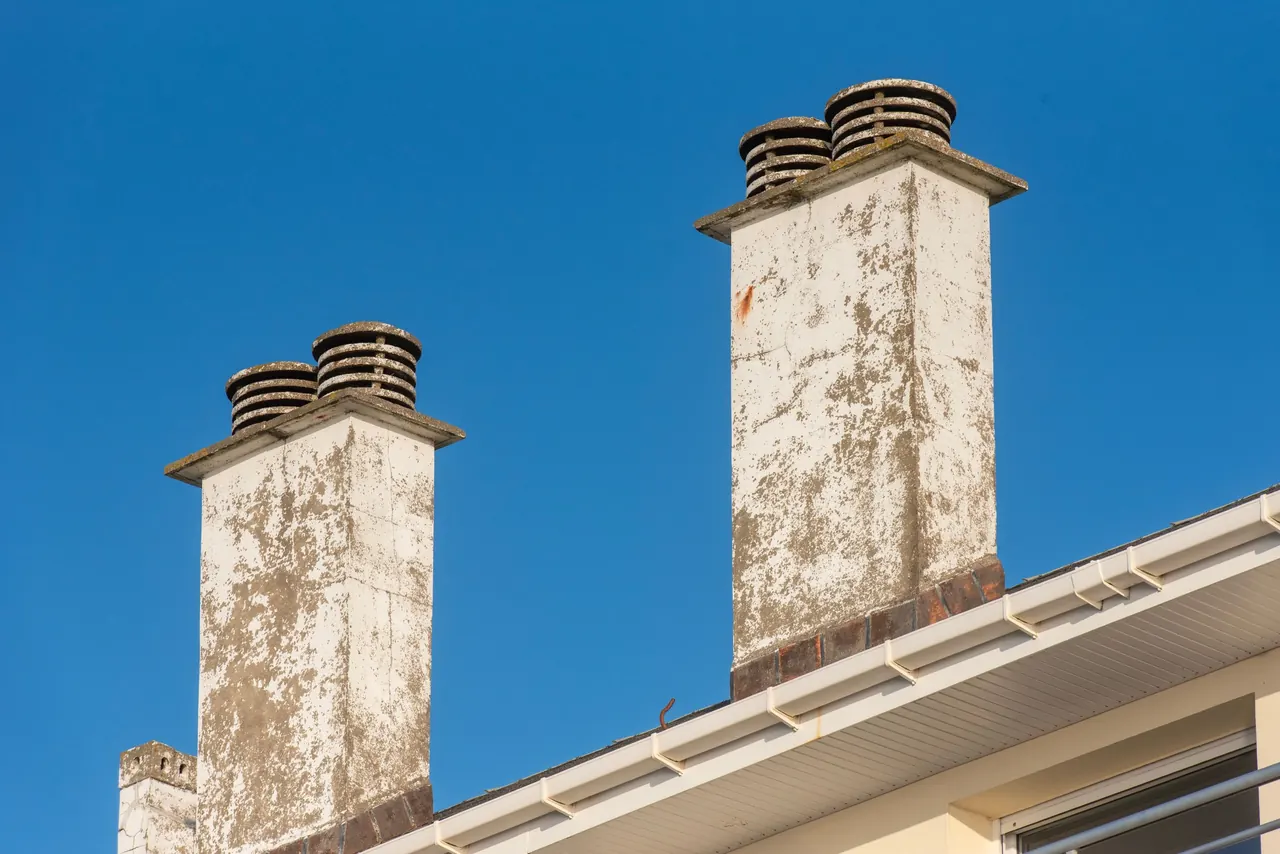
A stack like these takes all the weather whether or not the fireplace below is still used. Rain soaks into the top courses, frost works at the joints, and the mortar collar around the pots cracks. Without a fire to dry it out, a disused flue can stay damp for years. The first sign is often a stain on the chimney breast upstairs rather than anything visible on the roof.
On a street this full of cars, access is the part that takes planning. Small jobs such as refixing a section of flashing or resetting a pot can often be done from roof ladders. Re-leading, a full repoint or a rebuild usually needs scaffolding, and that has to fit around the parking. We photograph the stack by drone first, so the access put up matches the job that actually needs doing.
Stacks on the party walls off Bonner Hill Road
Around Bonner Hill Road, Linden Crescent and Rowlls Road, the study records semis with expressed party walls rising through the roof. On many semis of this age the stack sits on the party wall and serves both houses, with each side's lead dressed onto its own roof. When one half is re-leaded and the other is not, the join between the two can become the weak point, so it helps to talk to next door before work starts.
Because the stack and the raised wall meet, a leak at the chimney can also come from the party wall flashing just below it. Our roof repairs in Norbiton deal with the tiles and the upstand if they turn out to be the cause.
Height on Birkenhead Avenue and at Norbiton Hall
The three-storey late Victorian villas on Birkenhead Avenue put their chimneys a long way up, and next door the two Norbiton Hall blocks have a row of stacks along a four-storey pitched roof. At that height a failing stack is a safety question as well as a damp one, because a loose pot or brick falls a long way. After a storm, a cracked or leaning stack here is a case for our emergency roof repair in Norbiton.
The repairs themselves are the familiar ones: lead flashing refitted or renewed where wind has lifted it, eroded joints raked out and repointed, cracked flaunching renewed and rocking pots reset, and a ventilated cowl on an unused flue. As a national published figure, MyJobQuote's chimney leadwork cost guide gives £150 to £250 for a patch repair to flashing, rising to £450 to £600 where scaffolding is needed, which on the taller villas it usually is. Our chimney maintenance guide lists what to check between repairs, or call 0330 133 4111.
Frequently asked questions
Our Dawson Road stack has a slight lean towards the road. Is it dangerous?
A lean needs looking at soon. On old stacks it is often caused by the mortar on one side breaking down faster than the other, sometimes from years of flue gases. We check how far it has moved and whether it can be repointed or needs rebuilding from the roofline up.
Dawson Road is packed with parked cars. Can our stack still be repaired?
Usually. A smaller job may only need roof ladders, and where scaffolding is needed it can sometimes stand within the front garden rather than on the pavement. The drone photos tell us which before we quote, and if a licence is needed for anything on the pavement, we tell you at that stage.
Do the stacks at Norbiton Hall need council consent to repair?
The blocks are on Kingston's local list, which is weighed when a planning application is made. Like-for-like repairs to the stacks normally do not need one. Removing or reshaping stacks would be a different matter, and the managing agent should check with the council first.





