



 Google reviews

A small group of older stacks
Nine Elms grew up around rail yards, gasworks and wharves, and the crowded terraces that housed the people who worked in them were largely cleared and rebuilt from the 1950s. A good number of the old pubs have since been demolished too. The estate blocks and riverside towers that replaced them have no chimneys at all, so what remains is a scattering of older brick buildings, mostly converted to flats or mixed use. If your building has a stack, it is one of a fairly small group.
The best known is St George's vicarage at 33 Battersea Park Road, built in 1862 to 1863 to designs by the church architect Ewan Christian and now divided into flats. We have not inspected it, but a building of that age and type was usually built with brick stacks and lead at the junctions, and the same goes for the older shops and commercial buildings along the main roads.
Flues that run past several flats
On a converted building, one stack often carries flues from several flats. A fault at the top can show up some distance away, often in a top-floor flat that never had a fireplace of its own, and the repair is usually a matter for the freeholder or the management company rather than one flat owner. That is worth knowing before you call, because they will need to agree the work and the access.
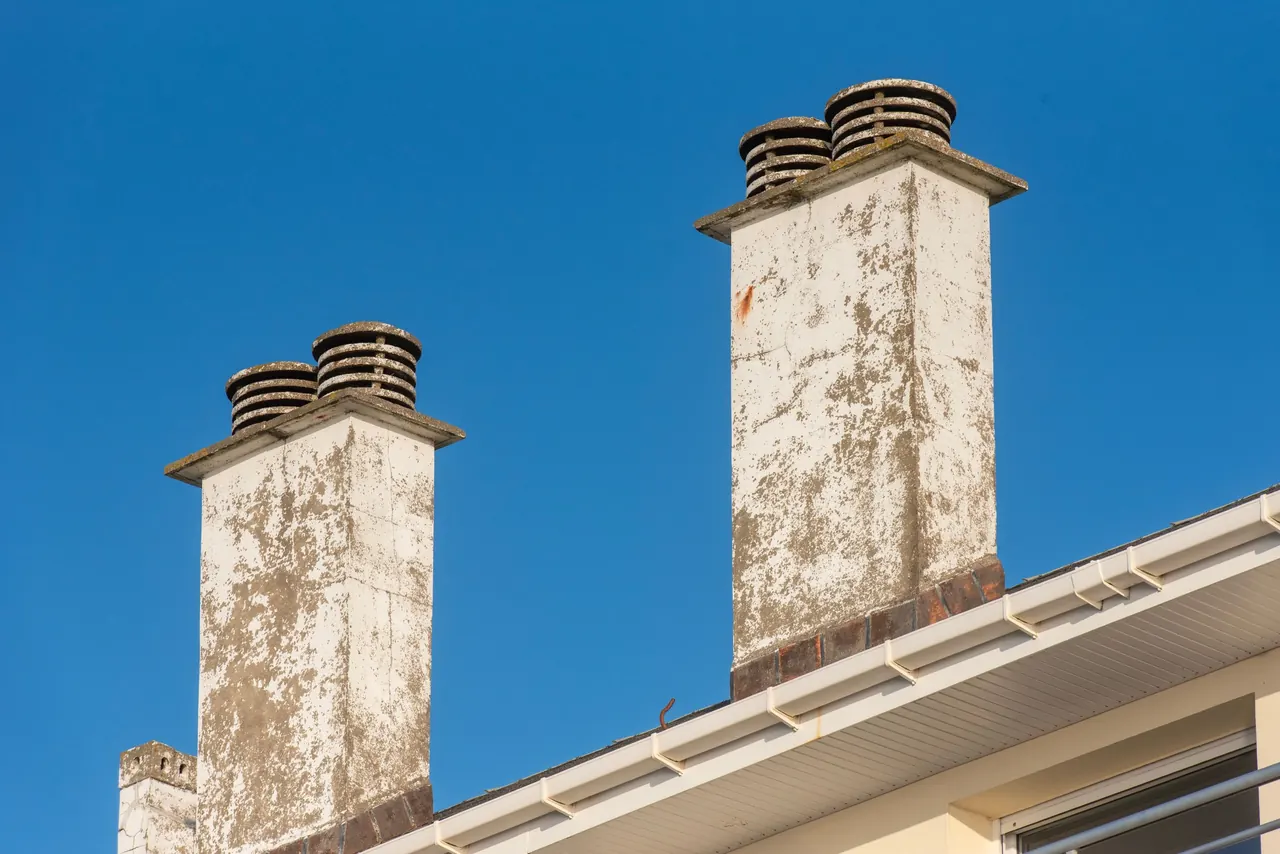
The damage on a tall, exposed stack builds slowly:
- Lead flashings lift or split where the mortar holding them into the brick has weathered out. This is the most common route for water into the room below.
- Pointing erodes on the weather side first, so rain soaks into the brick.
- Flaunching, the mortar bed around the pots, cracks and lets water into the top of the stack, and the pots start to rock.
- Pots on flues nobody uses stay open to the rain and to nesting birds.
Pavement scaffold on Battersea Park Road
On a building fronting a busy road, seeing the top of the stack is half the job and scaffolding is most of the cost. Where the airspace allows, we photograph the stack by drone first, so a scaffold only goes up once we know what it is for. Nine Elms sits close to the London Heliport restriction zone, so we check each address before promising a flight, as our Nine Elms roof inspection page explains. Where flying is not possible, we look from the roof itself or from a high window.
Scaffold on the pavement needs a licence from the highway authority, and we apply for it as part of planning the job. The repair itself might be re-dressing or replacing the lead, repointing, renewing the flaunching and resetting the pots, or capping a disused flue. We check how every flue is used before fitting anything, because a flue still serving a fire or stove needs a cowl made for a working flue. Our main chimney repair page covers each repair in more detail.
As an outside benchmark, MyJobQuote's leadwork guide puts a patch repair to chimney flashing at £150 to £250 nationally, before any scaffolding.
Frequently asked questions
Water is coming in beside the stack on our converted building off Battersea Park Road. Is it the chimney?
Very often. A leak beside a stack is usually the lead flashing or the back gutter behind the stack, where water and debris collect. Sometimes it is the roof covering around it. We check all three, and if the roof itself is at fault our roof repair page covers that work.
The pots on our building above the Wandsworth Road pavement rock in strong wind. Is that dangerous?
It can be. A loose pot on a tall building above a pavement is a risk to people below. Keep the area underneath clear and get it looked at quickly. Usually the flaunching needs renewing and the pot resetting.
I own one flat in a converted Victorian building in Nine Elms. Can I book a chimney repair myself?
You can ask us to look, but a shared stack is normally the freeholder's responsibility under the lease, so they need to agree the work. We can give you a photo and a written note of the fault to send them.





