



 Google reviews

Hoppers and long downpipes on estate blocks
A 2016 street-by-street history of the area recorded two runs of early 1960s flats on Battersea Park Road, built for the London County Council by the Reema method of precast concrete panels, and described them as painted bright blue. The same source notes that most of the Reema blocks built on the Savona Estate have since been demolished. If your block is one of the survivors, or one of the older estate blocks around them, it may well have no gutter on the front the way a house does. On many blocks of that era rain is collected at roof level, often in a gutter behind a parapet, and taken down the face of the building through a hopper and a long run of downpipe.
That arrangement has its own weak points. When a hopper cracks or a downpipe joint comes apart three or four floors up, the water runs down the wall and soaks into it on the way. The damp often appears in a flat well below the actual fault, and on the side of the building nobody looks at. So a gutter repair on a block starts by following the water upwards.
Broken parts from parapet to pavement
- At roof level: a parapet gutter lining that has split, or an outlet whose seal to the gutter has failed, so water goes into the wall instead of the pipe.
- At the hopper: cracks, rust holes in old cast iron, or a hopper that has come away from its fixings.
- Along the downpipe: joints that have slipped apart, brackets that have pulled out of the wall, sections cracked by frost or by something hitting them.
- At the bottom: a shoe or connection broken by bins, bikes or delivery vans, so water runs across the paving and back against the wall.
On the low-rise buildings with eaves gutters, the list is the familiar one: dried-out joint seals, brackets that have failed and let a run drop, and plastic gone brittle in the sun.
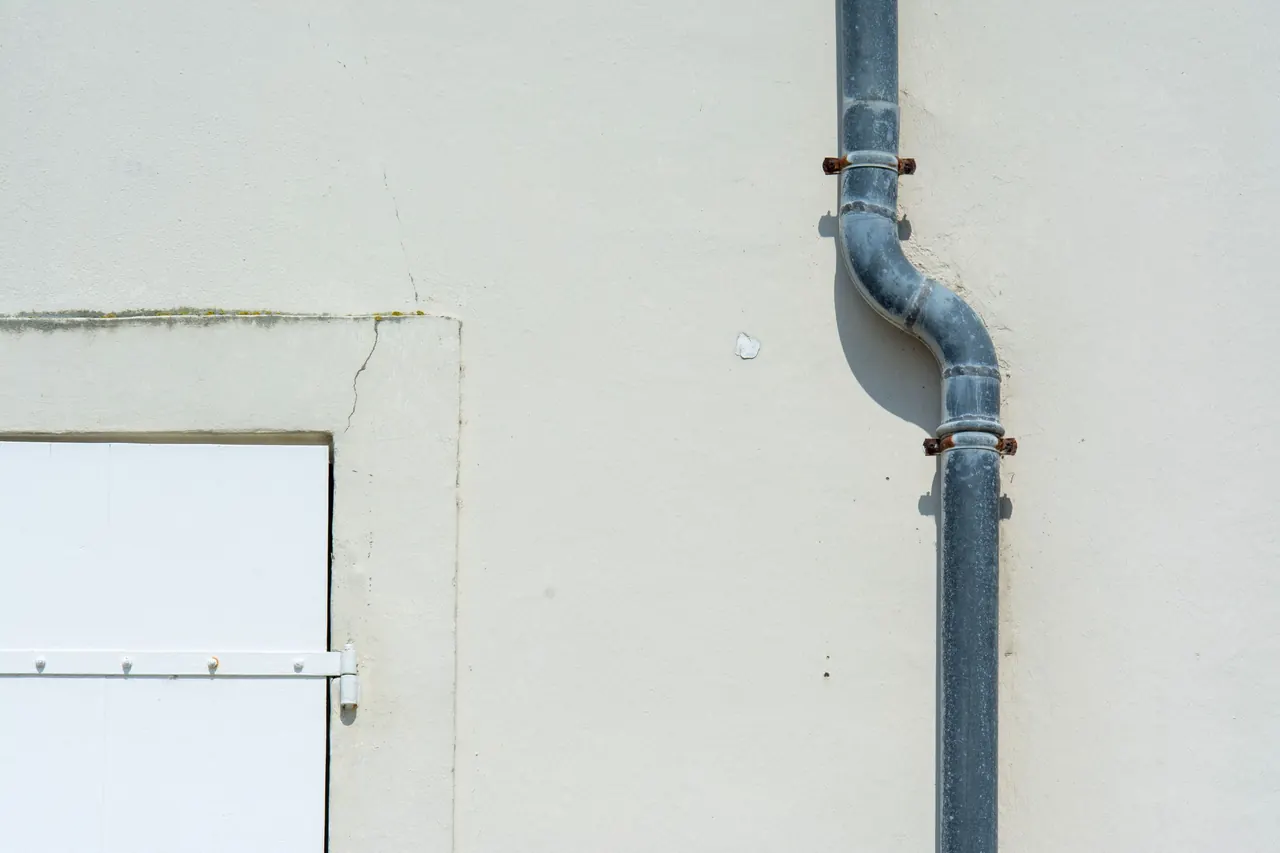
Reaching a fault four floors up
We replace a cracked hopper or downpipe section with one that matches, rejoin and rebracket loose sections, and reseal joints after cleaning them back properly. Where a run has dropped, we reset the brackets and the fall. If an outlet at roof level is the problem, we remake its seal to the gutter lining. Where old cast iron is sound apart from one failed piece, we replace just that piece rather than the whole stack.
Before we price anything, we agree access with the freeholder or managing agent. On a four or five-storey block, the way we reach the fault safely is often a bigger part of the job than the repair itself, so we set it out clearly in the quote. Once the repair is done, we run water through the system to prove it.
If the whole system is past saving, a new installation is the better spend, and our Nine Elms gutter installation page covers that. If an outlet or hopper is choked rather than broken, that is a job for our blocked gutter repair service. For a rough national figure, MyJobQuote's repair guide puts a typical UK gutter repair at about £215, on a house rather than a block.
Frequently asked questions
There is a damp stripe down the outside of our block on Battersea Park Road. Is it the downpipe?
Very likely, especially if it starts below a hopper or a downpipe joint. Sometimes the cause is higher, at the outlet where the parapet gutter meets the pipe. We follow it up to where it starts. Our guide to water leaking behind a gutter explains the other causes worth ruling out.
Can you replace a single cracked hopper on our private block without scaffolding?
Sometimes. It depends on the height, what is below and whether the hopper can be reached safely from a window, a lower roof or a ladder. We tell you before quoting what access the job needs and why.
As a leaseholder on the Patmore Estate, can I get a downpipe fault repaired myself?
The downpipes on a council block are the council's to repair, so report it to them first. Our Nine Elms page explains how a written note of the fault can help if the repair stalls.





