



 Google reviews

Gutters from the cast iron era
Kingswood's older housing comes from two short periods. The Edwardian houses along Waterhouse Lane and its neighbouring lanes were built after the Kingswood Warren estate was broken up in 1906, up to the First World War. Then, from 1923, Richard Costain and Sons developed the land between Waterhouse Lane and Copthill Lane. Both were built when cast iron was the normal material for gutters and downpipes, decades before plastic gutters arrived.
A century later, what is on any one house is hard to guess. It may still have its iron, painted many times over, or plastic on one elevation and iron on another, or a patchwork of repairs from different decades. Each needs a different kind of fix, so the first job is finding out what you actually have.
Cast iron that has been kept painted can last a very long time. The trouble starts where paint has failed. Rust works into the joints and the back of the gutter, where you can't see it from the ground, and eventually a section cracks or the bolt at a joint rusts through.
Iron joints on the Waterhouse Lane houses
Most iron gutter repairs are about the joints. Sections are bolted together over a sealant, and after decades the sealant dries out and the bolt corrodes. The joint is taken apart, cleaned back, resealed and fitted with a new bolt. A single cracked length can usually be replaced on its own with a new piece of the same profile, half-round or ogee, so the eaves line stays the same.
Iron is heavy, and on these houses the brackets are often screwed into a timber board or directly to the rafter feet. If that timber has softened, the run drops, water ponds at the low point and the joint there starts dripping. The timber is sorted first, which may mean our Kingswood fascias and soffits work, and then the run is reset to a fall.
Paint is what keeps iron going. Bare metal rusts fast, so a repaired section should be primed and painted soon afterwards, and the rest of the run lasts longer if it is painted at the same time.
When rust has eaten through the base of the gutter in several places, repairs become a stopgap. A new system is then better value, and our Kingswood gutter installation page goes through the choices for period houses.
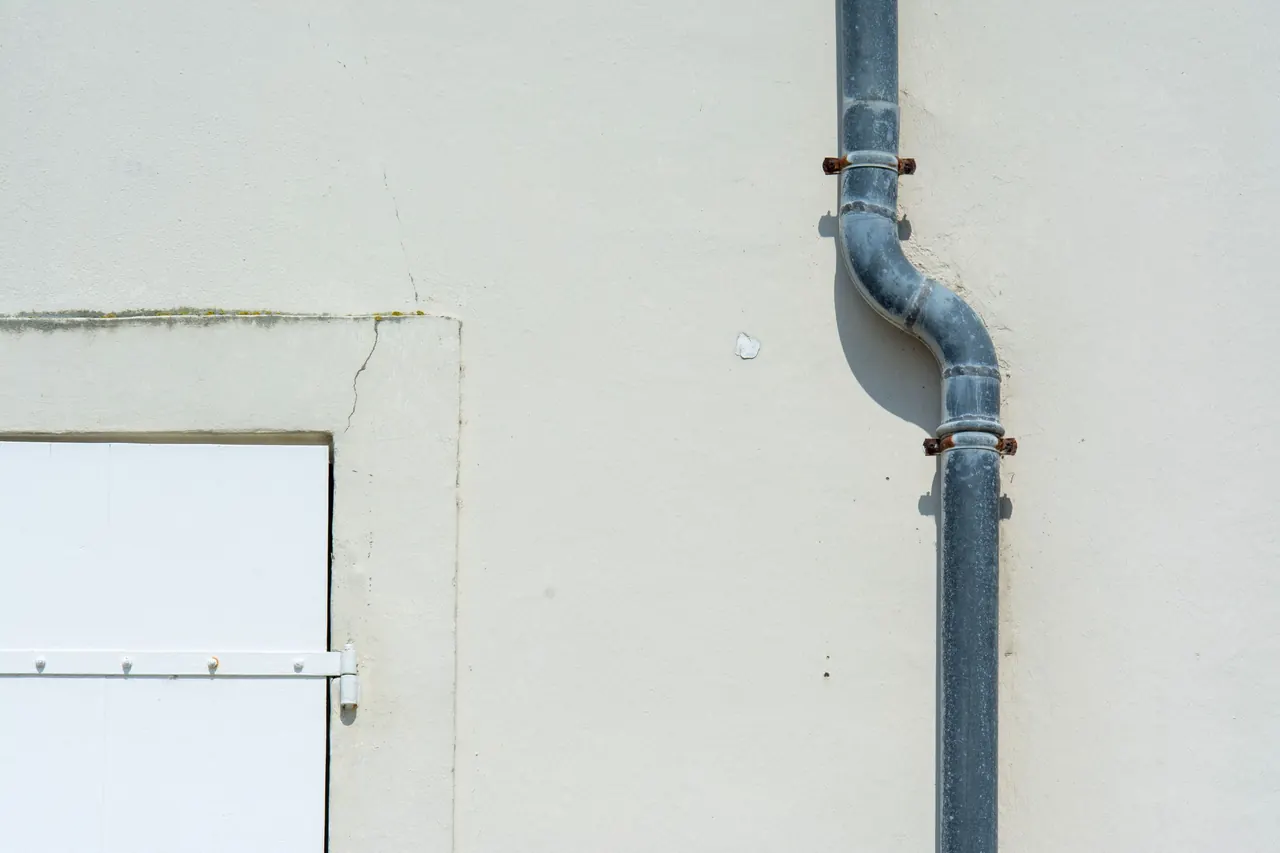
Iron meeting plastic on the Costain houses
Where iron has been swapped for uPVC, the faults are different: perished rubber seals at the unions, clips snapped by expansion, and old plastic turned brittle in the sun. Seals and clips are replaced and cracked sections swapped out. Faded plastic that cracks when you press it is usually past repairing.
The awkward spots are where materials meet, such as plastic joined onto iron with an adaptor, or a newer section hung at a different height. Those joints leak more often than either material on its own. They are made good, or, if the mix keeps causing leaks, replacing that elevation is the better advice. If water is staining the wall below rather than dripping from the front, our guide to water leaking behind a gutter explains why.
As a national guide, MyJobQuote's gutter repair guide (2026) gives a UK average of about £215 for a repair. Long elevations or a tall gable can add to the access.
Frequently asked questions
Where can you find matching ogee lengths for a 1910 Kingswood house?
Cast iron ogee and half-round gutters are still made in standard sizes, and reclaimed lengths turn up too. Your profile is measured and matched, so the new piece lines up with the old ones on either side.
Rust stains are running down the tile hanging below our gutter on The Glade. What is causing it?
Usually a joint or a rusted section dripping onto the wall. Left alone, that water gets behind the hung tiles and into the battens. Repairing the joint stops it, and painting the gutter afterwards keeps it from starting again.
Our 1920s house off Copthill Lane has iron at the front and plastic at the back. Can you repair both?
Yes. Each is repaired on its own terms, with most attention on where the two meet, since adaptor joints between iron and plastic are a common leak point.





