



 Google reviews

Garages and studios under a canopy
A detached garage at the end of a Kingswood drive, or a studio at the bottom of a long garden, often sits under a mature oak. Every year it takes leaves, acorns, catkins, twigs and the odd fallen branch, and it spends much of the day in shade. Big plots here also mean single-storey link corridors and rear wings added to Edwardian and 1920s houses, many of them flat-roofed.
On roofs like these, debris causes most of the failures. A mat of wet leaves at the outlet stops the roof draining, water ponds behind it, and a covering under standing water wears out years early. Shade keeps the surface damp, so moss and algae take hold on old felt and hold moisture against it. A falling twig can puncture a tired covering outright. Our guide on water pooling on a flat roof explains when ponding is a warning sign and when it is just a slow outlet.
So the first things to check on a Kingswood outbuilding roof are the outlet, its size and whether you can reach it to clear it; the fall, because a roof that has sagged keeps its debris; and the deck, since soft or springy spots underfoot mean rotten boards that no new covering will fix.
Where a flat roof meets a tile-hung wall
On the Edwardian houses around the station, the walls a rear wing or garage roof runs into are often tile hung rather than plain brick. That makes the junction trickier. The covering turns up the wall as an upstand, and the weathering above it has to work with the hung tiles, usually with lead tucked behind the bottom course rather than a flashing chased into brick. Where this has been done with mastic, or the hung tiles have slipped, water gets behind the upstand and appears on the ceiling below, often well away from the wall.
The fix is to open up the junction, renew the upstand and refix the hung tiles over new lead, matching any that are cracked. On a brick wall, the flashing is cut into a mortar joint and dressed down over the upstand.
Dormers on the steep main roofs bring the same problem at a smaller scale: a small flat top, lead cheeks against the clay tiles, and debris collecting behind the dormer. Dormer tops are re-covered and the cheeks and soakers checked while we are up there.
Re-covering an outbuilding roof that drains
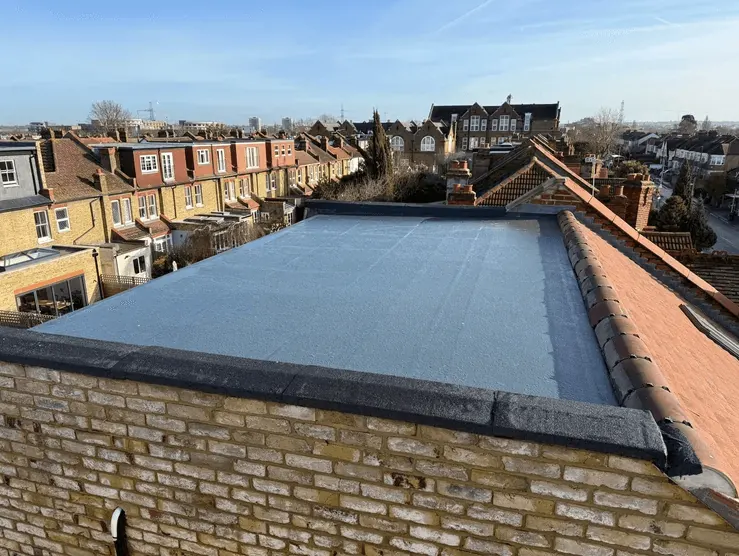
A sound roof with a split, a blister or a failed upstand can be repaired. One that leaks in several places or has a soft deck is better stripped and re-covered, since patching only moves the leak. When we re-cover, the rotten decking comes out, the falls are corrected, and the roof is laid in EPDM rubber, GRP fibreglass or torch-on felt with new trims and outlets. EPDM goes down in large sheets with few joints, which suits a big garage roof under trees. GRP gives a hard, jointless finish that suits dormers and roofs seen from upstairs windows.
As a national guide, MyJobQuote's flat roof cost guide (October 2026) gives £110 to £160 per m² for a rubber roof and £120 to £180 per m² for GRP, fitted. If you are adding a new building rather than renewing an old roof, our Kingswood roof installation page covers it, and if the gutter taking water off the flat roof keeps choking, the blocked gutter page explains how the cause is found.
Frequently asked questions
Twigs from the oak keep blocking the outlet on our Kingswood garage roof. Can it be changed?
Often, yes. During a re-cover we can fit a larger outlet, add a second one, or move it to the edge so it drains into a gutter you can reach from a ladder. A domed grille keeps the worst of the twigs out of the pipe.
The felt roof on our link corridor to a 1920s garage off Copthill Lane sags in the middle. What does that mean?
Usually that the deck boards have softened from long-term damp, often after years of ponding. A new covering on a soft deck won't last, so the boards need replacing and the fall correcting first.
Can you re-cover the flat top of a dormer on a tile-hung Edwardian house near Kingswood station?
Yes. The dormer top is stripped and re-covered, then the lead soakers and cheeks against the clay tiles are checked, which is where dormers on these houses usually let water in.





