



 Google reviews

Trinity Crescent's tall stacks
Numbers 5 to 19 Trinity Crescent are four pairs of mid-nineteenth century yellow brick houses, three storeys over basements. That is the description in Wandsworth Council's 2007 draft Holy Trinity appraisal. With a basement below and three floors above, a stack here starts high, and its top is hard to see properly from the pavement or the garden.
On stacks this exposed, the parts that suffer first are at the top:
- Flaunching, the mortar bed holding the pots, cracks and lets water into the top of the stack.
- Pots loosen in the flaunching, and on a stack this high a loose pot is a hazard over the front steps and basement area.
- Pointing on the faces that take the weather washes out, and the brick behind starts to take in water.
At the base, the back gutter on the uphill side of a stack collects leaves from the crescent's trees, and once it holds water it overflows under the slates. Old repairs in mastic or flashing tape in place of lead look fine from the ground and fail in driving rain. We replace them with lead cut into the brick joints.
Seeing the stack before anyone pays for scaffold
On a house three storeys over a basement, scaffold is a big part of any chimney bill. A drone flight first shows the stack close up, pots, flaunching, pointing and every side of the lead, so scaffold is booked only if the work needs it and you see what you are paying to fix. Often a chimney scaffold can be set from the roof slope instead of running a full front from the basement area.
For budgeting, MyJobQuote gives published figures of £150 to £250 for a patch repair to chimney flashing and £350 to £460 for full replacement leadwork, before any scaffolding.
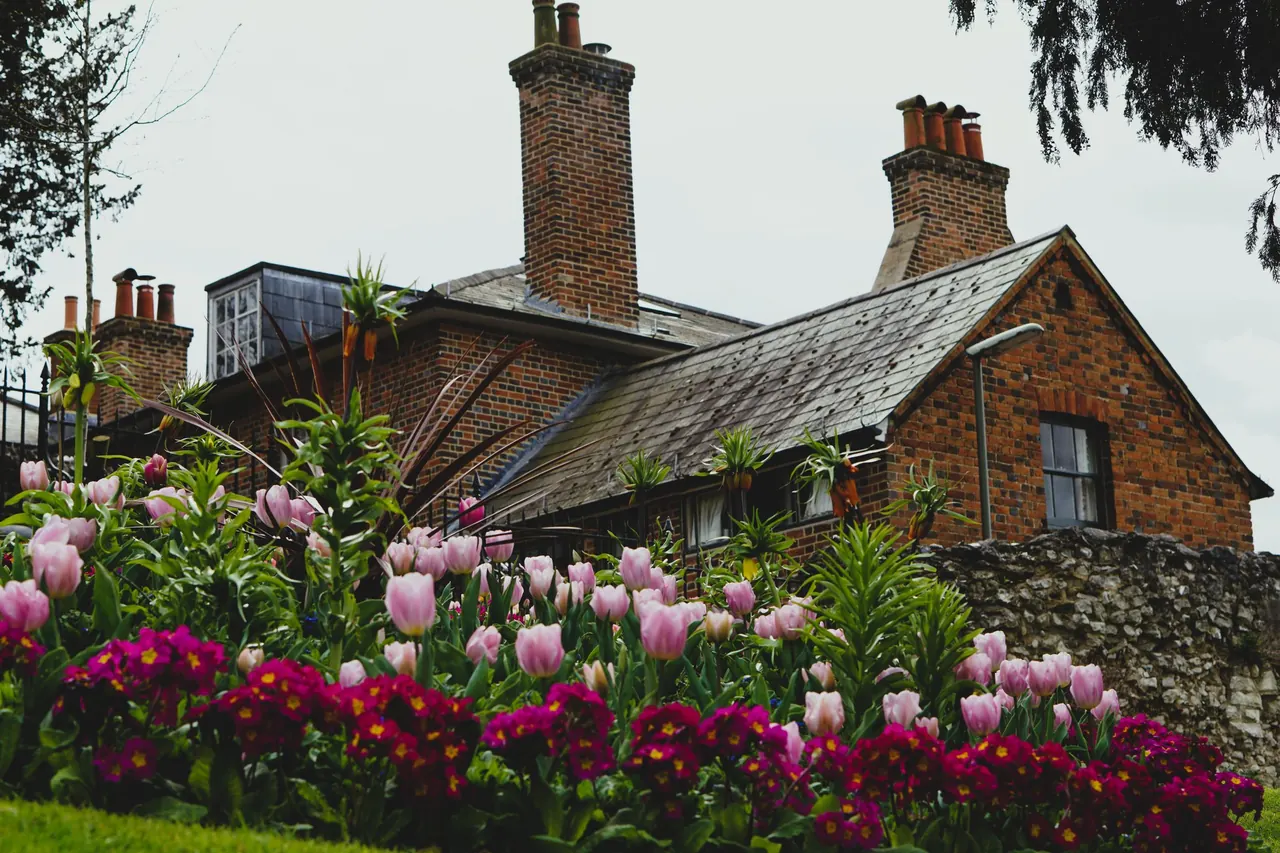
Heaver's houses on Trinity Road and round the corner
On Trinity Road, Heaver's villas at 121 to 147 have a three-storey gabled front with a two-storey wing, so where a house has stacks on both parts, they sit at different heights. On Dalebury and Crockerton Roads the houses come in pairs and short terraces of four. On pairs and terraces like these a stack is often shared on the party wall, so check whose flues it carries before work starts. If it is shared, both households should see the photos.
Where a flue is still used for a stove or fire, it needs the right cowl or guard. An unused flue still needs some airflow, so it is not sealed at both ends. More on the work itself is on our main chimney repairs page. Leaks beside a stack that turn out to be roof faults are covered on our Upper Tooting roof repair page.
Listed buildings and the conservation area
Like-for-like chimney repair, in matching brick, mortar and lead, is maintenance. Taking a stack down or changing how it looks from the street is a different matter in a conservation area, so talk to Wandsworth Council first. Listed buildings need listed building consent for most works that affect their character. The appraisal's listed buildings are Holy Trinity Church, 1 Trinity Crescent and the Grade II Trinity Road fire station of 1907, whose prominent chimneys it notes.
The Totterdown Fields cottages further south have their own chimney guidance; our Tooting chimney repairs page covers that estate.
Frequently asked questions
Can you reach the chimney on a Trinity Crescent house without scaffolding the whole front?
Often, yes. Depending on the roof, a chimney scaffold can be set up from the slope, or a section of scaffold run up the side. That is worked out from the drone photos.
My Trinity Road villa has stacks on the gabled front and on the lower wing. Do both need checking?
Yes. They sit at different heights and take the weather differently, so one can be sound while the other is not. The drone photos cover both.
Is there a council rule on chimney pots for Dalebury and Crockerton Roads?
The Holy Trinity appraisal does not set one. Its general advice is to repair original features and avoid changes that make one house stand out from its group, so matching pots are the safe choice. Check with Wandsworth Council before any change to the stack itself.





