



 Google reviews

Short pots on continuous roofs
A damp patch on the chimney breast in an upstairs room on Openview or Fieldview usually traces back to one of three places: the lead at the back of the stack, the stepped flashing at its sides, or the flaunching around the pots. These are modest stacks. Wandsworth's Magdalen Park appraisal describes both estates as having continuous roofs with no party walls projecting through them, broken only by simple brick stacks with short clay pots. On Openview the roof around them is slate; on Fieldview it is plain clay tile.
A stack in the middle of a continuous roof has slope on every side. The back of the stack faces up the roof and catches everything running down it, so the back gutter there needs a proper lead lining. The sides need stepped flashing cut into the mortar joints. When that mortar softens, the flashing loosens with it, and water runs down inside the brickwork into the roof space.
The appraisal says more generally that large chimneys add visual interest and should be retained. The estate stacks are small, but they are part of a design repeated along every group, so a repair keeps the stack at its height and the pot at its size.
Stacks on the party walls north of the station
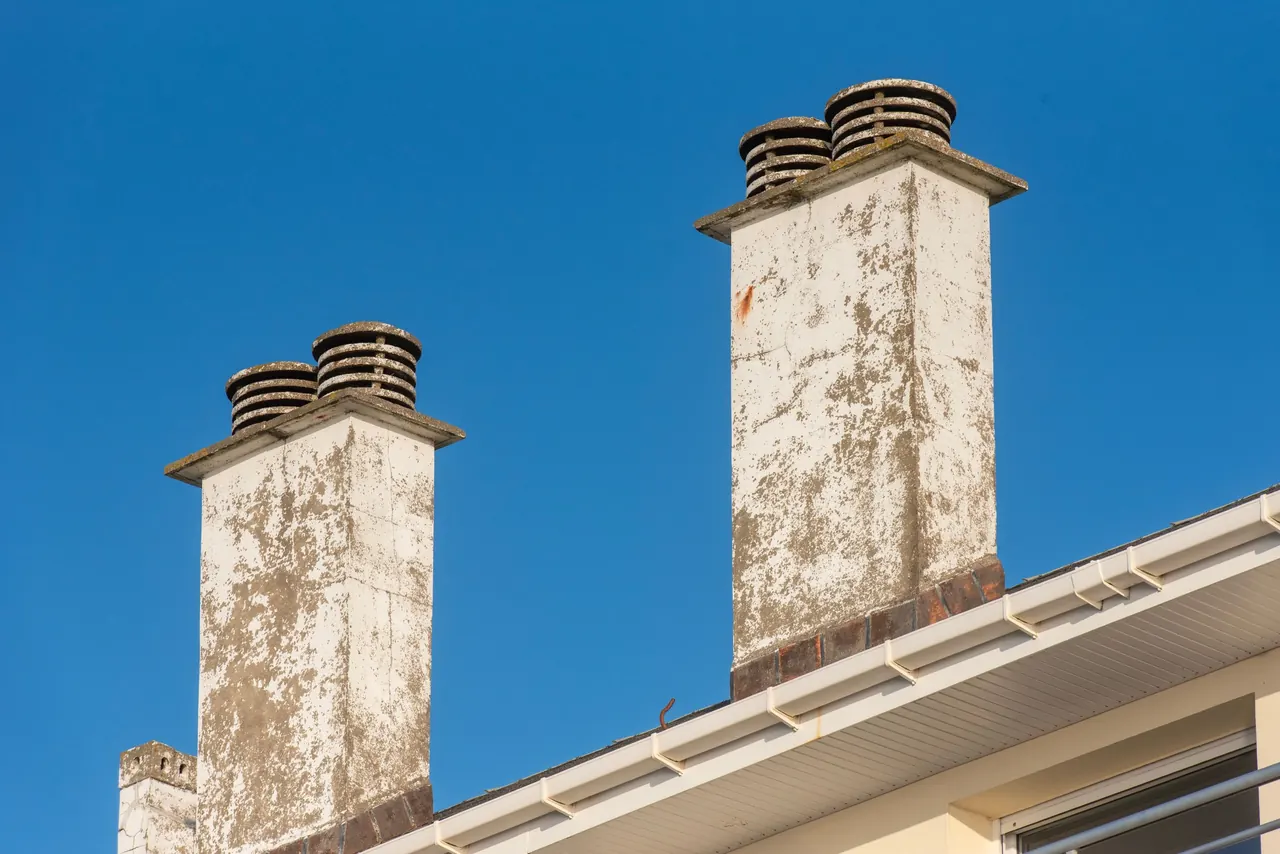
On the older terraces of Swaffield Road and Bassingham Road, the main stacks sit on the party wall between two houses, often with a smaller one on the rear addition. After more than a century the usual faults are open mortar joints that let the stack soak up rain, cracked flaunching around the pots, and lead lifted at the back of the stack. A party wall stack serves two houses, so it is worth telling next door before work starts.
Repointing soft old brick needs a mortar weaker than the brick, so the joint wears rather than the face of the brick. A hard cement repoint on a soft stack can make spalling worse, so we match the joint to what is there. Old cement fillets and mastic from past repairs come off, and proper leadwork goes back.
On a three-storey house on Earlsfield Road the stack is a long way up. We look at it by drone first, which shows the pots, flaunching, pointing and lead up close and tells us whether the work can be done from roof ladders or needs a scaffold. Re-leading or repointing a whole stack normally needs scaffolding.
Costs, and when the damp is not the chimney
MyJobQuote's chimney leadwork guide gives £150 to £250 as a national range for a patch repair to the flashing where no scaffold is needed, and £350 to £920 for full leadwork replacement depending on whether scaffolding is needed.
Sometimes the stain is not the chimney at all. A blocked valley or a gutter next to the stack can produce the same mark, and we tell you if that is what we find. Our roof repair team in Earlsfield can deal with the tiles around the stack on the same visit, and our chimney maintenance guide lists what to watch between visits. Across the Wandle to the west, we also carry out chimney repairs in Southfields.
Frequently asked questions
The short clay pot on my Fieldview stack has cracked. Can it be replaced to match?
Yes. The cracked pot comes off, the flaunching around its base is renewed, and a new clay pot of similar height and profile goes on, so the stack still matches the others along the group.
Our Openview fireplace is no longer used. Should the pot be capped?
A flue that is not in use can be fitted with a cap or cowl that keeps rain and birds out while letting air move through, which stops the flue going damp. Keeping the pot in place, rather than taking the stack down, keeps the roofline the same as the rest of the group.
How is a stack on a three-storey Earlsfield Road house reached?
We look at it by drone first. Small repairs can often be done from the roof with roof ladders. Anything bigger on a three-storey building usually needs a scaffold, and if it stands on the public pavement the scaffolder arranges a licence with the council.





