



 Google reviews

Tall terraces on Pound Street
Sutton Council's conservation area appraisal describes 11 to 17 Pound Street as good quality 19th century three-storey terrace houses in stock brick with timber sash windows. Houses of that height put the gutter well above ladder reach, and a failed run there sends water down three floors of brickwork before it reaches the ground.
That height affects the job in two ways. Access has to be planned and priced before we start, since a third-storey eaves usually means scaffold rather than ladders. And the gutter has to be right first time, because nobody wants to put the access back up a year later to fix a joint. So we measure the roof area each run drains, work out how many outlets it needs, and choose a profile deep enough to carry it.
Hipped roofs on West Street and gutters on every side
The listed houses at 7 to 11 West Street are 19th century, with slate hipped roofs, and the wing of No. 11 that breaks forward to the street has a separate hipped slate roof of its own. On a group like that the gutter turns several corners, and each corner is a joint.
On roofs like these the downpipe positions matter as much as the gutter. Water from a hip gathers at the corners, and a downpipe placed at the far end of a long run leaves the corner carrying more than it should. Where the old downpipes were sited by habit rather than need, a new system is a chance to put them where the water goes. We also look at where each one discharges, because a downpipe emptying against soft old brick or weatherboarding will cause damp however good the gutter above it is.
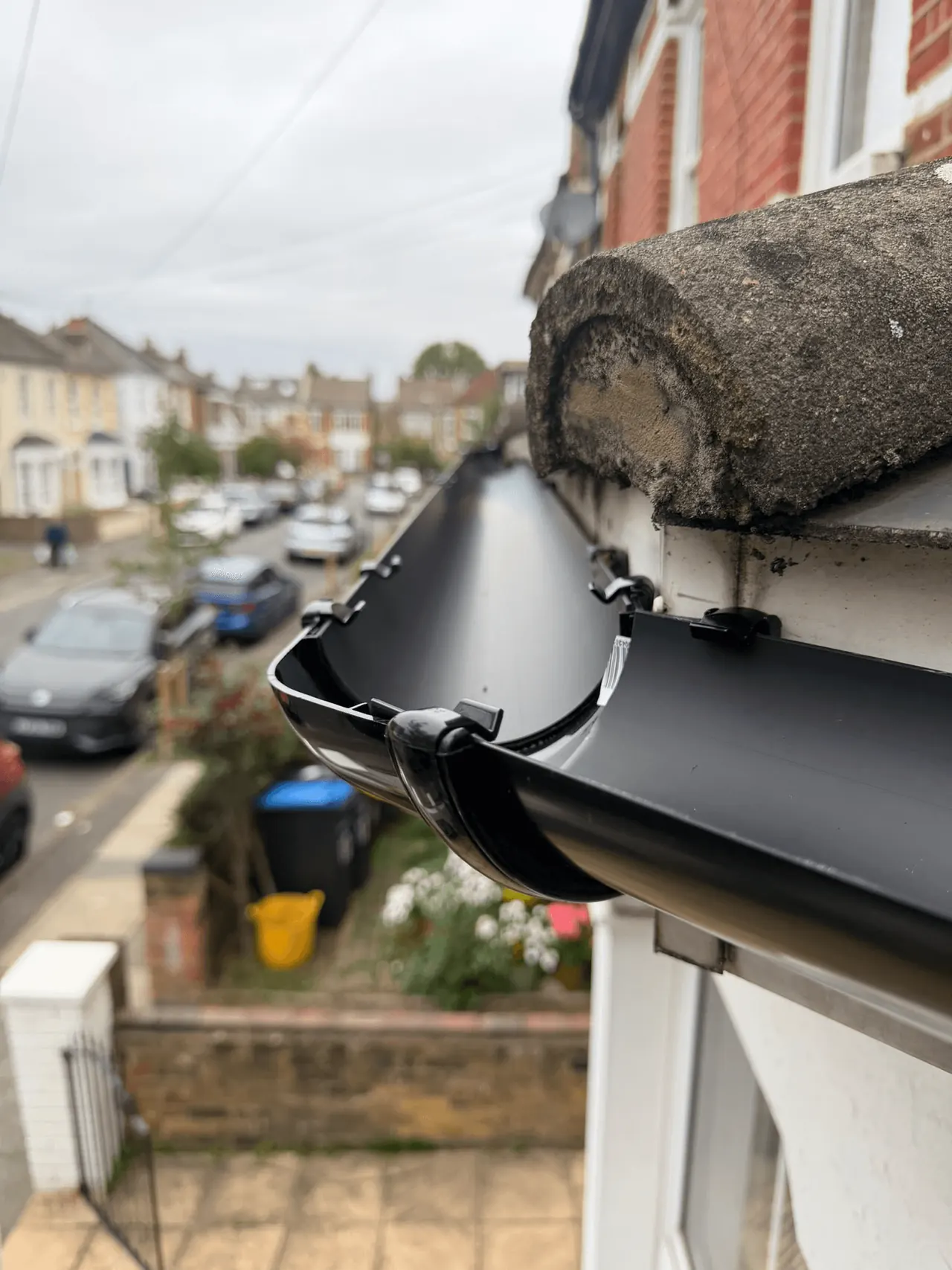
Cast iron on the listed fronts, lighter gutters elsewhere
- Cast iron is the traditional choice on period houses. It is heavy and lasts a long time if it is painted and kept clear, and on listed buildings it is usually what the council expects to see.
- Aluminium is lighter, does not rust and comes in coated colours. On an unlisted period house it can give a traditional look without the weight. Our page on seamless gutters in the village covers where the jointless version fits.
- uPVC is the low-cost option and suits the 20th century semis and the newer housing near Mill Lane.
Profile matters too. Half-round suits most older houses, ogee is flatter and more decorative, and deeper profiles carry more water on a big roof. Changing from cast iron to plastic on a listed building may need consent; our Carshalton Village overview explains.
For a ballpark, MyJobQuote's gutter replacement guide gives national supply-and-fit figures of £50 to £75 per metre for cast iron and £40 to £50 for uPVC, before access. London prices tend to sit higher, and scaffold on a three-storey house comes on top.
Putting up a new run on an old village house
We check the boards or brickwork the brackets will fix to, take down the old system, fix brackets at the right spacing, set the fall towards each outlet, connect the downpipes and run water through before we leave. If the boards behind are rotten, they are dealt with first. If your gutters are sound but one joint drips, a gutter repair may be all you need. The main gutter installation page has more on materials.
Frequently asked questions
My house is three storeys. Do new gutters need scaffold?
Usually, yes, and it is priced into the quote. On the Pound Street terraces the eaves are out of ladder reach, so because access is the expensive part, we measure the roof and outlets carefully so the new run does not need going back to.
My listed house on West Street has old cast iron. Do I have to keep it?
On a listed building, the council will usually expect cast iron to stay, and changing it to plastic may need consent. Ask Sutton Council before choosing. Damaged lengths can often be replaced in a matching profile.
Can a new gutter stop the green stain on my stock brick front?
If the stain comes from an overflowing or leaking gutter, yes, a correctly sized run with the right fall should stop it. The stain itself will fade as the brick dries, though it can take a season or two.





