



 Google reviews

Most of Addiscombe: the streets built after the estate
If you live in Addiscombe, your house is more likely to sit outside the East India Estate than in it. The estate is a ladder of six parallel roads between Addiscombe Road and Lower Addiscombe Road. Most of CR0 Addiscombe, across the Addiscombe East and Addiscombe West wards, went up later. The neighbouring Ashburton Estate was sold off for building from the 1890s, and by the 1930s, as Addiscombe's Wikipedia entry puts it, the land left after the first Victorian building had been filled with smaller housing developments.
Two plaques help date those streets. D. H. Lawrence lived at 12 Colworth Road from 1908 to 1912 while teaching locally, and the writer R. F. Delderfield lived at 22 Ashburton Avenue from 1918. Neither road is in a conservation area or one of the borough's Local Heritage Areas.
For these houses the work is ordinary roofing. Like-for-like repairs and re-roofs are normally treated as maintenance, and the estate's extra guidance does not apply. Roofs from the 1890s to the 1930s tend to need the same things as they age: fixings and battens near the end of their life, mortar on ridges and hips, old underlay gone brittle, and lead at the chimneys and bay roofs. A roof repair in Addiscombe covers most of that. If you want to change the shape of the roof, with a dormer or a hip-to-gable, check with Croydon's planning team first.
The East India Estate: Outram, Havelock, Elgin, Clyde and Canning
The older core dates from one sale. The East India Company trained its officers at a military college here until 1861. When it closed, the land was sold and five roads were laid across it, named after men prominent in British India. Elgin Road came first, in 1862, and plots on the others were auctioned over the following year.
The college's former gymnasium survives as Havelock Hall, a Grade II listed building. Around it went generous Victorian houses: two storey Italianate villas with shallow pitched roofs and projecting eaves, steep Gothic and Arts and Crafts gables on Havelock and Elgin Roads, and three storey semi-detached pairs with lower ground floors on Canning and Clyde Roads. Croydon Council's appraisal and management plan lists natural slate and hand-made clay tiles among the estate's common materials, and brick chimney stacks among its key features.
All of those five roads, plus Ashburton Road, Mulberry Lane and parts of Addiscombe Road and Lower Addiscombe Road, have formed the East India Estate Conservation Area since 2008. That includes the two 20th century cul-de-sacs off Ashburton Road: Ashburton Close, from the late 1930s, and Ashburton Gardens, from the early 1960s.
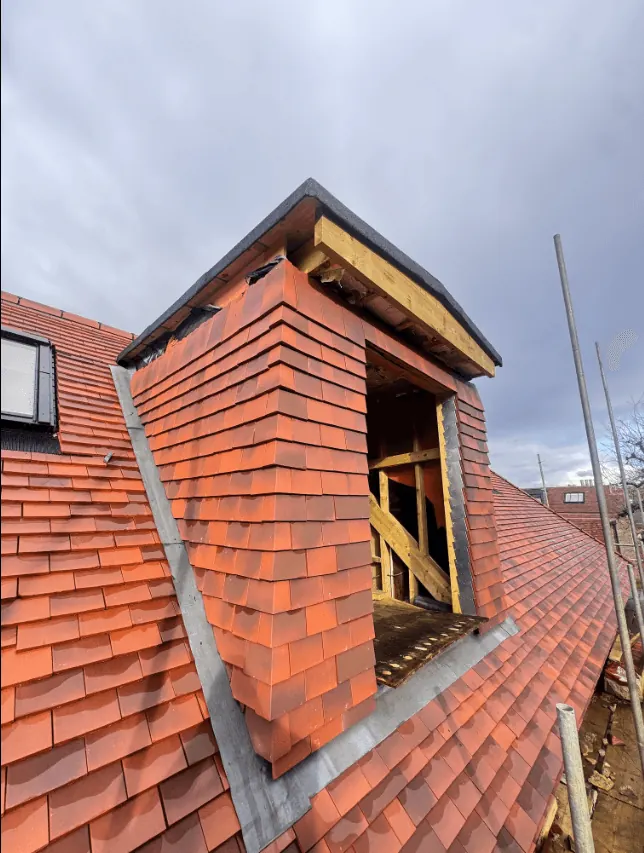
North of Lower Addiscombe Road: Inglis Road and Bingham Road
Inglis Road, Nicholson Road and part of Grant Road were also laid out in 1862, on smaller plots, and the council now treats them as the Addiscombe College Estate Local Heritage Area. The houses run from about 1862 to 1910 and have prominent gables, some of them Dutch, with shaped tops that need careful work at the coping and the flashing behind it.
Further north, numbers 10 to 24 and 11 to 49 Bingham Road form a second Local Heritage Area: Arts and Crafts houses of 1890 to 1910 with timbered gables, natural clay hanging tiles, clay finials and plain rendered stacks, as the council's Local Heritage Area review describes them. A Local Heritage Area carries lighter controls than a conservation area, but the council weighs it when deciding planning applications, and the review names insensitively sized roof extensions as a problem in the Inglis Road area.
Which roof job fits which street
A rough guide, drawn from the council's descriptions and the age of the houses, not from any record of our own.
| Where | Typical roof | Where it tends to fail |
|---|---|---|
| Canning, Clyde and Elgin Roads | Three storey semis and terraces, hipped or gabled slate, central stacks | Slate nails, ridges, rear valleys, high back gutters |
| Outram and Havelock Roads | Italianate villas with shallow slopes and bracketed eaves; steep Gothic gables | Eaves timbers, gable verges, valley linings |
| Ashburton Road (1 to 7, 40, 50 to 64) | Edwardian red tile with pairs of dormers | Dormer cheeks, soakers, cracked tiles |
| Lower Addiscombe Road | A mix: stock brick villas with bracketed eaves, three storey Victorian semis, an Edwardian group with bargeboards and hanging tiles, rooms in the roof | Eaves timbers, tile hanging, bargeboards, slopes over attic rooms |
| Inglis Road and Bingham Road | Victorian and Arts and Crafts gables, clay hanging tiles, rendered stacks on Bingham Road | Hanging tiles, finials, gable copings |
| Ashburton Close, Ashburton Gardens, East India Way | 1930s, 1960s and modern houses, bungalows | Later tile coverings, flat roofs, uPVC roofline |
| Ashburton Avenue, Colworth Road and the rest of CR0 Addiscombe | Houses of about 1890 to 1930s, outside the heritage designations | Ridges and hips, tired fixings, old underlay, chimney lead |
When a slope is failing all over, our roof replacement page explains what a full re-cover involves, on the estate and off it.
Height, trees and the council on the estate
The tallest houses, three and four storeys, stand along Addiscombe Road and on the western part of the estate, with gaps between buildings often under three and a half metres. Rear slopes there are hard to see and harder to reach, so a drone roof inspection in Addiscombe lets us photograph the back of the roof, the stacks and the valleys before anyone climbs. Josh flies it and will take you through the pictures.
Clyde Road has avenues of pollarded limes and Havelock Road has cherries, and the conservation area has oak, cedar and fir among its trees, with several mature trees in rear gardens, so gutters on these streets fill faster than on open roads.
The management plan says roof extensions on three and four storey buildings will generally not be permitted, and one visible from the street is unlikely to be. It treats the loss of chimneys and non-traditional roofing materials as harm. Repairs in matching materials are routine. For anything that changes how the roof looks from the road, speak to Croydon's planning team before you commission it. More about our team, from Ryan and Luke to our surveyor Simranjeet.
Frequently asked questions
We live on Ashburton Avenue. Do the East India Estate rules apply to us?
No. The conservation area takes in every house on Canning, Clyde, Elgin, Havelock, Outram and Ashburton Roads, Mulberry Lane, Ashburton Close and Ashburton Gardens, plus stretches of Addiscombe Road and Lower Addiscombe Road. Ashburton Avenue is outside it. Ordinary planning rules apply, and like-for-like roof work is normally maintenance.
Does the Inglis Road Local Heritage Area change what roof work we can do?
Not for repairs. Re-fixing slates, renewing flashing or relaying a ridge carries on as normal. The council's review names insensitively sized roof and side extensions as a problem on these streets, so a large dormer or a change of covering on the front slope is where it is likely to take an interest.
What makes the Bingham Road roofs different from the rest of Addiscombe?
They went up between 1890 and 1910, a generation after the estate's first villas, in an Arts and Crafts style: timbered gables with natural clay hanging tiles, tile-hung bays, clay finials on the ridges and plain rendered stacks. Much of the work there is on the gables, the tile hanging and the stacks.
Which Addiscombe houses are the hardest to reach?
The three and four storey pairs on Canning and Clyde Roads and the large houses along Addiscombe Road. Their rear slopes cannot be seen from the street and the side gaps are narrow, so we usually look by drone first and plan towers or scaffold from the photos.





