



 Google reviews

Wellesley Road (North): tall villas, many now flats
Just north-east of West Croydon station, Wellesley Road (North) became a conservation area in October 2008. Croydon Council's conservation area appraisal dates the first houses, 79 to 91, to the 1840s and 1850s. The larger semi-detached villas at 69 to 79 came next, and the Gothic Revival Belfield terrace at 49 to 65 last. They are London stock brick with stone or stucco dressings, natural slate roofs, clay pots on prominent stacks and deep overhanging eaves.
Most are three storeys over a basement or raised lower ground floor, which puts the gutters and chimney tops a long way above the front garden. When the area was designated, many of the houses stood empty, and it was on English Heritage's Conservation Areas at Risk register in 2010 and 2011. Since then many have been sold, repaired and divided into flats, so a roof that was once one owner's concern is now shared by several leaseholders and a freeholder.
The appraisal asks owners to clear gutters and rainwater pipes, re-fix loose slates and repaint timber, and it treats non-traditional roofing materials as a threat, encouraging a return to natural slate. It does not list an Article 4 Direction. Like-for-like repairs in slate are maintenance; anything that changes how the roof looks from the road is worth raising with Croydon's planning team first.
Broad Green and the Royal Mansions parade
West of the railway, London Road runs north-west out of the town centre. On its north-east side, Hathaway Road, Nova Road and Kidderminster Road head back east towards the railway, and the small triangular green that gave Broad Green its name lies between London Road, Hathaway Road and Kidderminster Road. The Broadgreen Place estate here was sold for building in 1900. Hathaway Road and Nova Road were laid out that year and the houses went up in 1902.
The same year brought Royal Mansions, the parade of lock-up shops with flats above at 206 to 272 London Road, with rendered fronts and decorative gable ends. Numbers 256 to 272 were demolished in 2011 after fire damage, so only part of the parade survives. Behind decorative gables like these, a gutter can sit out of sight from the street, so a blockage often shows first inside the flat.
Croydon's borough character appraisal describes the housing round Broad Green as largely unchanged in a century: tight terraces, mostly in rows of more than five houses, generally with no street trees and many front gardens paved for parking. In a row like that, the chimney stack and the front gutter are often shared with next door, so a fault on one house can show up on two. Our chimney repairs in West Croydon page deals with stacks on both kinds of street.
Along London Road itself, the Local Plan notes that a number of buildings first set back from the street have been extended at ground floor. Those extensions usually have flat roofs, some directly below the windows of a flat, and our flat roofing page for West Croydon covers them.
Estates from 1964 to 1979, and the busy roads between
The same borough appraisal records planned estates of compact houses built between 1964 and 1979 at Handcroft Road, between Ruskin Road and Tamworth Road, and from Wellesley Road to Tavistock Road. They are typically plain red brick with pitched roofs. The Handcroft Road estate is the odd one out: flats and maisonettes in three-storey blocks with white clad walls. East of Wellesley Road, Woburn Court is an earlier group of 1950s and 1960s flats set behind mature trees.
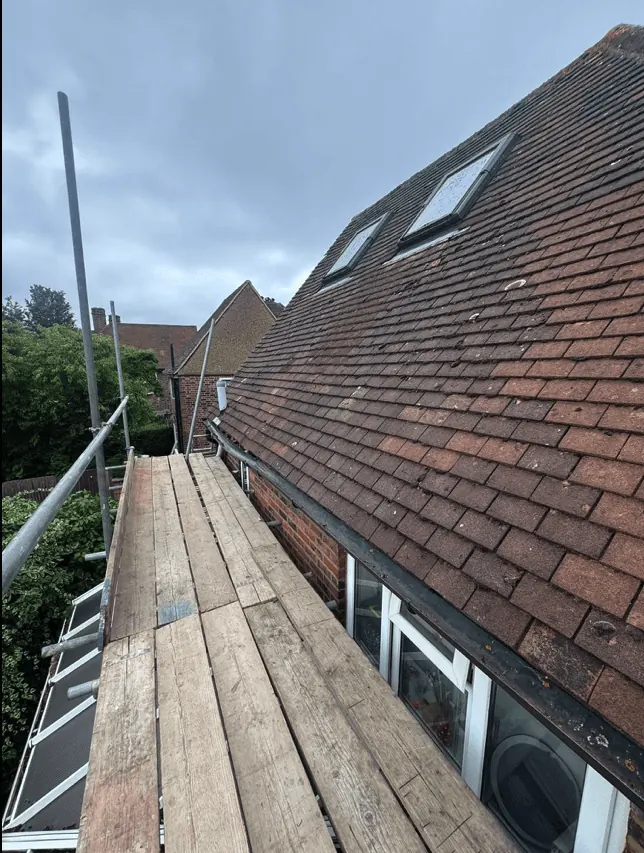
These roofs are now roughly 47 to 62 years old. Where the original covering, felt underlay and timber fascias are still in place, repairs come round more often, and owners and managing agents start weighing roof repairs in West Croydon against a full renewal.
Access is the other local factor. Wellesley Road is a major north-south route through the town centre carrying heavy traffic and several bus and tram routes, and London Road is the area's main shopping street. A scaffold or ladder on the front of a building on either road has to be planned around the pavement. Where the site allows, we look at the roof by drone first, so the access plan is right before anyone books a scaffold; our roof inspection page explains how that works.
The ground under the station has its own history. It was the terminus basin of the Croydon Canal, which opened in 1809 and closed in 1836, and the railway station opened on part of the basin site in 1839. Building followed the trains, which is why roofs from several very different eras now stand within a few hundred metres of the platforms.
We are a family run firm based on Kenley Road in Morden, about 5 miles from West Croydon station. Call 0330 133 4111 or send the address and what you can see through our contact page.
Frequently asked questions
Our Wellesley Road flat's lease makes the roof the freeholder's job. Can I still ask you to look?
Yes. Anyone can ask for a look and a quote. In a converted villa the freeholder or managing agent usually has to approve and pay for the repair, so we send the photos and the written quote to them as well as to you.
Royal Mansions is a Local Heritage Area. Does that affect roof work on the parade?
Not in terms of consents. Croydon's Local Heritage Area guidance adds no extra permissions, but where a job does need planning permission the council considers the parade's character. Its review lists lost mouldings and poor maintenance among the parade's problems, so repair the gable details rather than strip them.
Do the Handcroft Road blocks need a different approach from the Victorian houses?
Yes. They are long, plain blocks with simple pitched roofs, and the work is normally agreed with a managing agent for the whole block rather than one flat. Renewing the roofline of a whole building at once keeps it uniform and needs only one scaffold.
Can you work on the front of a house on Wellesley Road with all the traffic?
Yes, with planning. A scaffold on the public footway needs a licence from the highway authority, and the work is arranged so the pavement stays safe for people walking past. A drone look beforehand tells us whether a scaffold is needed at all.





