



 Google reviews

Offices by the station, houses to the south
Right by East Croydon station the buildings are offices and tall blocks of flats, where a roof repair is usually a decision for the freeholder or managing agent rather than the people living underneath. Walk a few minutes south and the offices give way to houses. That is where most of the roof and gutter work in East Croydon is, and it splits along the Brighton main line: Park Hill to the east, the Chatsworth Road streets to the west.
How Wates rebuilt Park Hill, estate by estate
East of the railway is Park Hill. In 1861 the Ecclesiastical Commissioners (now the Church Commissioners) laid out an estate of Victorian villas along Park Hill Road. A century later the builder Wates redeveloped about 120 acres of the area, roughly half a mile south-east of the station, and pulled down many of those villas. What went up instead was a run of small estates, each a few years apart, and the roofs changed as Wates went along.
- Brownbourne estate (1962-64): split-level houses set into steeply sloping ground.
- Hill Rise (early 1960s): terraces and town houses by Wates's chief architect, K. W. Bland.
- Turnpike (1965-68): two and three storey terraces in pale brown brick around courtyards on Turnpike Link, built with flat roofs.
- St Bernards (1969-71): 21 stepped, flat-roofed houses by the Swiss practice Atelier 5, now a conservation area.
- Hunters Way, Caroline Close and Tipton Drive (1970-74): more flat roofs.
- Steeple Hill (1973-79) and Rushmead Close (1974-75): by now flat roofs had been dropped, and Rushmead Close has very large gables.
Chichester Road has 1970s Wates housing in yellow brick with tile-hanging. Wates's plan for Park Hill had no house fronting a road, with garages reached by service roads and shared landscaped ground between the homes.
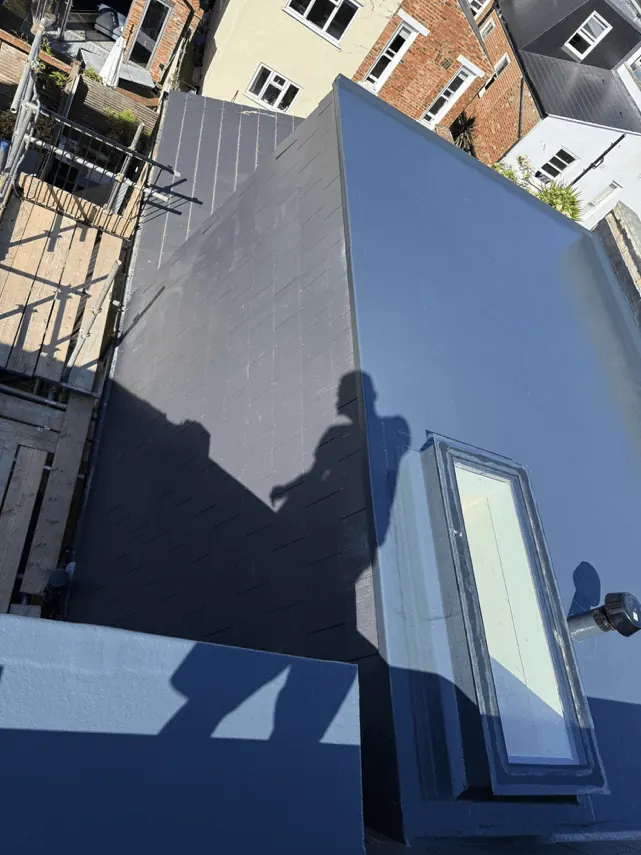
That history tells you a lot about what a Park Hill roof needs. The flat-roofed estates are the ones where coverings, rooflights and upstands wear out, and our flat roofing work on the Park Hill Wates estates deals with those. The pitched estates from the 1970s are reaching the age where underlay and battens are tired, and the tile-hung walls need their slipped tiles and flashings put right before water gets behind them.
The Chatsworth Road villas and their Article 4 Direction
West of the railway, between Park Lane, Coombe Road and Barclay Road, is the Chatsworth Road Conservation Area, designated by Croydon Council in October 2008. It is a grid of late Victorian and Edwardian houses of two and three storeys, typically roofed in natural slate or handmade clay tile, with gables, gablets, dormers, carved bargeboards and brick chimney stacks.
An Article 4 Direction has covered the whole conservation area since January 2016, which brings alterations to the roof of a house under planning control. Repairs in matching slate or clay carry on as normal; changes of material, new roof windows and solar panels need an application. Our page on re-roofing under the Chatsworth Road Article 4 rules sets out where the line falls.
Trees, slopes and the Recreation Ground
Both halves of East Croydon have big trees. Park Hill Recreation Ground runs for 15 acres from Barclay Road to Coombe Road beside the railway, with a Lebanon cedar, monkey puzzle, yew and an old mulberry among its specimen trees. Its Norman-style water tower, built in 1867, still stands on the high ground. Around St Bernards, the council's appraisal records elms, chestnuts, maples and limes along Park Hill Road, a large cedar, a group of Scots or Corsican pines, and a very large oak by the Fairfield Path. Across the line, Mulgrave Road is lined with copper beech.
Pine needles and beech leaves are slow to rot and quick to pack into outlets, so gutters under these trees fill faster than the ones on open streets. Our page on clearing gutters under the Park Hill pines covers the timing. The slopes matter too: three-storey villas and houses on higher ground can catch more wind than lower, more sheltered terraces, so ridges, verges and flat roof edges are the parts to watch after a gale.
Getting us out to your roof
We are a family run roofing and guttering firm based on Kenley Rd in Morden, about 5 miles from East Croydon station. A first visit usually starts with a look from the ground, a drone flight where the roof is hidden or high, and a look in the loft where there is one. You then get a plain explanation of what we found and a written price for anything that needs doing.
The town centre, Old Town and the streets around the Minster are covered on our Croydon area page. For everything we offer, see our full list of roofing and guttering services, or send us the details of your roof.
Frequently asked questions
I live on Hill Rise. Is my house one of the Wates ones?
Yes. Hill Rise was one of the early Wates schemes in Park Hill, built in the early 1960s as terraces and town houses designed by the firm's chief architect, K. W. Bland. Houses from that period are now around sixty years old, so original gutters, fascias and roof underlay are all worth checking.
Which Park Hill estates were built with flat roofs?
The Turnpike development of 1965 to 1968, St Bernards from 1969 to 1971, and the houses on Hunters Way, Caroline Close and Tipton Drive from 1970 to 1974. By the time Steeple Hill was built, flat roofs had been dropped. Many flat roofs on the earlier estates will have been re-covered at least once since they were built.
Who else has a say over roof work at St Bernards?
Two bodies. Croydon Council, because St Bernards is a conservation area, and the estate's management company, which the council's appraisal says sets paint colours and agrees some replacements in writing. Mending a covering like for like is maintenance, but changing skylights, edges or the roof profile is worth raising with both first.
Why do gutters near the St Bernards pines fill up so quickly?
Pine needles are fine and slow to rot, and once wet they mat into a pad over the outlet. The council's appraisal for St Bernards lists regular clearing of gutters and rainwater pipes among its basic maintenance advice, and under conifers that usually means more than one visit a year.





