



 Google reviews

The Totterdown Fields rule, in full
Every gutter on Totterdown Fields started out as black cast iron, and the council wants it to keep looking that way. Wandsworth Council's management strategy for the estate deals with rainwater goods in two sentences. The gutters and downpipes are cast iron and painted black. Repairs and renewals should preferably be in cast iron painted black, or black plastic or aluminium, always provided they match the size and pattern of the originals.
That gives an owner on one of the estate's eight streets three acceptable choices, with one condition shared by all three. The colour is black, and the size and profile follow what was there. A white or grey plastic system in a modern square profile is not on the list, however neat it looks, and the estate's Article 4 Direction brings external alterations visible from the street under planning control.
The strategy adds a related point about pipework. No additional soil or water pipes should be fixed where they can be clearly seen from the street. If a new downpipe is needed, the expectation is that it goes at the rear, or that pipework runs inside. So on these cottages, fixing an overloaded front gutter by adding a second front downpipe is not the easy answer it would be elsewhere.
Cast iron, black plastic or aluminium
Cast iron is the original and the closest match. It is heavy, so the fixings must be sound, and it needs painting to keep rust away. Looked after, it lasts: MyJobQuote's gutter guide says metal gutters can last up to 50 years with proper care, against up to 25 years for uPVC.
Black plastic in a matching profile is the lower-cost route the council accepts. It is light and needs no painting, but it moves more with temperature and the joints need more attention over time.
Aluminium sits between the two: light, rust-free and finished in a coloured coat, so it can be black from the start. It is also acceptable when it matches the original size and pattern.
Before fitting any of these, we look at what is there now. Many cottages still have some original cast iron, and some have had partial replacements over the years in assorted profiles. We match the original section, not whatever your neighbour fitted in the 1980s.
Fixing gutters on deep eaves and front gables
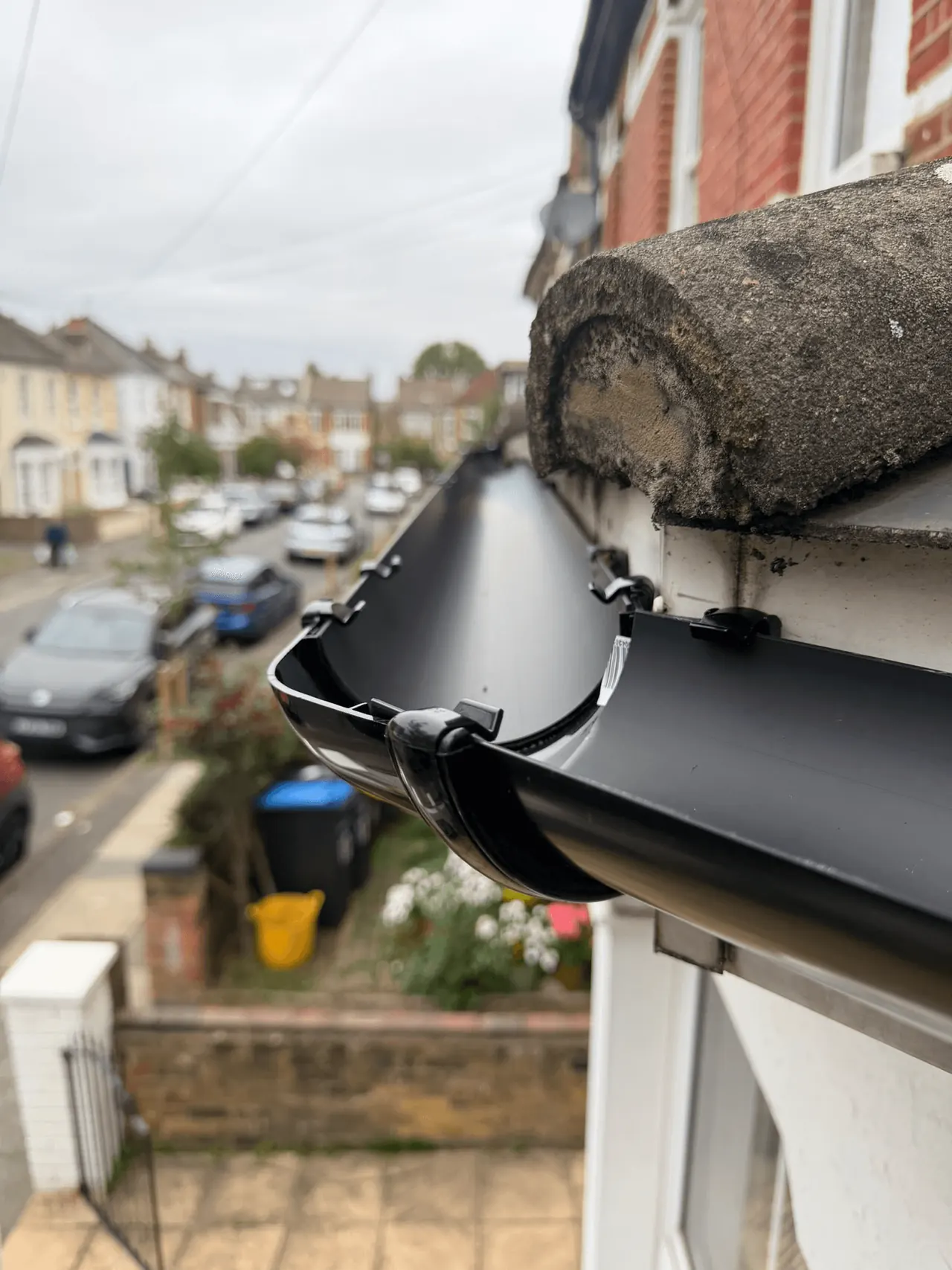
Some cottages on the estate have double-pitched front gables with a prominent eaves projection and no visible fascia. On eaves like that, a gutter is normally carried on rafter brackets rather than screwed to a board. Before fitting, we look at how the existing gutter is held and use brackets that follow it, so the eaves keep their plain overhang and no new fascia board appears. Where a fascia does carry the gutter and has rotted, we deal with it first through our fascias and soffits work in Tooting.
The rest of the fitting is careful work rather than special work: brackets at the right spacing for the material, a steady fall towards the outlet, sound joints and downpipes connected to the drain. On a terrace, we also look at where your run meets next door's, because a new gutter that empties into a neighbour's tired section only moves the leak.
Off the estate, towards Longley Road
On the Victorian streets towards Longley Road, outside the conservation area, owners have a wider choice, and uPVC is the usual low-cost option. Some owners of period houses still prefer cast iron or aluminium for the look. For long, simple runs where joints keep failing, our seamless gutters in Tooting page explains where a one-piece run makes sense.
For a price yardstick, MyJobQuote lists uPVC at £40 to £50 per metre and cast iron at £50 to £75 per metre, supply and fit. On a cottage that needs cast iron and a scaffold at the back, expect to be at the top end. The main gutter installation page compares the materials in more depth.
Frequently asked questions
Can a new downpipe go on the front of my Derinton Road cottage?
The council's guidance is that no additional water pipes should be fixed where they can be clearly seen from the street. If the front gutter needs more drainage, we look at re-sizing it or taking water to the rear first.
My front-gabled Totterdown cottage has no fascia under the gutter. How is a new one fixed?
Where there is no board, a gutter is normally carried on brackets fixed to the rafters. We check how yours is held and fit the new gutter the same way, so the eaves look as they did once the work is done.
Do the Totterdown gutter rules apply to my house on Longley Road?
No. Longley Road is outside the Totterdown Fields conservation area, so the estate's rainwater guidance does not apply. If your house is listed or in another conservation area, check with Wandsworth before changing anything that shows from the street.





