



 Google reviews

What the draft plan says about upper floors
The borough's 2019 draft management plan for the conservation area is clear about the shopping parades. Its guidance for that sub-area reads: "Upper floor detailing should be retained, enhanced and, where appropriate, reinstated." It notes that many upper floors along the High Street are largely unaltered since they were first built.
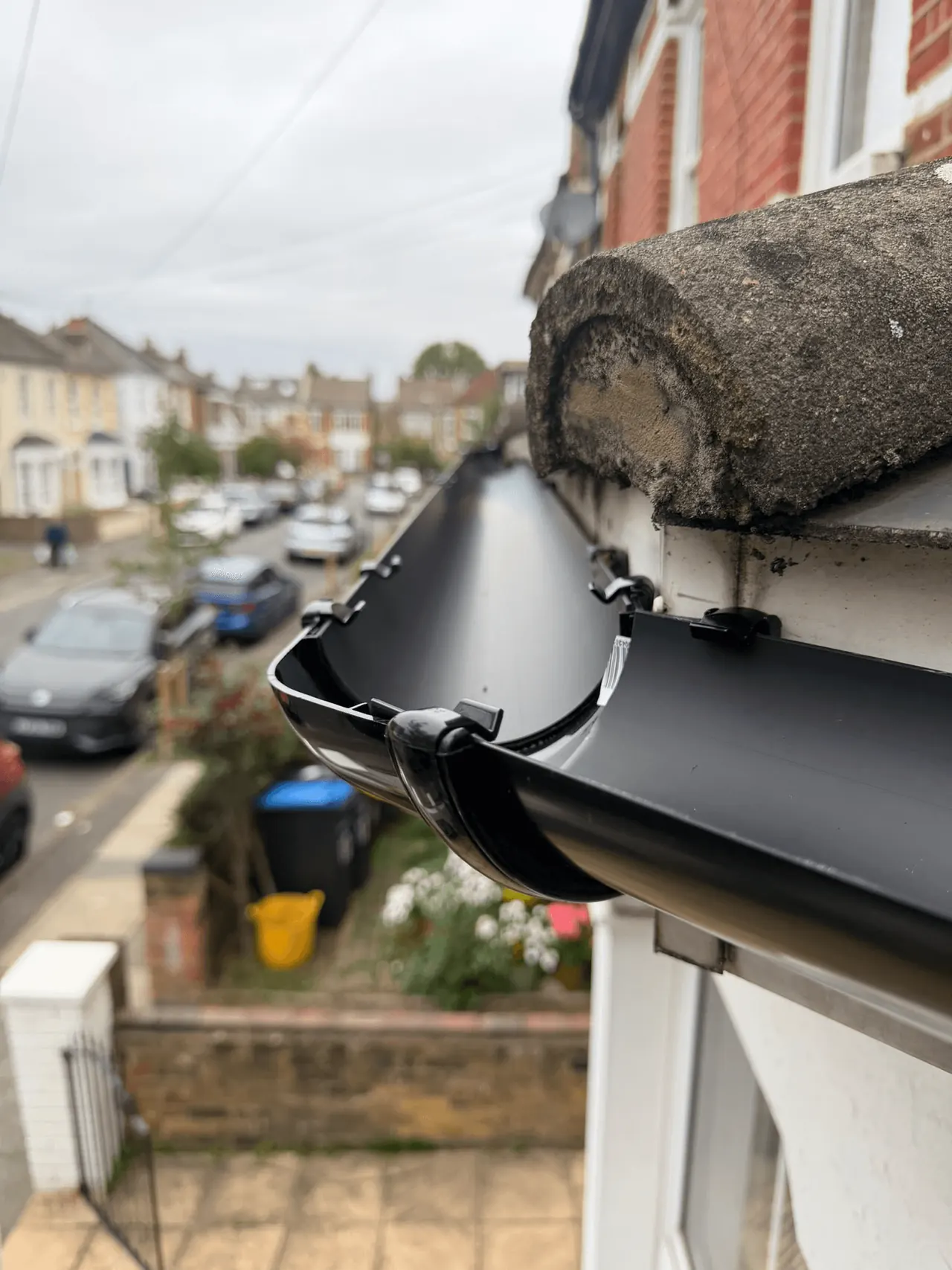
Gutters and downpipes sit right in the middle of that detailing. On a parade front with moulded cornices or polychrome brick, a bright white plastic gutter and a pipe cutting across the brickwork can undo a lot. So a new installation on the front of an older High Street building starts with what suits the façade: a traditional half-round or ogee profile, in cast iron or a coated aluminium or uPVC system in black or a dark colour, with downpipes set in the line of the original.
On the backs of the parades, which are rarely seen from the street, the choice is more practical, and long rear runs can be done as seamless aluminium guttering.
Listed buildings: 26 to 28 High Street and Carshalton Road
A handful of buildings in the town centre are nationally listed. The corner building at 26 to 28 High Street is Grade II, listed for its Art Nouveau ground floor by the local architect Frederick Wheeler, with a hipped slate roof above. The Edwardian police station on Carshalton Road, built in 1908 to 1909 with a slate roof and three pedimented dormers, is Grade II too, and Trinity Church and St Nicholas Church are listed as well.
On a listed building, check with the council before any gutter work, as listed building consent can apply even to like-for-like replacement. We are happy to provide the details of the existing and proposed gutters for an application, but the owner or their architect leads on the consent.
Sizing gutters for tall slate roofs
Three-storey parades with steep slate roofs shed a lot of water quickly, and a gutter that was undersized when it went on will overflow in a heavy shower however clean it is. When we install new gutters, we look at the roof area that drains into each run and the number of outlets, and pick a profile with enough capacity. Where a deep cornice limits what can be fitted, adding a downpipe can help more than a bigger gutter.
The details that make it work are the same on any building: fascia boards sound enough to hold brackets, brackets at the right spacing, a steady fall to the outlet, joints sealed so the run acts as one, and downpipes connected properly at the bottom. On tall elevations, hopper heads at the top of the downpipe need to be big enough for the gutter feeding them. If the boards behind the gutter are soft, our fascia and soffit work can be done on the same visit. The 1930s to 1950s parapet buildings, such as 211 High Street, have no eaves gutter at the front at all; their water leaves through the parapet into hoppers, and the outlets are covered under our blocked gutter repair service.
Frequently asked questions
Our building is listed. Can you replace the gutters like for like?
We can, once the council has confirmed what consent is needed. On 26 to 28 High Street, the police station or another listed building, ask the London Borough of Sutton first, as listed building consent can apply even to like-for-like work.
What gutter profile suits a Victorian parade front with a moulded cornice?
Usually an ogee or half-round in a dark finish, fixed so it sits neatly above the cornice rather than across it. We look at what survives on neighbouring buildings in the same parade and follow that.
Can the downpipes go down the back instead of across the front of our parade?
Sometimes, if the roof falls that way or a hidden gutter can carry the water through. It depends on the roof shape, and we will tell you after seeing it whether rerouting is practical.





