



 Google reviews

Height and narrow frontages off Maple Road
Kingston's character study for the Maple area describes Maple Road as mostly three to four storeys, unified by a fine avenue of mature trees, with three-storey shops along its small retail stretch. To the west, towards the river, it describes a grid of streets running from narrow plots and short terraces on Cleveland Road to large villas on Cadogan, Grove, Catherine and St Leonards Roads. Cleveland Road is singled out for narrow frontages, a strong building line and heavy on-street parking.
That combination shapes gutter repair here more than the fault does. A leaking joint is a small job at any height. Reaching it on the front of a four-storey house with cars parked tight along the kerb, or at the back of a terrace with no side passage, is the part that needs planning.
Iron gutters and hoppers on the Maple Road villas
- Cast iron joints. Houses of this age were built with cast iron gutters, and where the iron survives, the joints between lengths are sealed with a compound that dries and cracks over the years, and rust starts there and at the outlets. A leaking joint can be taken apart, cleaned and remade.
- Rusted hoppers. Where several gutters meet a downpipe high on a wall, an iron hopper collects them, and standing water sits in its base. Once rust holes the base, water runs straight down the brickwork, and the stain often shows before the leak is noticed.
- Brackets in soft timber. A run that dips between brackets usually means the fascia behind has softened and the screws have lost their grip, not that the gutter is faulty.
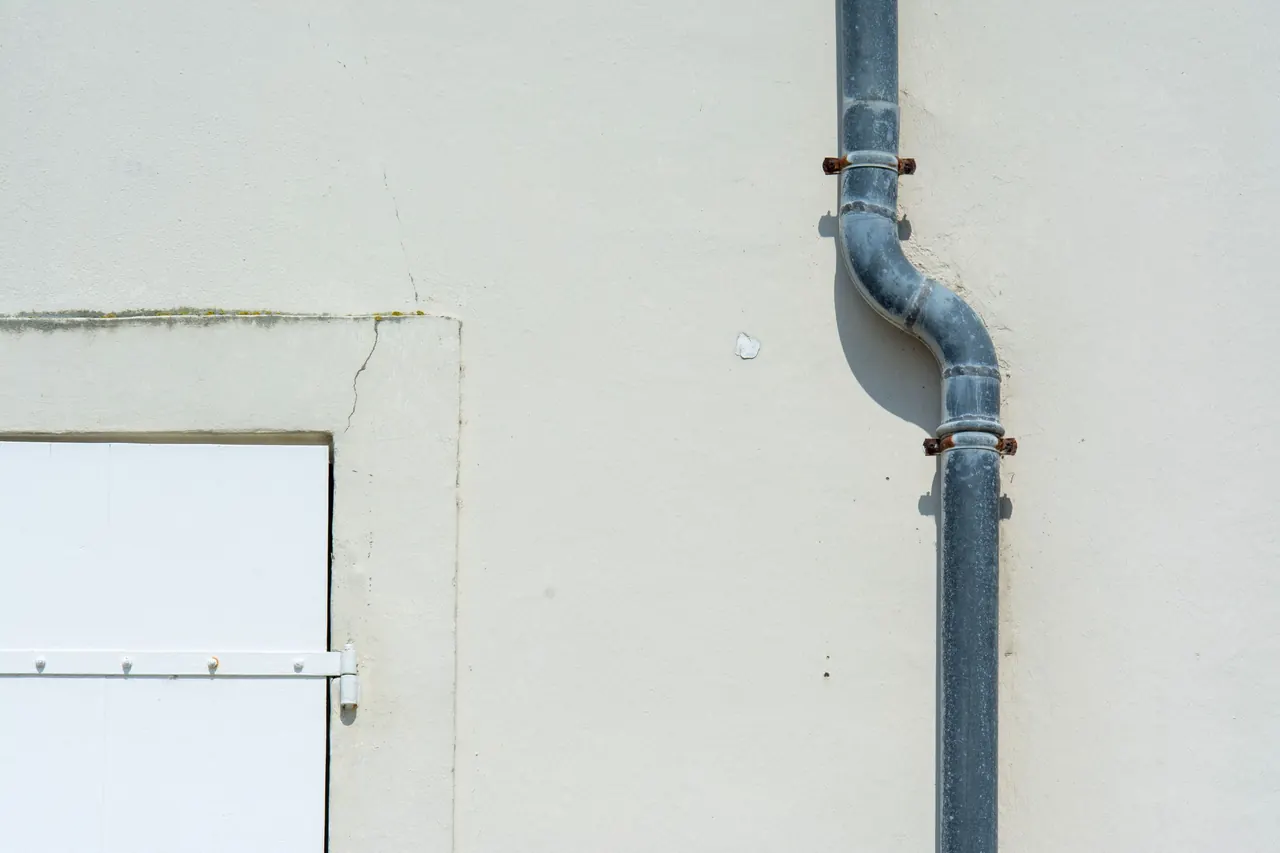
- Cracked downpipes. An iron downpipe that has split down its back, against the wall, leaks where nobody looks. The first sign is often a green streak or damp patch on the brickwork at ground-floor level.
The test of any repair is the whole run, not the single drip. A sag at one end may be caused by a blocked outlet at the other, and a hopper that spills over its rim, rather than leaking through its base, is usually blocked rather than broken. That is covered on our blocked gutter repair page for Surbiton.
Reaching the gutter
We start with a look from the ground and, on the tallest houses, a drone flight, so we know where the fault is and what needs replacing before anyone goes up. That keeps the visit short on a street where parking is tight. Some repairs at three storeys can be reached safely by ladder; at four storeys, or where there is no safe footing at the back, scaffolding is the usual answer, and we say so in the quote rather than on the day.
At the back of a terrace on Cleveland Road, access may only be through the house. Where that is the case, we agree with you how materials will come through and how floors are protected before we book the job.
The MyJobQuote gutter repair guide gives an average of around £215, which covers a straightforward repair at normal height. On a four-storey house the access tends to cost more than the repair itself.
When the iron is past saving
If the gutter itself is sound, a repair is almost always the right answer, and on a period house it keeps the original iron in place. If cast iron has rusted through along its length rather than just at the joints, or a uPVC system has gone brittle and is cracking in several places, renewing it is better value. Our page on new gutters for Surbiton houses covers that, and if water is running down behind the gutter rather than over it, read about water leaking behind gutters.
Frequently asked questions
Our Cleveland Road terrace has no side passage. How do you reach the back gutter?
Through the house, with your agreement, or from a neighbour's garden if they are happy to allow it. We plan which before booking, protect the floors on the way through, and bring only what is needed for the repair.
The iron hopper on our Maple Road house has rusted through at the bottom. Can just that be replaced?
Yes. Hoppers come off as separate pieces, and a new cast iron or matching hopper can be fitted to the existing downpipe and gutters. We check the pipe below at the same time, since a blocked pipe is often what made the hopper rust.
Why does damp only show in the top-floor flat of our Grove Road villa?
Because the gutter and the top of the wall are right beside it. A leaking joint or a gutter fixed too low lets water into the head of the wall, and it shows on the top-floor ceiling or wall first. Fixing the gutter usually stops it; the plaster then needs time to dry.





