



 Google reviews

Two generations of house in one conservation area
Cross Westow Street from Haynes Lane into Ovett Close and you go from Victorian cottages to houses built more than a century later, without leaving the Upper Norwood Triangle Conservation Area. Between 1975 and 1981 much of the inner Triangle was rebuilt for Barratt Homes, to designs by Clifford Davies Partnerships, as two-storey houses in irregular terraces on Ovett, Brunel and Telford Closes. Ovett Close replaced early Victorian cottages. Nesbitt Square followed in the later 1980s, just south-west of Westow Street.
A new run on a Brunel Close house and a new run on a St Aubyn's Road terrace are different jobs, with different materials, profiles and fixings, even though Croydon drew the conservation area boundary round both.
Replacing the gutters on the Barratt closes
The closes are now more than 40 years old. Where a house still has its first gutters, or a patchwork of replacements, a full new system is often better value than another round of repairs. Before anything is ordered, check what is up there. Most gutters on houses of this age are plastic, but grey, heavy fibre-cement gutters were used on some buildings into the 1990s and can contain asbestos, so if yours look like that, have them checked before anyone cuts them.
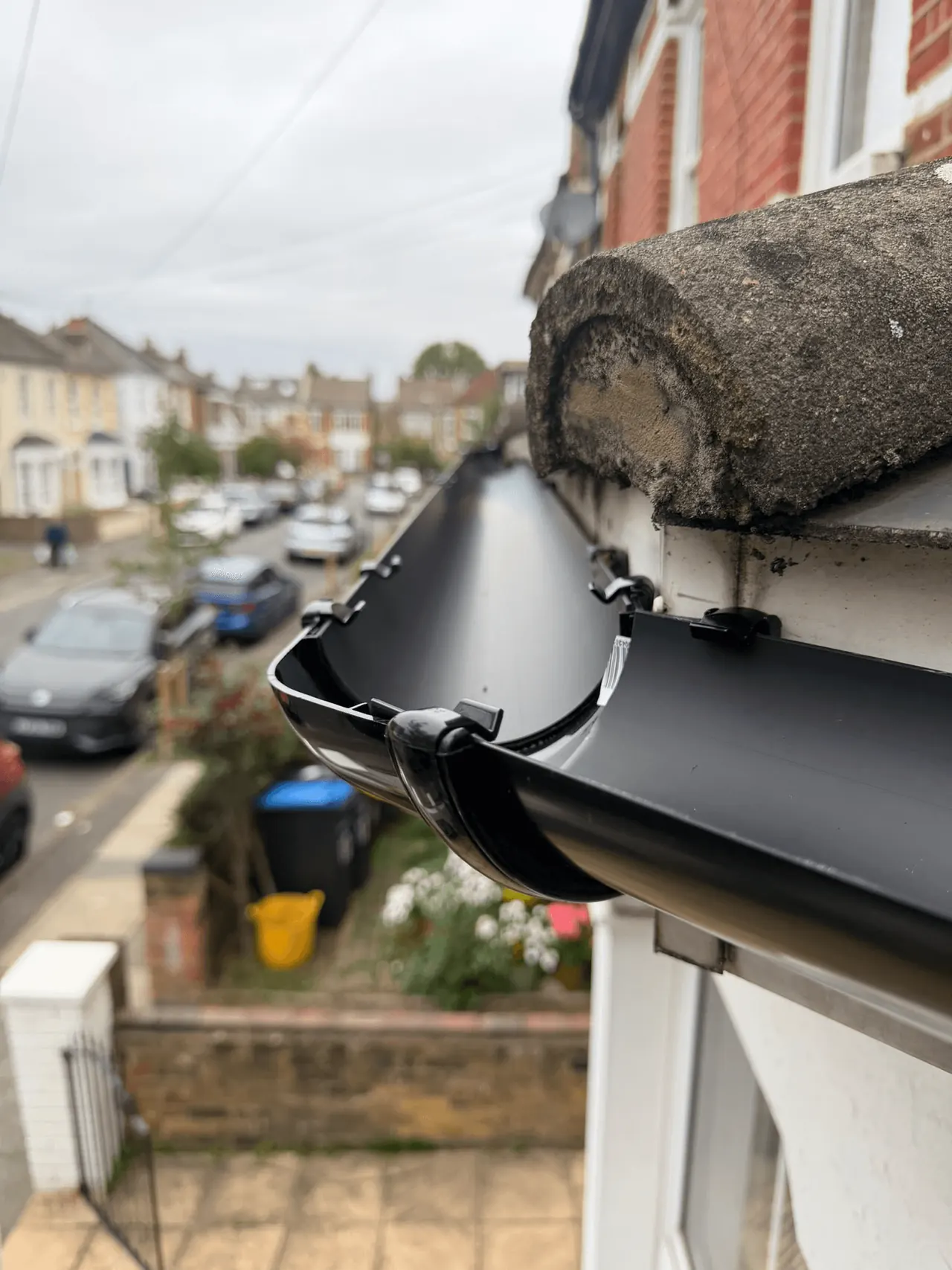
The irregular terraces make the layout the main design job. Runs turn corners, step up and down between houses and meet next door's run at awkward angles, so the corner joints and the outlets at the ends of short runs decide whether a new system works. We size each run and outlet to the roof area it drains, set an even fall, and join cleanly to the neighbour's gutter where the terrace continues.
uPVC suits houses of this era: it is light, needs little upkeep and fits their plain eaves. If the boards behind are soft, we can replace them on the same visit through our fascia and soffit service in Crystal Palace. A long, plain back wall elsewhere in the Triangle may also suit a one-piece aluminium run.
Period fronts on St Aubyn's Road and Haynes Lane
On the Victorian buildings the question is less about capacity and more about fit. The Haynes Lane and Carberry Road cottages and the terrace on the east side of St Aubyn's Road are the buildings the conservation area exists to protect. A traditional profile in a material that matches the rest of the terrace keeps the front looking right, and makes the joint at the boundary with next door easier to seal. Cast iron is the traditional choice, and aluminium in a traditional profile is a lighter option that does not rust.
On a tall St Aubyn's Road house, the length of the downpipes and the number of joints in them matter as much as the gutter. Where a re-roof or chimney job already has scaffolding up, fitting new gutters at the same time saves paying for access twice.
What new gutters cost here
MyJobQuote's gutter replacement guide gives national figures of £40 to £50 per metre fitted for uPVC, £50 to £75 for cast iron and £55 to £78 for aluminium. A two-storey house on one of the closes sits at the simple end of that. A three-storey Victorian front in cast iron, with long downpipes and scaffold over the pavement, costs a good deal more per metre once access is added. Quotes are free, and new gutters from us come with our 10 year guarantee. Our main gutter installation page goes through the materials and profiles in more detail.
Further south-west along the ridge, our Upper Norwood gutter installation page covers the villas around Harold Road and Beulah Hill.
Frequently asked questions
Is my Ovett Close house held to the same rules on gutters as the Victorian terraces?
It is inside the same Upper Norwood Triangle Conservation Area, but like-for-like gutter replacement on a 1970s house is straightforward. If you want to change the look noticeably, for example a very different colour on a street-facing elevation, check with Croydon's planning team first.
My Telford Close house shares a gutter line with next door. Can I replace only my half?
Yes. We fit your run up to the boundary and join it to your neighbour's with a proper connector. If the two profiles differ, an adaptor makes the join. It is still worth telling your neighbour, since the work happens right at their roof edge.
Where should a new downpipe go on the front of a Haynes Lane cottage?
Into the existing drain connection, in the same place as before, so the front stays as it was. If the current downpipe is soaking the wall because the connection at the bottom has failed, we fix that rather than moving the pipe.





